
Why Health System RCM Metrics Hide the Real Work
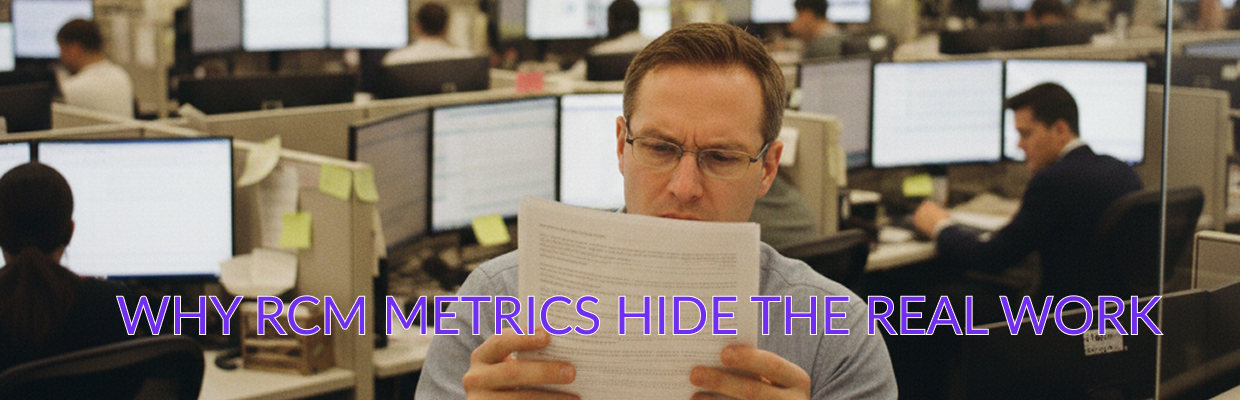
If you oversee revenue cycle operations in a health system, you probably know this moment well.
You are looking at your dashboards. Days in A/R look stable. Denial rates are within range. Cash is coming in. Productivity metrics are not flashing red. On paper, things look under control.
Then you walk the floor, or join an operations call, or listen to escalations from your centralized teams, and the story sounds very different.
People are overwhelmed. Backlogs are growing in pockets. Payer issues are consuming entire days. Everyone feels busy, but the metrics say the system is fine.
This gap is not accidental. Health system RCM metrics were never designed to show the real work required to keep large, complex revenue operations functioning. At scale, they measure outcomes, not effort. And that difference matters more than most organizations realize.
What health system RCM metrics were built to measure
Most health system RCM metrics come from a time when revenue cycle operations were simpler.
Days in A/R, clean claim rate, denial rate, and cash collections were designed to answer a straightforward question: are we getting paid, and how efficiently?
In single-site or small multi-site environments, those metrics worked well. When work increased, results moved quickly. If eligibility checks slipped or claims piled up, performance deteriorated in a way leadership could see almost immediately. Effort and outcomes were closely tied together.
Metrics worked because scale was still manageable.
What changes when RCM operates at health system scale

As systems grow, something subtle but important happens. Work and results stop moving in sync.
Centralized RCM teams absorb payer variability from across dozens of hospitals and outpatient sites. They handle more plans, more state rules, more contract differences, and more local exceptions than any single site ever would.
But the system also gets better at buffering that complexity.
Teams compensate. They triage. They work overtime. They prioritize some issues and quietly defer others. They keep outcomes stable even as the amount of work required to do so increases.
Health system RCM metrics reward that buffering. As long as the numbers hold, the effort stays invisible.
The work health system RCM metrics do not show you
Most of the hardest work in system-level revenue cycle operations never appears on a dashboard.
Exception handling becomes a full-time function. Eligibility mismatches, prior authorization gaps, unclear payer responses, and contract edge cases consume hours without necessarily moving metrics in either direction.
Payer phone work is a major part of this invisible load. Long hold times, repeated follow-ups, documentation after every call, and payer-specific processes take enormous effort. When those calls succeed just enough to prevent delays, the metrics stay flat. The cost is absorbed in labor and burnout instead.
Context switching also adds up. Staff move constantly between facilities, payers, systems, and workflows. Rework caused by upstream variability rarely has a metric attached to it, but it slows everything down.
None of this shows up clearly in health system RCM metrics. But it defines the daily experience of your teams.
Why acceptable metrics can hide unsustainable operations
One of the hardest truths for leaders to confront is this: stable metrics do not always mean healthy operations.
In many health systems, performance looks acceptable because people are compensating. Backlogs are controlled through heroics. Gaps are covered informally. Teams stretch to keep the system afloat.
From the outside, the system looks efficient. In reality, it is resilient. And resilience has a cost.
That cost shows up later as turnover, stalled initiatives, growing skepticism toward new tools, and leaders feeling like every improvement effort arrives too late to matter.
By the time metrics finally move, the organization is already exhausted.
The human signals that matter more than another dashboard

If you want to understand how your revenue cycle is really functioning, the most important signals are often not numerical.
You hear it in escalating frustration on operations calls. You see it in growing reliance on workarounds that were meant to be temporary. You notice it when experienced staff start leaving centralized roles faster than you can replace them.
You feel it when teams no longer have patience for pilots or long implementation timelines, even when the ideas are good.
These are early warning signs that health system RCM metrics do not capture. They tell you that the amount of work required to maintain performance is becoming unsustainable.
Why adding more metrics rarely solves the problem
When leaders sense this disconnect, the instinct is often to add more measurement.
More dashboards. More KPIs. More tracking.
The problem is that measurement does not create visibility into work if the work itself is not being captured. Adding metrics often increases reporting burden without reducing operational load. It can even make teams feel more pressure to perform without addressing what is actually slowing them down.
Visibility is not the same as relief.
A better way to think about performance at scale
At health system scale, performance and load are two different things.
Performance tells you what outcomes you are achieving. Load tells you how much effort it takes to achieve them.
Health system RCM metrics are very good at measuring performance. They are much worse at revealing load.
As payer complexity increases, load grows faster than performance changes. Teams absorb more work just to keep results flat. Until you account for that dynamic, it is easy to underestimate how close the system is to strain.
Why this matters right now
Health systems are operating under tighter margins, ongoing staffing challenges, and increasing payer variability. The room for hidden effort is shrinking.
When metrics hide the real work, leaders are forced to react late rather than intervene early. By the time performance declines, teams are already overwhelmed and trust in new initiatives is thin.
Organizations that start paying attention to operational load earlier are better positioned to act before burnout and backlog become structural.
Some systems are beginning to look for ways to reduce the most time-consuming payer work without forcing large-scale workflow redesign. Tools like SuperDial are designed around that reality, supporting centralized teams by absorbing repetitive payer interactions rather than asking people to work harder or differently. The point is not the tool itself. It is the recognition that removing work is often more valuable than measuring it more precisely.
What health system RCM metrics cannot tell you, but your teams already know
Health system RCM metrics are not wrong. They are incomplete.
They tell you what the system produces, not what it costs your people to produce it. They reflect outcomes, not strain. And at scale, that difference can determine whether revenue operations remain sustainable or quietly erode.
If this article feels familiar, that is not because something is broken. It is because your teams are doing more than the metrics will ever show.
Recognizing that reality is the first step toward meaningful relief.

Harrison is a software developer in the Bay Area. Before SuperBill, he worked as an engineer for Amazon in Madrid. While in Spain, Harrison developed an appreciation for both Mediterranean cooking and simplified healthcare systems. He returned to the Bay to co-found SuperBill (now SuperDial) with fellow Stanford grad Sam Schwager after mounting frustrations with US insurance networks.
Run a pilot on a real workflow.
Bring a representative batch, define the output schema, and validate ROI with your payer mix in 30 to 90 days.
