
Advance Beneficiary Notice (ABN): Rules, Modifiers and Liability
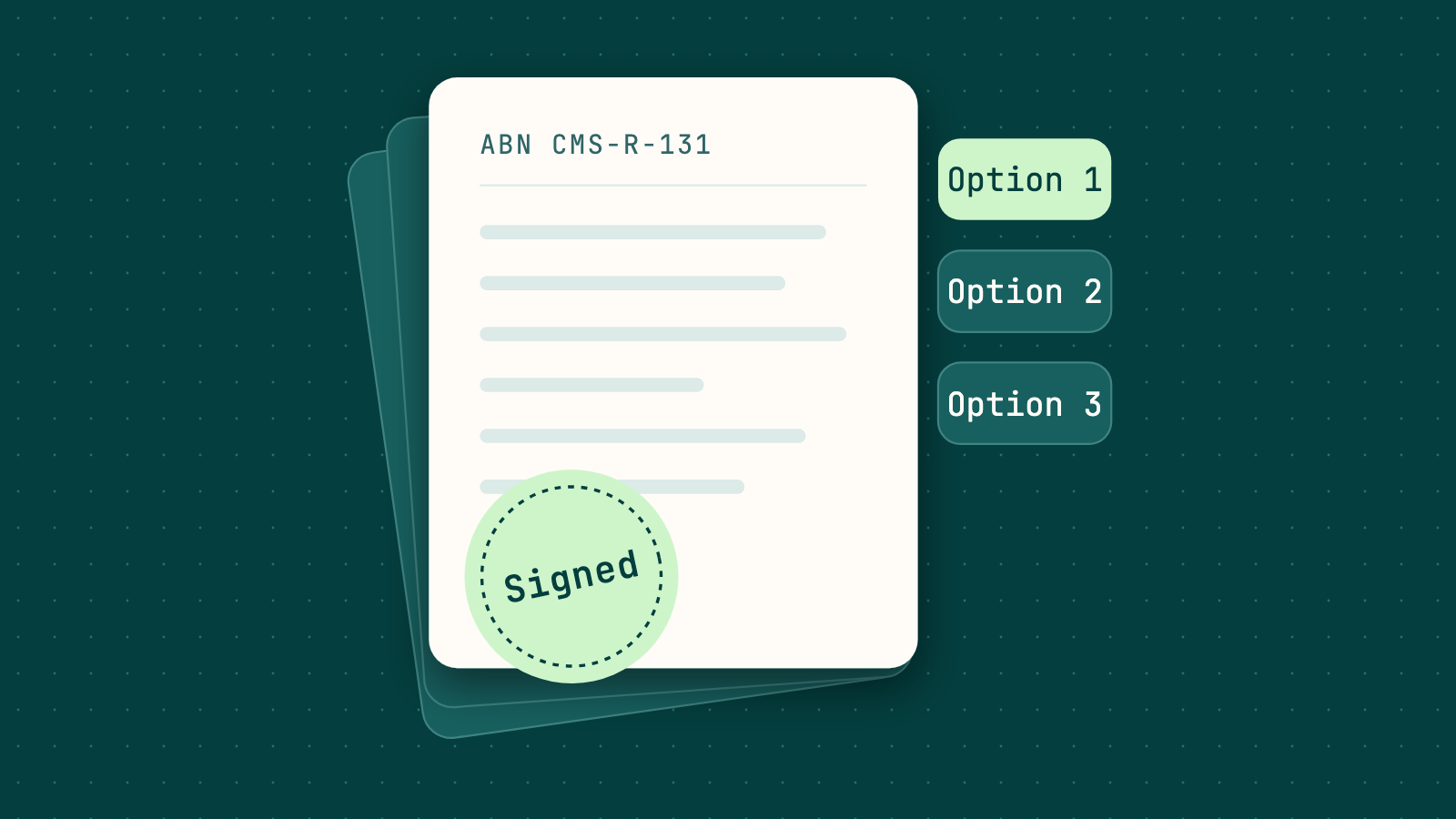
"The patient signed an ABN, so we can bill them." Front desks say it often, but a signature on its own does not move a balance to the patient. An Advance Beneficiary Notice of Non-coverage (ABN) shifts potential liability only when the notice was the right one for the situation, specific to the service, delivered properly, and reported on a claim that Medicare then denies.
The ABN is Form CMS-R-131, which CMS says providers, physicians, practitioners and suppliers issue to Original Medicare beneficiaries "in situations where Medicare payment is expected to be denied." It is required before care Medicare usually covers but may deny as not reasonable and necessary, and before custodial care. For services Medicare never covers it is optional.
TL;DR
- A signature is not enough. The ABN transfers potential liability only for a specific service, with a genuine reason for expecting denial, delivered before the service and chosen by the patient.
- Required versus voluntary. An ABN is required when Medicare may deny a usually covered service as not reasonable and necessary or as custodial care; for statutory exclusions it is a voluntary courtesy notice.
- Routine and blanket ABNs are invalid. Giving every patient a notice "just in case" will generally not protect you, apart from a few listed exceptions such as frequency limits.
- The modifier has to match the notice. GA means a required ABN is on file, GZ means you expected a necessity denial without one, and GX and GY cover voluntary notices and statutory exclusions.
- Missing or defective notice usually means provider liability. If you knew or should have known Medicare would not pay, you cannot collect from the patient and must refund what you already collected.
What the ABN is and which version to use
The ABN is a single-page, OMB-approved notice, and the detailed rules start at section 50 of Chapter 30 of the Medicare Claims Processing Manual. The English form in the download package on CMS's FFS ABN page carries the footer "Form CMS-R-131 (Exp. 03/31/2029)" and OMB No. 0938-0566, and the package includes Spanish and large-print versions. As of November 2026, that page does not post a date by which notifiers must switch to this version. Chapter 30 says notifiers "are expected to exclusively use the current version of the ABN," that routine approval is for three years, and that CMS will allow a transition period from expiring notices to newly approved ones.
The ABN form instructions list who must use it: physicians, practitioners, providers and suppliers paid under Part B, including outpatient hospitals and independent laboratories, plus hospices and home health agencies. Inpatient hospitals and skilled nursing facilities use the ABN for Part B items and services and other notices for Part A.
When an ABN is required and when it is voluntary
Under 42 CFR 411.404, written notice from the provider is one way a beneficiary is considered to have known a service was not covered. Chapter 30, section 50.2, lists the provisions that make an ABN necessary. For most Part B providers the two that matter are services that may be denied as not reasonable and necessary under section 1862(a)(1) of the Social Security Act and custodial care under section 1862(a)(9). Others apply to hospice, home health and several DME supplier situations.
The CMS MLN booklet on advance written notices adds practical triggers, such as services beyond the number allowed in a period for a diagnosis, outpatient therapy above the threshold amounts, and preventive services beyond their frequency limits. CMS adds that when an NCD or LCD limits coverage, its availability in most cases means you knew, or should have known, Medicare would deny the service.
Statutory exclusions are different. Section 50.2.1 says ABNs "are not required for care that is either statutorily excluded from coverage under Medicare (i.e. care that is never covered)," though CMS strongly encourages a courtesy notice. Its examples include personal comfort items, routine eye care, dental care and routine foot care. When used this way, the patient should not be asked to choose an option or sign.
| Situation | ABN status | Where CMS says so |
|---|---|---|
| Usually covered, but may be denied as not reasonable and necessary | Required to shift liability | Chapter 30, section 50.2 |
| Custodial care | Required to shift liability | Chapter 30, section 50.2 |
| Frequency limit may be exceeded | Required; may be given routinely if it states the limit | Chapter 30, section 40.2.2; MLN006266 |
| Statutorily excluded or not a Medicare benefit | Voluntary courtesy notice; no option or signature needed | Chapter 30, section 50.2.1 |
| Service paid in full through a bundled payment | Cannot be used to shift liability | Chapter 30, section 50.9 |
| Denial from a Medically Unlikely Edit | Cannot be used to bill the patient | MLN006266 |
| Medical emergency or great duress | Not valid; never required | Chapter 30, section 40.3; ABN instructions |
Why routine and blanket ABNs fail
In Chapter 30, "routine" means "giving written notice to beneficiaries where there is no specific, identifiable reason to believe Medicare will not pay," and notifiers "should only give written notices to beneficiaries when there is some genuine doubt that Medicare will make payment." A generic notice that only says denial is possible will not protect you, nor will a blanket notice given for all claims or a notice signed blank and completed later.
The same section lists narrow exceptions where a routine notice can be effective. These cover services an NCD says are never covered as not reasonable and necessary, experimental items, frequency-limited services and two DME supplier denials. A notice is valid only for the denial reason written on it, so an ABN citing a frequency limit does not cover a denial for any other reason.
How to deliver a valid ABN under Chapter 30
Section 50.8 defines effective delivery in six parts. The ABN must be delivered by a suitable notifier to a capable recipient who understands it, on the correct OMB-approved form with all required blanks completed. It should be delivered in person if possible and far enough ahead of the service for the patient to consider the options. Staff must explain it in full and answer questions, and the patient must sign it.
Specificity is where many ABNs break. The instructions require the specific name of each item or service, at least one plain-language reason for each, and a good-faith cost estimate. A reduction needs detail, so "wound care supplies decreased from weekly to monthly" works while "wound care supplies decreased" does not. Under section 50.8, if a contractor finds you refused to answer the patient's questions or direct them to 1-800-MEDICARE, delivery is considered defective.
The patient, not your staff, picks one of three options. Option 1 means they want the service and want Medicare billed for an official decision, which the notifier must then submit. Option 2 means they want the service, Medicare is not billed and there are no appeal rights. Option 3 means they decline it. Per the instructions, "Pre-selection of an option by the notifier invalidates the notice," and the signature line "can't be completed in advance of the rest of the notice."
In-person delivery is the default. Section 50.8.1 allows phone, mail, secure fax or email when that is not possible, but you must receive a response to validate delivery. A phone contact should be followed immediately by a written notice, and you keep the unsigned copy on file while waiting. If the patient refuses to sign, annotate the original, give them a copy, and consider not furnishing the service unless health, safety or liability concerns rule that out.
Section 50.7 says that in general, retention is "5 years from discharge/completion of delivery of care when there are no other applicable requirements under State law," and scanned copies are acceptable. A notice stays effective for repetitive care until the care, the patient's condition or the coverage policy changes. It cannot be backdated to cover care already given.
Reporting the ABN on the claim: GA, GZ, GX and GY
Chapter 30 says a valid notice reported on the claim leads the contractor to hold the beneficiary liable, but "If it is determined that the written notice was invalid, the contractor will override the GA code, and the healthcare provider or supplier will be found liable." Modifier names and uses come from the MLN booklet; liability notes come from Chapter 30's general rules.
| Modifier | When used | ABN on file? | What CMS says about liability |
|---|---|---|---|
| GA (Waiver of Liability Statement Issued, as Required by Payer Policy) | A mandatory ABN was issued for the service | Yes, required ABN, available on request | Beneficiary, if the notice is valid; provider, if found invalid (section 30.2.3) |
| GZ (Item or Service Expected to Be Denied as Not Reasonable and Necessary) | You expect a necessity denial and did not issue an ABN | No | Provider will likely be liable (section 50.9) |
| GX (Notice of Liability Issued, Voluntary Under Payer Policy) | A voluntary ABN was issued for a statutorily excluded service or non-benefit | Yes, voluntary ABN | A voluntary notice does not change liability (MLN006266) |
| GY (Item or Service Statutorily Excluded or Does Not Meet the Definition of Any Medicare Benefit) | The service is excluded by statute or is not a Medicare benefit | Not required; GX may be added | Limitation on liability does not apply to statutory exclusions (section 20.2) |
Institutional claims differ in two ways. The institutional chart in Chapter 1, section 60.4.2 states liability per modifier: beneficiary for GA, GX and GY, provider for GZ. Section 60.4.1 also requires occurrence code 32 with the date the beneficiary signed the ABN, and ABN-related services go on the claim as covered charges. Mixed claims use GA on the lines tied to the ABN.
What happens when the ABN is missing or defective
Section 50.9 states the consequence. A notifier who "knew or should have known that Medicare would not pay and fails to issue an ABN when required, or issues a defective ABN" will likely be liable and is "precluded from collecting funds from the beneficiary and is required to make prompt refunds if funds were previously collected." Failure to refund on time may lead to sanctions.
There is one narrow defense. A notifier may be protected if it can show it "did not know or could not reasonably have been expected to know" that Medicare would not pay. A defective notice removes even that, because Chapter 30 treats issuing it as clear evidence that you knew.
Refunds also apply when the ABN works as intended and Medicare pays anyway. Option 1 lets you ask for payment at the visit, and the MLN booklet treats refunds as timely within 30 days after you get the remittance advice, or within 15 days after an appeal determination. When an ABN-related line denies, our guide to the CO-50 denial code covers reading the remittance and choosing between a reopening and a redetermination.
QMB and dual-eligible patients
Dual-eligible patients follow special instructions. Section 50.17 says they must be told to check Option 1 so a claim goes to Medicare. You cannot bill them when the ABN is delivered and must wait until both Medicare and Medicaid adjudicate. After that, the ABN may allow you to bill a patient who has QMB coverage without full Medicaid, or a full-Medicaid patient whose claim Medicaid denies, subject to any state limits on beneficiary liability. Our guide to verifying QMB and dual-eligible patients covers how to identify QMB status before the visit.
Medicare Advantage uses different notices
Chapter 30, section 50.1, says the ABN "is not used for items or services provided under the Medicare Advantage (MA) Program" or for Part D drugs. In Medicare Advantage, coverage questions run through the plan's organization determinations. Under 42 CFR 422.566, a provider that "furnishes, or intends to furnish, services to the enrollee" may request one, including before the service. When a plan denies coverage in whole or in part, CMS requires it to issue the Integrated Denial Notice (CMS-10003). Our comparison of Medicare Advantage and Traditional Medicare covers the wider differences.
Related notices that are not the ABN
Skilled nursing facilities use the SNF ABN (CMS-10055) for Part A care and the standard ABN for Part B. Chapter 30 says the Home Health Change of Care Notice (CMS-10280) replaced the old HHABN's Option Boxes 2 and 3, and the standard ABN replaced Option Box 1. Hospitals use Hospital-Issued Notices of Noncoverage (HINNs) for inpatient care.
Where automation fits before the visit
SuperDial's benefits verification workflow checks eligibility and benefits through multiple channels, including electronic sources, payer portals and phone calls, and returns fields such as plan type, coverage for specific procedure codes and benefit limitations as structured results before service. Whether a service is likely to be denied, and whether to issue an ABN, stays with your clinicians and compliance team.
FAQ
Can I collect payment when the patient signs the ABN?
You can ask, if the patient chose Option 1 or Option 2. The form tells the patient "You can ask to be paid now." Under Option 1, if Medicare pays, you refund what the patient paid minus copays or deductibles. Under section 50.9, a properly notified patient who agrees to pay may be charged your usual and customary fee, not limited to the fee schedule.
How long is an ABN good for?
For repetitive or continuous care, section 50.8 says you may issue a new ABN after one year but are not required to unless the care, the patient's condition or the coverage policy changes. Separately, section 40.2 says a written notice delivered more than one year before the service is not acceptable evidence of knowledge.
Can an ABN be signed electronically?
Yes. Section 50.8 says electronic issuance "is not prohibited." The patient may ask for paper instead, and should get a paper copy of the signed ABN either way.
Can a hospital give an ABN in the emergency department?
Not before EMTALA obligations are met. Section 40.4 says a written notice should not be given until the medical screening exam is done or the condition is stabilized. After that, a notice may be given if there is a genuine reason to expect denial.
Sources
- CMS, FFS ABN (page last modified 07/17/2026): https://www.cms.gov/medicare/forms-notices/beneficiary-notices-initiative/ffs-abn
- CMS, Advance Beneficiary Notice of Non-coverage (ABN) Form Instructions, OMB 0938-0566: https://www.cms.gov/medicare/medicare-general-information/bni/downloads/abn-form-instructions.pdf
- CMS, ABN Forms English and Spanish (Incl Large Print), Form CMS-R-131 (Exp. 03/31/2029): https://www.cms.gov/medicare/medicare-general-information/bni/downloads/abn-forms-english-and-spanish-incl-large-print.zip
- CMS, Medicare Claims Processing Manual, Chapter 30, Financial Liability Protections (Rev. 12934, issued 10-31-24): https://www.cms.gov/regulations-and-guidance/guidance/manuals/downloads/clm104c30.pdf
- CMS, Medicare Claims Processing Manual, Chapter 1, General Billing Requirements (Rev. 13725, issued 04-10-26): https://www.cms.gov/regulations-and-guidance/guidance/manuals/downloads/clm104c01.pdf
- CMS, Medicare Advance Written Notices of Non-coverage, MLN006266 (May 2025): https://www.cms.gov/files/document/mln006266-medicare-advance-written-notices-non-coverage.pdf
- eCFR, 42 CFR 411.404, Criteria for determining that a beneficiary knew that services were excluded from coverage: https://www.ecfr.gov/current/title-42/section-411.404
- eCFR, 42 CFR 422.566, Organization determinations: https://www.ecfr.gov/current/title-42/section-422.566
- CMS, MA Denial Notice (page last modified 05/13/2025): https://www.cms.gov/medicare/forms-notices/beneficiary-notices-initiative/ma-denial-notice
- CMS, FFS SNF ABN (page last modified 05/15/2025): https://www.cms.gov/medicare/forms-notices/beneficiary-notices-initiative/ffs-snf-abn
- CMS, FFS HHCCN (page last modified 05/14/2025): https://www.cms.gov/medicare/forms-notices/beneficiary-notices-initiative/ffs-hhccn
- SuperDial, Automated Insurance and Benefits Verification: https://www.superdial.com/workflows/benefits-verification
Run a pilot on a real workflow.
Bring a representative batch, define the output schema, and validate ROI with your payer mix in 30 to 90 days.
