
Benefits Investigation: What a Complete BI Covers
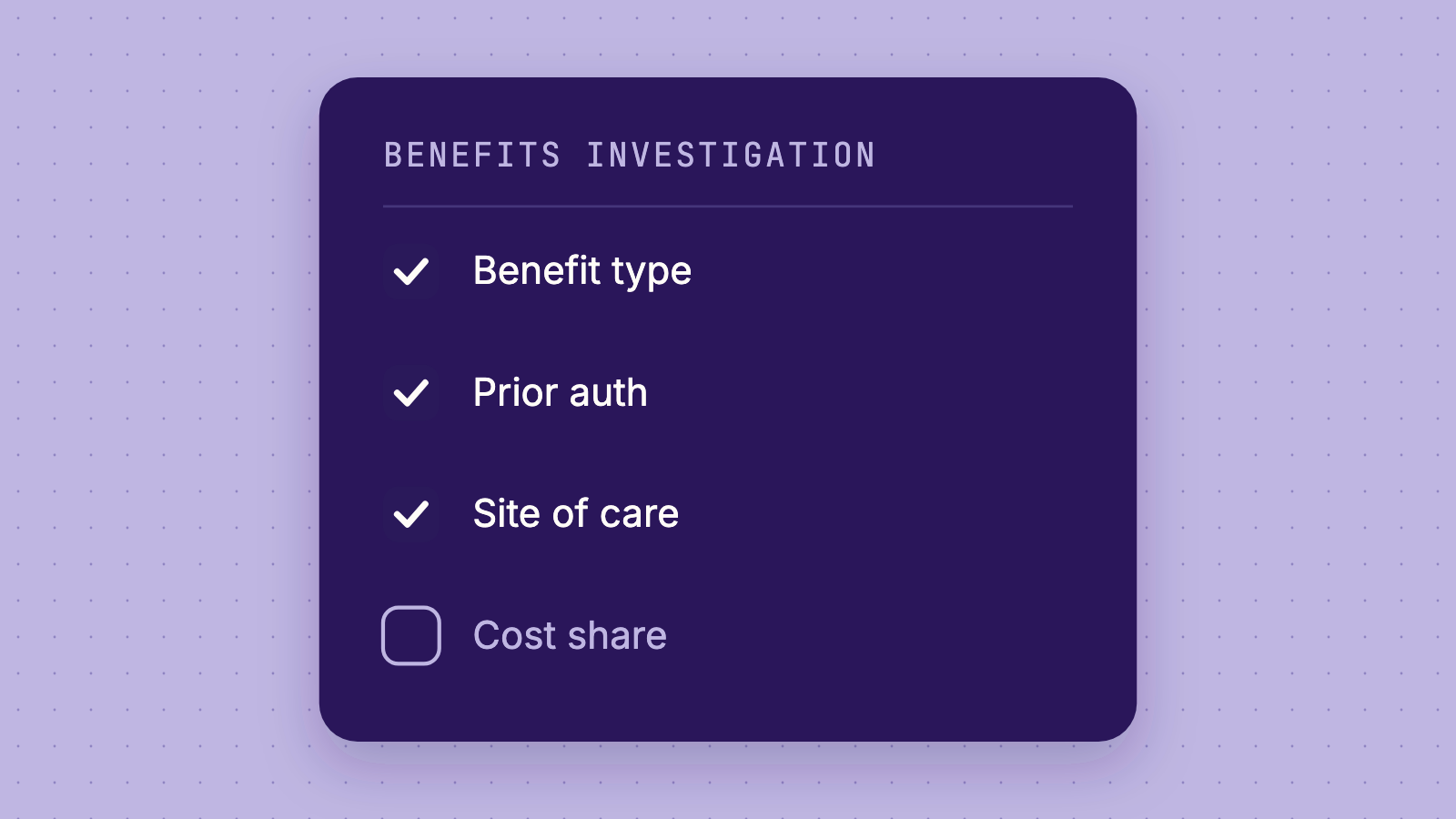
"We already ran eligibility. Why does this therapy need a benefits investigation?" The infusion coordinator has a point. The 271 came back active, the plan is commercial PPO, and the deductible is listed. What the response does not say is whether this infused drug sits under the medical or pharmacy benefit, whether the plan will let the practice buy and bill it, whether the hospital outpatient department is an approved site of care, or whether a preferred product has to come first.
A benefits investigation (BI) answers those questions. Eligibility confirms that a patient has coverage. A BI confirms whether and how a specific drug or service is covered for this patient, at this site of care, under which benefit, with which authorization and sourcing rules, and at what cost share. For specialty therapies, it is the record that pharmacy, authorization and billing teams work from before anyone orders a dose.
TL;DR
- Eligibility is not a BI. A 271 confirms coverage, dates and cost-sharing amounts; a BI answers whether a specific drug is covered for this patient, under which benefit, at which site and through which sourcing route.
- A complete BI is field by field. Benefit type, prior authorization and where to submit, step therapy or formulary status, site of care, specialty pharmacy or buy-and-bill, cost share with amounts met, the codes the answer applies to, and a reference number.
- BIs go stale. Plan years reset, eligibility changes and payer drug policies update, so verify before the first dose and again when the plan or policy changes.
- Four service models do this work. Manufacturer hubs, specialty pharmacies, in-house staff and automated or AI agent workflows each draw on a different mix of payer sources.
- SuperDial automates payer and PBM follow-up for pharma patient access. It retrieves from clearinghouses, portals, APIs and EDI where those sources are available, continues by phone when more is needed, and returns structured fields.
How a benefits investigation differs from an eligibility check
X12 describes the 271 eligibility response as carrying information that "includes but is not limited to: benefit status, explanation of benefits, coverages, dependent coverage level, effective dates, amounts for co-insurance, co-pays, deductibles, exclusions and limitations" (X12 transaction sets). That is plan-level information about the member, not how one high-cost drug will be handled at one location. Our guide to why insurance eligibility checks still fail covers the general gaps in a bare coverage response.
Specialty drugs add a second layer, because the transaction depends on the benefit. Under the HIPAA standards at 45 CFR 162.1202, retail pharmacy eligibility runs on the NCPDP Telecommunication Standard (moving to version F6, with a dual-use period from August 14, 2027 through April 14, 2028), while professional and institutional eligibility runs on the X12 270/271. A medical-side 271 and a pharmacy-side response come from different systems, and a BI has to reconcile them.
Which benefit is responsible comes first, and our post on medical vs. pharmacy benefit for specialty drugs covers that split in depth. In short, the pharmacy benefit typically covers self-administered drugs dispensed under a prescription, the medical benefit typically covers drugs given by a professional, and a specialty drug can fall under either or both depending on the plan. For Medicare, CMS's Benefit Policy Manual says Part B covers drugs furnished "incident to" a physician's service "provided that the drugs are not usually self-administered by the patients who take them," and each Medicare Administrative Contractor "must make its own individual determination on each drug."
What a complete benefits investigation includes
A useful BI answers one question per field: what will this plan require, and what will it pay, for this drug, this patient and this site? Many answers come from payer drug policies rather than the eligibility response.
| Field | Why it matters | Where it usually comes from |
|---|---|---|
| Active coverage, plan type and effective dates | Confirms coverage on the planned date of service and which plan rules apply | 271 or NCPDP eligibility response; payer portal |
| Responsible benefit (medical or pharmacy) | Decides the authorization channel, claim format and who bills for the drug | Payer or PBM drug policy; portal or phone |
| Prior authorization requirement and where to submit | Medical-benefit and pharmacy-benefit drugs can route to different reviewers | Payer or PBM policy; portal or phone |
| Step therapy, preferred product or formulary status | The plan may require a different drug first | Formulary, payer drug policy; portal or phone |
| Site-of-care requirements | The plan may review whether hospital outpatient infusion is medically necessary | Payer site-of-care policy; portal or phone |
| Sourcing: specialty pharmacy or buy-and-bill | Decides whether the practice may purchase and bill the drug | Payer sourcing policy; portal or phone |
| Deductible, copay or coinsurance, out-of-pocket maximum, with amounts met | Sets what the patient owes on the drug and the administration | 271 or pharmacy response when populated; portal or phone |
| Codes the answer applies to (HCPCS or J-code, NDC) | An answer for one code or formulation may not hold for another | Payer policy and code lists; confirmed on the call or portal |
| Reference number, representative name, date and source | Lets your team trace and, if needed, dispute the answer | Payer call or portal record |
Prior authorization, step therapy and preferred products
HealthCare.gov defines preauthorization as a plan's decision that a service, treatment plan, prescription drug or equipment is medically necessary, and adds that it "isn't a promise your health insurance or plan will cover the cost." A BI records whether authorization applies and where it goes, because the reviewer can differ between the medical and pharmacy benefit. The BI does not replace the authorization; it tells the authorization team where to send it.
Medicare's drug plan rules page describes step therapy as "a type of prior authorization that requires you first to try a certain, less expensive drug on the plan's drug list" before moving up to a more expensive one. Commercial plans have their own versions: UnitedHealthcare's medical benefit specialty drug programs say that for certain specialty medications it "requires providers to use a lower-cost specialty medication before coverage for a clinically similar, higher-cost medication," and may require "lower-cost, self-administered medications available through the pharmacy benefit before we'll cover infused or provider-administered medications." So a BI on a medical-benefit infusion can still turn on pharmacy-benefit history.
Site of care and sourcing
Site-of-care rules decide where the plan will pay for an infusion. UnitedHealthcare's commercial Provider Administered Drugs, Site of Care policy (policy 2026D0121X, effective October 1, 2026) applies to drugs on its applicable medications list and sets criteria for hospital outpatient infusion. It names "non-hospital outpatient infusion, physician office, ambulatory infusion suites, or home infusion services" as alternative sites, which may be used when the patient does not meet the hospital outpatient criteria.
Sourcing decides who acquires the drug. UnitedHealthcare describes medication sourcing as an infusion provider receiving "a specialty medication from an outside specialty pharmacy," and says that if a medication has no sourcing requirement, "providers can buy-and-bill." In buy-and-bill, the physician purchases the drug, administers it and claims for both. "Covered under medical" without the sourcing answer leaves the most expensive question open.
Cost share and accumulators
The cost-share fields follow standard definitions. HealthCare.gov defines the deductible as "the amount you pay for covered health care services before your insurance plan starts to pay," a copayment as a fixed amount paid for a covered service, and the out-of-pocket maximum as "the most you have to pay for covered services in a plan year." The limit excludes premiums, non-covered services and out-of-network care, so amounts met matter as much as plan values.
The codes the answer applies to
CMS describes HCPCS Level II as a coding system "used primarily to identify products, supplies, and services" not included in CPT codes, and the J-codes for drugs belong to it. A BI should name the code it applies to, because payer rules attach to codes and products. New products show why: UnitedHealthcare's August 2026 specialty medication bulletin lists two medications added to review at launch, both under the codes J3490, J3590 and C9399 rather than a product-specific code.
NDCs matter too, especially for Medicaid. Under 42 CFR 447.520, a state must require providers to submit claims for certain physician-administered drugs "using National Drug Code (NDC) numbers," so a BI for a Medicaid patient should capture the NDC as well as the HCPCS code.
When to run a benefits investigation, and when to run it again
Run the BI before the first dose and before the drug is ordered. Once a practice has bought an expensive vial, learning that the plan required specialty pharmacy sourcing turns a coverage question into a reimbursement problem. The BI should also feed the authorization request so it reaches the right reviewer the first time.
A BI then goes stale for three reasons. First, plan years reset: HealthCare.gov defines a plan year as a 12-month period of benefits coverage under a group health plan that "may not be the same as the calendar year," so deductibles and out-of-pocket amounts can restart in the middle of a course of therapy. Second, eligibility changes when a patient changes jobs or plans, and authorizations can end with it. For the program changes it lists, UnitedHealthcare's August 2026 bulletin says it will honor approved prior authorizations "until the earlier of the end date on the authorization/notification or the date the member's eligibility changes."
Third, payer drug policies change on their own schedule. The same bulletin says that upon renewal "the updated policy will apply" and that providers "are encouraged to confirm whether prior authorization or other program requirements apply." For ongoing therapy, re-verify at the new plan year, when the patient reports new coverage, before an authorization renewal and when a policy update touches the drug.
Who performs benefits investigations
Benefits investigations for specialty therapies come from four broad service models. They differ mainly in who sponsors the work, which sources they use and what form the answer takes.
| Model | How it gets answers | What it typically returns |
|---|---|---|
| Manufacturer hub programs | Referral to the manufacturer's hub, which contacts payers about that product | A coverage summary for the manufacturer's drug |
| Specialty pharmacies | Pharmacy-benefit eligibility, PBM and payer contact for drugs the pharmacy dispenses | Coverage and cost share for the dispensed drug |
| In-house practice staff | Eligibility tools, payer portals, policy lookups and payer calls | Notes or a BI form in the practice management system or EHR |
| Automated or AI agent workflows | Electronic transactions, portals, APIs and payer phone lines, depending on the setup | Structured fields with supporting records |
Manufacturer hubs often run BIs for their own products. In OIG Advisory Opinion 18-14 (2018), a physician would "submit a referral to the Drug's reimbursement hub," and "the reimbursement hub would complete a benefits investigation." Some hubs also run patient support programs, which sit outside the BI itself.
Specialty pharmacies come into the picture when the drug is dispensed rather than bought and billed, including under medical-benefit sourcing rules like UnitedHealthcare's. In-house teams and automated workflows tend to handle the full mix of drugs a practice administers. The practical exercise is deciding, field by field, where each answer comes from for each payer.
How SuperDial handles benefits investigation work
For pharma patient access teams, SuperDial handles benefits verification, prior authorization, and payer and PBM follow-up, among other workflows. It uses AI across digital and voice channels to retrieve missing information, complete follow-up and return structured answers your team can act on. SuperDial can retrieve information from clearinghouses, payer portals, APIs and EDI where those sources are available, and when additional information is still needed, the workflow can continue by phone.
Teams can begin with batch uploads from an existing work queue and expand into APIs, webhooks and production integrations as the workflow matures. Each completed workflow returns the fields the workflow requires, along with a concise summary, next action, timestamps and supporting workflow evidence, and for voice interactions teams can review call recordings and transcripts. The benefits verification workflow returns coverage, cost-share and requirements fields in the same structured format.
When a payer cannot give a complete answer, the request comes back to your team as an exception with a summary of what happened and the recommended next action. SuperDial states that it is HIPAA compliant, SOC 2 Type II attested and HITRUST e1 certified, and a BAA is standard before any PHI is exchanged.
Interested in evaluating SuperDial?
SuperDial lists specialty benefits verification and payer and PBM coverage workflows among its suggested pilot starting points. A practical test is a real queue of upcoming therapy starts: bring the batch, define the BI fields you need back, and review the results. Book a demo to set one up.
FAQ
Is a benefits investigation the same as benefits verification?
The terms overlap, and usage varies. Here, "benefits investigation" means the drug-specific version: benefit type, authorization, sourcing and site of care for one therapy, on top of routine coverage and cost-share fields. Whatever you call it, define the field list so every request returns the same answers.
What information is needed to start a benefits investigation?
Start with patient demographics and member ID, the payer and plan, the prescribing and administering provider with NPI and tax ID, the drug's HCPCS code and NDC, the diagnosis, the planned site of care and the start date. A missing item can send the payer to the wrong policy or benefit.
Does a benefits investigation guarantee payment?
No. HealthCare.gov notes that preauthorization "isn't a promise" of coverage, and UnitedHealthcare's site-of-care policy says its documentation requirements "do not guarantee coverage of the service requested," with coverage determined by the member's benefit plan document and applicable laws. The reference number and source record let your team trace the answer if the claim is later denied.
Can Medicare Advantage plans use step therapy for infused drugs?
Yes, within limits. Under 42 CFR 422.136, an MA plan that uses step therapy for Part B drugs must apply step therapy "only to new administrations of Part B drugs, using at least a 365 day lookback period," with the program approved by its pharmacy and therapeutics committee. For a new MA patient on a Part B drug, record any step therapy requirement and prior use of the drug.
Sources
- X12, Transaction Sets (271 Eligibility, Coverage or Benefit Information): https://x12.org/products/transaction-sets
- eCFR, 45 CFR 162.1202, Standards for eligibility for a health plan transaction: https://www.ecfr.gov/current/title-45/subtitle-A/subchapter-C/part-162/subpart-L/section-162.1202
- CMS, Medicare Benefit Policy Manual, Chapter 15, Section 50, Drugs and Biologicals (Rev. 13889, issued July 30, 2026): https://www.cms.gov/Regulations-and-Guidance/Guidance/Manuals/downloads/bp102c15.pdf
- CMS, Healthcare Common Procedure Coding System (HCPCS): https://www.cms.gov/medicare/coding-billing/healthcare-common-procedure-system
- eCFR, 42 CFR 447.520, Conditions relating to physician-administered drugs: https://www.ecfr.gov/current/title-42/chapter-IV/subchapter-C/part-447/subpart-I/section-447.520
- eCFR, 42 CFR 422.136, Medicare Advantage (MA) and step therapy for Part B drugs: https://www.ecfr.gov/current/title-42/chapter-IV/subchapter-B/part-422/subpart-C/section-422.136
- Medicare.gov, Drug plan rules: https://www.medicare.gov/health-drug-plans/part-d/what-drug-plans-cover/plan-rules
- HealthCare.gov, Glossary: Preauthorization: https://www.healthcare.gov/glossary/preauthorization/
- HealthCare.gov, Glossary: Deductible: https://www.healthcare.gov/glossary/deductible/
- HealthCare.gov, Glossary: Copayment: https://www.healthcare.gov/glossary/co-payment/
- HealthCare.gov, Glossary: Out-of-pocket maximum/limit: https://www.healthcare.gov/glossary/out-of-pocket-maximum-limit/
- HealthCare.gov, Glossary: Plan year: https://www.healthcare.gov/glossary/plan-year/
- UnitedHealthcare, Specialty Pharmacy: Medical Benefit Management (Provider Administered Drugs): https://www.uhcprovider.com/en/resource-library/drug-lists-pharmacy/specialty-medical-injectable-drug-programs.html
- UnitedHealthcare, Provider Administered Drugs: Site of Care, Commercial Medical Benefit Drug Policy 2026D0121X (effective October 1, 2026): https://www.uhcprovider.com/content/dam/provider/docs/public/policies/comm-medical-drug/provider-administered-drugs-soc.pdf
- UnitedHealthcare, Medical benefit specialty medication update bulletin (August 2026): https://www.uhcprovider.com/content/dam/provider/docs/public/resources/news/2026/sdub/med-benefit-specialty-drug-update-bulletin-august-2026.pdf
- HHS Office of Inspector General, Advisory Opinion No. 18-14 (issued November 13, 2018): https://oig.hhs.gov/documents/advisory-opinions/757/AO-18-14.pdf
- HHS Office of Inspector General, Advisory Opinion No. 26-13 (issued June 4, 2026): https://oig.hhs.gov/documents/advisory-opinions/11688/AO-26-13.pdf
- SuperDial, SuperDial for Pharma Patient Access: https://www.superdial.com/pharma
- SuperDial, Benefits Verification: https://www.superdial.com/workflows/benefits-verification
Run a pilot on a real workflow.
Bring a representative batch, define the output schema, and validate ROI with your payer mix in 30 to 90 days.
