
CO-16 Denial Code: Missing Information and How to Fix It
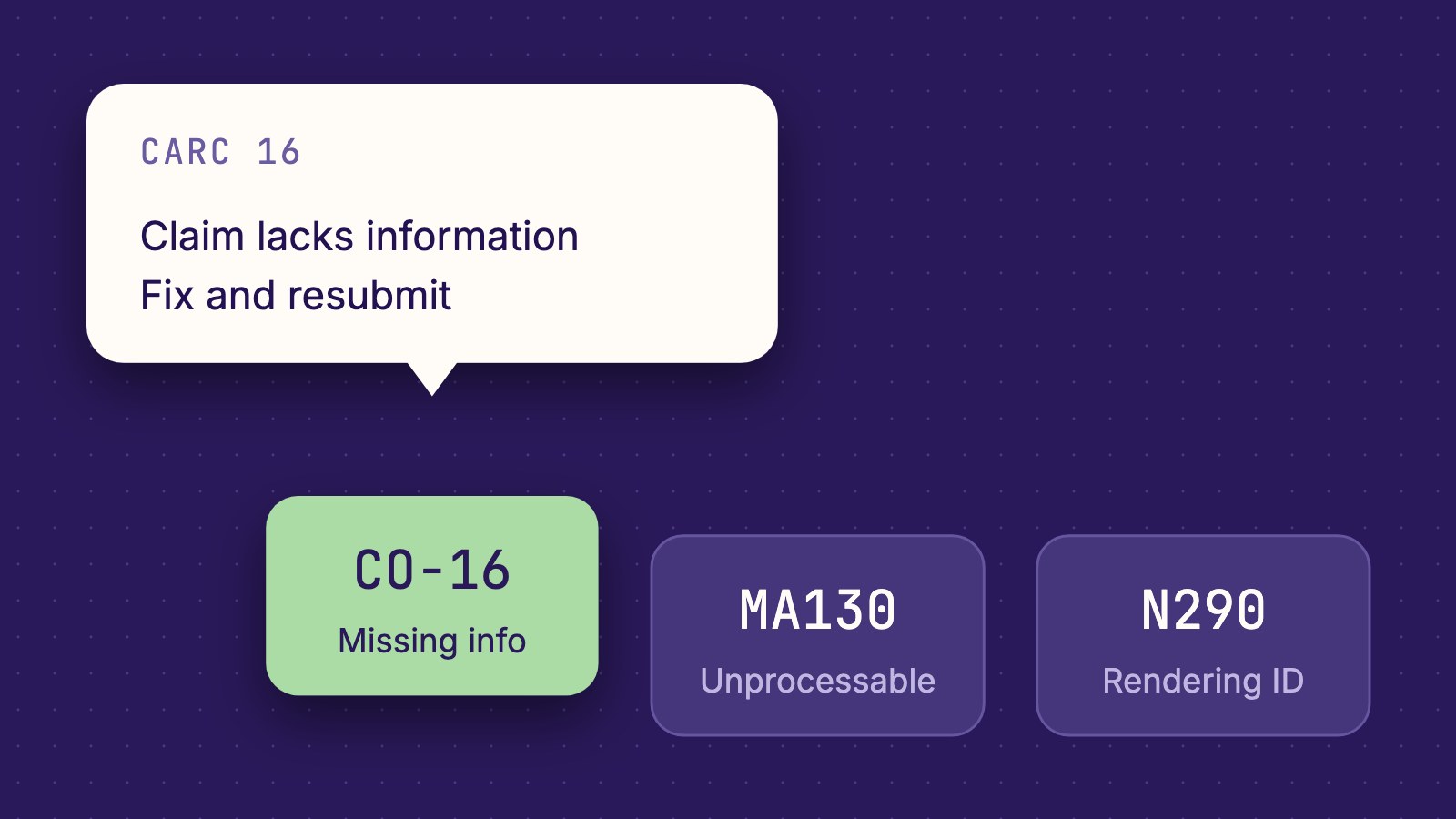
What does CO-16 mean on a remittance? It means the payer could not finish processing the claim or line because information was missing or a billing error was found, and the CO group code keeps the unpaid amount with the provider. X12, which maintains the code list, words CARC 16 as "Claim/service lacks information or has submission/billing error(s)."
That wording names a category, not a field. The detail lives in the remark code that comes with it, and X12 requires at least one. A CO-16 with N290 is a rendering provider identifier problem, while a CO-16 with N382 is a patient identifier problem, and the two get fixed in different places by different people.
On Medicare Part B claims, CO-16 can arrive with MA130, which tells you the claim was treated as unprocessable rather than denied. That distinction changes the remedy: there is nothing to appeal, so you correct the data and submit a new claim.
TL;DR
- CO-16 means missing or invalid claim data. CARC 16 covers claims or lines that lack information or carry a submission or billing error, and the CO group code assigns the balance to the provider.
- The remark code tells you what to fix. X12 requires at least one remark code with CARC 16 that is not an alert, so N290, M51, M76 or N382 points you to the exact field.
- Medicare does not treat it as a denial. CMS says a claim returned as unprocessable "is not denied, and, as such, is not afforded appeal rights," so the fix is a corrected or new claim.
- Commercial plans set their own rules. Whether a CO-16 fix goes in as a corrected claim, a replacement or a new claim depends on the payer and your contract.
- The filing clock keeps running. Medicare's general limit is 12 months from the date of service, and a rejected claim is not considered received until it comes back corrected and complete.
What CARC 16 says, word for word
The full X12 entry for CARC 16 reads: "Claim/service lacks information or has submission/billing error(s). Usage: Do not use this code for claims attachment(s)/other documentation. At least one Remark Code must be provided (may be comprised of either the NCPDP Reject Reason Code, or Remittance Advice Remark Code that is not an ALERT.) Refer to the 835 Healthcare Policy Identification Segment (loop 2110 Service Payment Information REF), if present."
Three parts of that usage note matter. First, CARC 16 is not the code for a missing attachment; X12 keeps CARC 252 for that, worded "An attachment/other documentation is required to adjudicate this claim/service." Second, the remark code is mandatory, and an alert-only remark does not satisfy the rule. Third, the payer may point to a policy through the REF segment in loop 2110 of the 835, so check it before you call.
CO, PR or OA: what the group code adds
Every adjustment on an 835 pairs a group code with a reason code. X12 defines CO as Contractual Obligation, PR as Patient Responsibility, OA as Other Adjustment and PI as Payor Initiated Reduction. Our guide to reading a remittance advice walks through how those pieces sit on each service line.
In Chapter 1 of the Medicare Claims Processing Manual, the examples for returning Part B claims as unprocessable specify Group Code CO with CARC 16, so CO-16 is what Part B billers typically see there. Some of those examples add remark code MA13, which X12 words as "Alert: You may be subject to penalties if you bill the patient for amounts not reported with the PR (patient responsibility) group code." In practice, a CO-16 balance is not one to move to the patient while the claim data is being fixed.
Other payers may report reason 16 under a different group code, so read the group code on each line before deciding who owes what. When a payer uses OA or PR with reason 16, check your participation agreement.
Remark codes you may see with CO-16
The remark code is the work instruction. The wording below comes from X12's current remark code list, and the payer or MAC decides which remark codes accompany a given CO-16. Where a CMS manual section uses the pairing, it is noted.
| RARC | X12 wording | What's missing or wrong | Where to look | Fix |
|---|---|---|---|---|
| MA130 | "Your claim contains incomplete and/or invalid information, and no appeal rights are afforded because the claim is unprocessable. Please submit a new claim with the complete/correct information." | The claim as a whole was unprocessable; other remark codes name the field | Every other CARC and RARC on the claim | Correct every flagged field and submit a new claim |
| N290 | "Missing/incomplete/invalid rendering provider primary identifier." | Rendering provider NPI | Provider master file and the rendering NPI on the claim line | Enter the correct individual NPI and resubmit |
| N265 | "Missing/incomplete/invalid ordering provider primary identifier." | Ordering provider NPI (CMS pairs it with MA13 in Pub. 100-04, Ch. 1, §80.3.2.1.2) | The order and the ordering provider field | Add the ordering NPI from the order |
| M51 | "Missing/incomplete/invalid procedure code(s)." | CPT or HCPCS code | Charge entry and the code set in effect for the date of service | Correct the procedure code |
| M76 | "Missing/incomplete/invalid diagnosis or condition." | ICD-10-CM code | Coding and the codes valid for the date of service | Correct the diagnosis code to match the record |
| M77 | "Missing/incomplete/invalid/inappropriate place of service." | Place of service code (CMS uses CO-16 with M77 when more than one POS is billed on one claim, §10.1.1.1) | POS on each line against where the service happened | Fix the POS, or split into separate claims by POS |
| N382 | "Missing/incomplete/invalid patient identifier." | Member ID, or the Medicare beneficiary identifier (CMS pairs CO-16 with N382, §80.3.2.1.1) | Insurance card and the latest eligibility response | Correct the member ID and resubmit |
| MA04 | "Secondary payment cannot be considered without the identity of or payment information from the primary payer." (abridged) | Primary payer adjudication data on a secondary claim | Primary payer's remittance for the same service | Report the primary payer's payment and adjustments |
| N4 | "Missing/Incomplete/Invalid prior Insurance Carrier(s) EOB." | Prior carrier's explanation of benefits | Primary EOB or ERA on file | Send the prior carrier's EOB information the payer requires |
MA130 signals that no appeal rights apply, but it does not name the field, so never stop there. When several remark codes appear, fix all of them in one pass, since a new claim that clears one edit and fails another just repeats the cycle.
How CO-16 differs from codes that look similar
CO-16 sits in a family of "something is missing" codes that need different responses. CARC 252 asks for an attachment or other documentation, which you send rather than correct. CARC 226 reads "Information requested from the Billing/Rendering Provider was not provided or not provided timely or was insufficient/incomplete," which means the payer asked for something first. A CO-97 is different again, because it means the payer considers the service included in another service, not that the claim was incomplete.
How Medicare handles a CO-16 claim
The Medicare Claims Processing Manual (Pub. 100-04), Chapter 1, sets the rules in §80.3. Section 80.3.1 defines an unprocessable claim as "Any claim with incomplete or missing, required information, or any claim that contains complete and necessary information; however, the information provided is invalid." It then states the consequence plainly: such a claim "does not meet the criteria to be considered as a claim, is not denied, and, as such, is not afforded appeal rights."
Section 80.3.1 describes several return routes, including these three. Front-end errors can be returned with no remittance at all, some claims are suspended and processed if corrections arrive "within a 45-day period," and others are rejected through the remittance. CMS notes that the remittance route applies to carriers only, because "FIs do not use the remittance advice process for return to provider (RTP)." A CO-16 on an 835 is therefore mostly a Part B experience.
Section 80.3.2 fills in the operating rules. The contractor "shall not deny claims and afford appeal rights for incomplete or invalid information," the notice "will not contain the usual reconsideration notice," and no Medicare Summary Notice goes to the beneficiary. When a remittance is used, it must show all applicable error codes, with at least "a CARC/RARC combination that is compliant with CAQH CORE Business Scenario Two."
For the fix, §80.3.2 says providers may submit corrections "in writing, on-line, or via telephone when the claim was suspended for development," or submit "a 'corrected' claim or as an entirely new claim" when the original data was not retained, as with a front-end return, or when a remittance advice was used to return the claim. It also notes that "Rejected claims are not counted as an appeal on resubmissions." Our explainer on corrected claims, reconsiderations and appeals covers how those three tools differ.
Watch the calendar while you work it. Chapter 1, §70 says claims "must be filed to the appropriate Medicare claims processing contractor no later than 12 months, or 1 calendar year, after the date the services were furnished," with exceptions in §70.7. Section 80.2.1 adds that claims failing basic legibility, format or completion requirements "are not considered as received until resubmitted as corrected, complete claims." A CO-16 left in a queue for months can become a timely filing loss.
Working a commercial CO-16
Commercial and Medicare Advantage plans set their own resubmission rules, and they vary by payer and by contract. Depending on the plan, the fix may go in as a corrected or replacement claim that references the original, or as a new claim. Check the payer's provider manual and your participation agreement before you resubmit, so the second submission follows the plan's process rather than your default.
Start with the same triage used for Medicare: read every remark code, fix every flagged field, and confirm the payer did not also ask for records. If the original claim data was right and the payer still returned CO-16, dispute it through the plan's reconsideration process, with the claim data and the payer's field requirements in hand.
CO-16 versus a 277CA rejection
A CO-16 is not the same event as a front-end rejection. Chapter 24 of the Medicare Claims Processing Manual, §50.3.3, describes how edit failures can reject the entire transaction set through the 999 implementation acknowledgment or flow to "claim level rejection via the ASC X12 277CA claim acknowledgment." Section 50.3.1 says an accepted claim has "passed all translator syntax/semantic" and business edits and has been assigned a claim control number, which is reported back on the 277CA.
The practical difference is where the claim stopped. A 277CA rejection means the claim never got into adjudication, so it shows up in acknowledgment reports, often through your clearinghouse, not on a remittance. Our guide to 277 claim status codes explains how the 277CA differs. A CO-16 arrives on the 835 after the claim made it far enough to be adjudicated or returned through the remittance, and it belongs in your denial worklist, not your rejection queue.
Preventing CO-16 at the front end
Most CO-16 remark codes map to a field someone mistyped or skipped. Patient identifier errors start at registration, so capture the member ID from the card and match it to the most recent eligibility response. Rendering, ordering and referring provider identifiers belong in a maintained provider master file, so the claim pulls the right NPI rather than relying on someone to type it.
Coding errors (M51, M76) and place of service errors (M77) are best caught by claim scrubber edits before submission. Clearinghouse edits catch many format and code-set problems, but not every payer-specific requirement, so feed your own CO-16 remark code counts back into the edit list. For secondary claims, hold the claim until the primary payer's remittance has posted, which heads off MA04 and N4 returns.
Track CO-16 by remark code, payer and provider. A spike in N290 for one physician suggests a provider setup problem, while N382 clustered at one payer suggests a registration gap.
Where automation fits in CO-16 follow-up
A CO-16 sometimes leaves a question the remittance does not answer, such as which identifier the payer has on file or whether a corrected claim is already in process. SuperDial's claim status workflow covers denial follow-up and returns the denial reason and code, the reconsideration or appeal path, and the next action, so your team can decide whether to correct, resubmit or appeal. The correction itself, and the call on which field is wrong, stays with your billers and coders.
FAQ
Can you appeal a CO-16 denial?
For Original Medicare, a claim returned as unprocessable has no appeal rights, and the MA130 remark code says so directly. You correct the information and submit a new claim. For commercial plans, the payer's own dispute rules apply, so an appeal or reconsideration may be available when you believe the claim was complete.
What does remark code N290 mean?
X12 words N290 as "Missing/incomplete/invalid rendering provider primary identifier." It points to the identifier of the individual who performed the service, not an authorization number. A billing provider problem has its own code, N257, "Missing/incomplete/invalid billing provider/supplier primary identifier." Check that the rendering NPI on the claim line matches the provider who actually saw the patient.
What does MA130 mean with CO-16?
MA130 says the claim "contains incomplete and/or invalid information, and no appeal rights are afforded because the claim is unprocessable." It is Medicare's way of telling you to submit a new claim rather than an appeal. It does not identify the missing field, so read the other remark codes on the claim to find it.
Does a resubmitted CO-16 claim reset timely filing?
It does not. Medicare's general limit stays 12 months from the date of service, and CMS says a rejected claim is "not considered as received until resubmitted as corrected, complete claims." Commercial payers publish their own corrected-claim and resubmission windows, so check the contract.
Sources
- X12, Claim Adjustment Reason Codes: https://x12.org/codes/claim-adjustment-reason-codes
- X12, Remittance Advice Remark Codes: https://x12.org/codes/remittance-advice-remark-codes
- X12, Claim Adjustment Group Codes: https://x12.org/codes/claim-adjustment-group-codes
- CMS, Medicare Claims Processing Manual, Chapter 1, General Billing Requirements (Rev. 13725, issued 04-10-26), §§10.1.1.1, 70, 80.2.1, 80.3.1, 80.3.2, 80.3.2.1.1, 80.3.2.1.2: https://www.cms.gov/regulations-and-guidance/guidance/manuals/downloads/clm104c01.pdf
- CMS, Medicare Claims Processing Manual, Chapter 24, General EDI and EDI Support Requirements, Electronic Claims, and Mandatory Electronic Filing of Medicare Claims (Rev. 13954, issued 09-29-26), §§50.3.1, 50.3.3: https://www.cms.gov/regulations-and-guidance/guidance/manuals/downloads/clm104c24.pdf
- SuperDial, Claim Status workflow: https://www.superdial.com/workflows/claim-status
Run a pilot on a real workflow.
Bring a representative batch, define the output schema, and validate ROI with your payer mix in 30 to 90 days.
