
CO-97 Denial Code: Why Bundled Services Pay $0 and What to Do
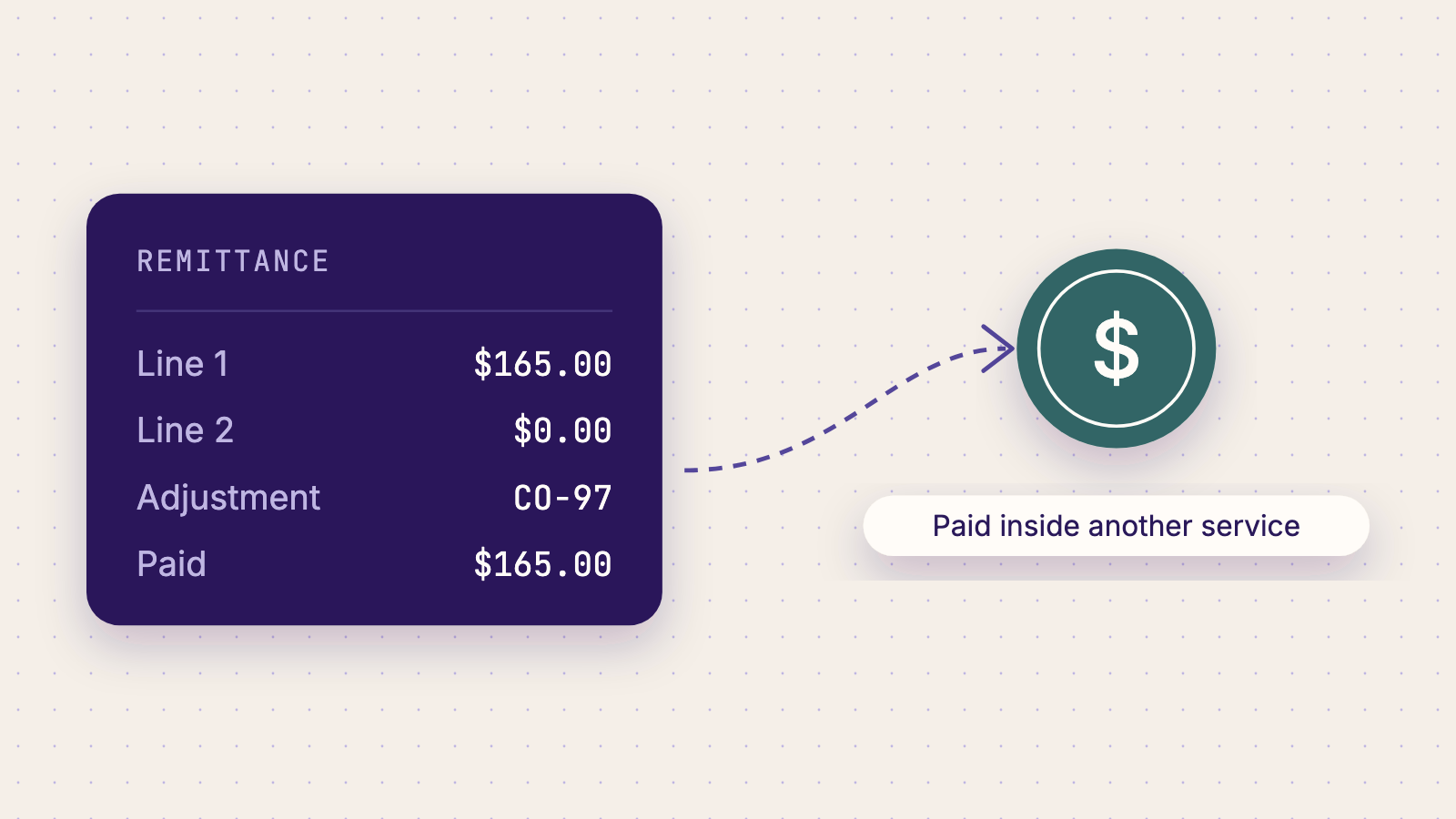
Picture a hypothetical line on a remittance: an office visit billed at $165, allowed $0.00, paid $0.00, adjustment CO-97, remark code M144. Say the visit took place six days after a minor procedure with a 10-day global period, and the payer treated it as part of the surgery. No records request or medical necessity dispute, just a service the payer considers already paid.
CO-97 means the payer decided the benefit for this service is included in the payment for another service it has already adjudicated, and the CO group code places the unpaid balance on the provider. The cause is usually a bundling rule, such as a Medicare NCCI edit, the global surgical package or a commercial plan's own payment policy. Whether you fix, appeal or write off the line depends on which rule fired and what the chart shows.
TL;DR
- CO-97 is a bundling adjustment with provider liability. X12 words CARC 97 as a benefit "included in the payment/allowance for another service/procedure that has already been adjudicated," and CO assigns the balance to the provider.
- NCCI edits pay column one and deny column two. CMS says the column two code is denied unless a clinically appropriate NCCI PTP-associated modifier is reported, and a modifier indicator of 0 means no modifier can bypass the edit.
- Global surgery folds related care into the surgical fee. Medicare counts a 90-day global period for major surgery and 0 or 10 days for minor procedures, and modifiers 24, 25, 57 and 79 identify care outside the package.
- A modifier is only a fix when the record supports it. CMS says documentation must support modifiers 59, XE, XP, XS and XU, and Medicare beneficiaries may not be billed for services denied by PTP edits.
- Commercial plans run their own edits. CMS says it does not control how private insurers that voluntarily adopt NCCI edits apply them, so check the plan's policy and your contract.
The exact X12 wording for CARC 97
The full entry on the X12 claim adjustment reason code list reads: "The benefit for this service is included in the payment/allowance for another service/procedure that has already been adjudicated. Usage: Refer to the 835 Healthcare Policy Identification Segment (loop 2110 Service Payment Information REF), if present." When a payer fills in that segment, the 835 can point to the policy behind the adjustment.
The payer is not saying the service was wrong or unnecessary, only that its value sits inside another payment. That separates CO-97 from CO-16, which X12 reserves for a claim that "lacks information or has submission/billing error(s)." Payers may instead use CARC 234, "This procedure is not paid separately," or CARC 236, which names the National Correct Coding Initiative.
What the group code tells you about a 97 adjustment
Every adjustment on an 835 pairs a group code with a reason code. X12 lists CO as Contractual Obligation, OA as Other Adjustment and PR as Patient Responsibility, and CMS explains that CO "assigns responsibility to the provider" while "Medicare beneficiaries may be billed only when Group Code PR is used with an adjustment." Our guide to reading a remittance advice shows where those pairs sit.
For Original Medicare, NCCI bundling denials stay with the provider. The NCCI Policy Manual introduction states that "CPT codes representing services denied based on NCCI PTP edits may not be billed to Medicare beneficiaries," and because these are coding denials, the provider "cannot use an 'Advanced Beneficiary Notice' (ABN) form to seek payment." If you see OA-97 or PR-97, check with the payer or the contract before you move any balance to the patient.
Three rules behind most CO-97 denials
NCCI procedure-to-procedure edits
CMS describes its procedure-to-procedure (PTP) edits as a way to "prevent inappropriate payment of services that should not be reported together." On its PTP page, CMS explains that each edit has a column one and a column two code, and when both are reported for the same beneficiary on the same date of service, "the Column One code is eligible for payment, but the Column Two code is denied unless a clinically appropriate NCCI PTP-associated modifier is also reported." CMS keeps separate edit tables for practitioners and outpatient hospital services and updates them quarterly.
The modifier indicator on each edit decides whether a fix exists. Chapter 1 of the 2026 NCCI Policy Manual says a Correct Coding Modifier Indicator (CCMI) of "0" means "NCCI PTP-associated modifiers cannot be used to bypass the edit," a "1" means they "may be used to bypass an edit under appropriate circumstances," and a "9" means modifier use "is not specified." CMS uses the 9 for code pairs whose deletion date equals their effective date.
The global surgical package
The Medicare Claims Processing Manual, Chapter 12, section 40, defines the global surgical package. Codes with "090" in the fee schedule database are major surgeries, and codes with "000" or "010" are "either minor surgical procedures or endoscopies." For major surgery, Medicare counts "1 day immediately before the day of surgery, the day of surgery, and the 90 days immediately following the day of surgery."
The package covers preoperative visits after the decision to operate (from the day before major surgery or the day of minor surgery), related postoperative visits and complications that do not need a return to the operating room. It excludes unrelated visits, diagnostic tests and complications that require a return trip to the operating room, among other things.
For minor procedures, a same-day visit is usually part of the package. Chapter 12 says visits on the same day as a minor surgery or endoscopy "are included in the payment for the procedure, unless a significant, separately identifiable service is also performed." If the Field 16 entry is 010, MACs "do not allow separate payment for postoperative visits or services within 10 days of the surgery that are related to recovery from the procedure."
Packaged services on hospital outpatient claims
Facility claims under the hospital Outpatient Prospective Payment System (OPPS) carry a separate kind of bundling. Under 42 CFR 419.2(b), the OPPS rate includes costs "integral, ancillary, supportive, dependent, or adjunctive" to a procedure, such as recovery room use. Before calling a zero-paid outpatient facility line a coding error, check whether the item is packaged by design.
Modifiers that separate a service, and the ones that do not
The NCCI Policy Manual lists the NCCI PTP-associated modifiers: anatomic modifiers such as LT, RT and the finger and toe modifiers; global surgery modifiers 24, 25, 57, 58, 78 and 79; and modifiers 27, 59, 91, XE, XS, XP and XU. It warns that a modifier "shall not be appended to a HCPCS/CPT code solely to bypass an NCCI PTP edit if the clinical circumstances do not justify its use."
CMS's MLN booklet on modifiers 59 and the X modifiers defines XE as "Separate encounter," XP as "Separate practitioner," XS as "Separate structure" and XU as "Unusual non-overlapping service." CMS tells providers to use the X modifiers "instead of modifier 59 whenever possible" and to use 59 only "if no other more specific modifier is appropriate." It also says not to use 59 or XU "just because the code descriptors of the 2 codes are different."
The global surgery modifiers each answer a narrower question. Chapter 12 and the NCCI manual describe them this way:
- Modifier 57 marks a visit on the day of or the day before major surgery that "results in the initial decision to perform surgery."
- Modifier 25 marks a significant, separately identifiable E/M service on the day of a procedure. The visit and minor procedure "do not require different diagnoses," per the NCCI manual.
- Modifier 24 reports an unrelated E/M service during a postoperative period, and the claim "must be sufficiently documented to establish that the visit was unrelated to the surgery."
- Modifier 79 reports an unrelated procedure by the same physician during a postoperative period, which starts a new postoperative period.
Remark codes you may see with CARC 97
The remark code usually tells you which rule applied. Wording below is quoted from the X12 remark code list, and each payer decides which RARC it sends.
| RARC | X12 wording | What it points to |
|---|---|---|
| M15 | "Separately billed services/tests have been bundled as they are considered components of the same procedure. Separate payment is not allowed." | A component code billed beside its comprehensive code |
| M144 | "Pre-/post-operative care payment is included in the allowance for the surgery/procedure." | A visit inside the global surgical package |
| N525 | "These services are not covered when performed within the global period of another service." | A service dated inside another procedure's global period |
| N19 | "Procedure code incidental to primary procedure." | A minor code considered part of the main procedure |
Sorting a CO-97 before anyone touches the claim
Start with the paid line the denied service was bundled into, and confirm the edit was active on the date of service. Then match the scenario to its remedy.
| Scenario | What to check | Likely fix |
|---|---|---|
| NCCI PTP pair, modifier indicator 0 | The edit pair and indicator in the current CMS PTP file for that date of service | Accept the bundle; the column two code cannot be paid with a modifier |
| NCCI PTP pair, indicator 1, separate site or encounter documented | Notes showing a separate structure, encounter or practitioner | Corrected claim (or Medicare reopening) adding XS, XE, XP, XU or 59 as the record supports |
| NCCI PTP pair, indicator 1, same site and session | Whether the codes describe overlapping work | Accept the bundle |
| Same-day E/M with a minor procedure (000 or 010 global) | Whether the note shows a significant, separately identifiable E/M | Append 25 if documented; otherwise accept the bundle |
| E/M on the day of or the day before major surgery | Whether the visit produced the initial decision to operate | Append 57 if documented |
| Visit or procedure in the postoperative period | Diagnosis and reason for the encounter, and whether it was a complication requiring the OR | Modifier 24 or 79 if unrelated, 78 for a related return to the OR, accept if routine follow-up |
| Modifier was billed correctly and the payer still bundled | The payer's edit or policy, and your contract | Medicare redetermination or the commercial plan's reconsideration and appeal steps |
Correcting versus appealing a Medicare bundling denial
Chapter 34 of the Medicare Claims Processing Manual says clerical errors must be "processed as reopenings rather than appeals," and its examples include "Incorrect data items, such as provider number, use of a modifier or date of service." It also notes that "the contractor has discretion in determining what meets this definition," so confirm your MAC's reopening rules before you request one. Our explainer on corrected claims, reconsiderations and appeals maps those paths to commercial vocabulary.
When the claim was coded correctly and the MAC still bundled the service, the NCCI manual says "Since NCCI edits are auto-deny edits, denials may be appealed," and that appeals go to the MAC or QIC, "not the NCCI Contractor." CMS gives the appellant "120 days from the date of receipt of the initial claim determination" to request a redetermination, and presumes receipt "5 calendar days after the date of the notice."
Commercial plans and Medicaid set their own bundling rules
The NCCI manual's section on other payors says that for "other government, third-party, or private insurers who voluntarily choose to implement NCCI edits, we do not have control over how those edits are applied outside of Medicare." Medicaid has its own NCCI program, edit files and policy manual.
Because adoption is voluntary, a commercial plan's edits and bundling policies may not match Medicare's. Read the plan's reimbursement policy for the code pair and check your participation agreement before deciding a CO-97 is wrong. If bundling denials cluster on one code family, our guide to improving your clean claim rate covers turning that pattern into coder training.
MUEs are a different edit
A units denial is not a bundling denial. CMS describes a Medically Unlikely Edit as "the maximum units of service (UOS) reported for a HCPCS/CPT code" on the vast majority of appropriately reported claims by one provider for one beneficiary on one date of service. An MUE limits how many units of one code are paid, while a PTP edit stops two different codes from paying together. The NCCI manual adds that the provider "cannot bill the beneficiary for UOS denied based on an MUE."
Where automation fits in CO-97 follow-up
Most CO-97 work is coding judgment, but some lines need a payer answer first, such as the exact denial reason or the appeal path. SuperDial's claim status workflow checks status through EDI, payer portals and payer calls, and returns the denial reason and code, the reconsideration or appeal path and the next action. Your coders still decide whether the record supports a modifier.
FAQ
Is CO-97 the same as unbundling?
Not exactly. Unbundling is a billing error, reporting separate codes for work one comprehensive code describes, and the NCCI manual says providers "must not unbundle" those services. CO-97 is the payer's response, and it can also appear when the codes were right but a modifier the record supported was left off.
Can I bill the patient for a CO-97 denial?
For Original Medicare, no when the denial comes from an NCCI PTP edit, because CMS says those services "may not be billed to Medicare beneficiaries" and an ABN does not change that. For other payers, the CO group code still assigns the balance to the provider, so check the participation agreement before billing anything to the patient.
Does adding modifier 59 fix a CO-97?
Only when the edit allows modifiers and the record shows a separate site, encounter or non-overlapping service. CMS says to choose XE, XP, XS or XU over 59 whenever one fits, and a 0 modifier indicator means no modifier will bypass the edit.
How long do I have to appeal a Medicare CO-97?
For a redetermination, 120 days from receipt of the initial determination, with receipt presumed 5 calendar days after the notice date. For a clerical error such as a missing modifier, Chapter 34 allows a reopening request within one year of the initial determination for any reason.
Sources
- X12, Claim Adjustment Reason Codes: https://x12.org/codes/claim-adjustment-reason-codes
- X12, Remittance Advice Remark Codes: https://x12.org/codes/remittance-advice-remark-codes
- X12, Claim Adjustment Group Codes: https://x12.org/codes/claim-adjustment-group-codes
- CMS, Health Care Payment & Remittance Advice (page last modified 09/10/2024): https://www.cms.gov/medicare/coding-billing/electronic-billing/health-care-payment-remittance-advice
- CMS, National Correct Coding Initiative (NCCI) Edits (page last modified 03/04/2026): https://www.cms.gov/medicare/coding-billing/national-correct-coding-initiative-ncci-edits
- CMS, Medicare NCCI Procedure to Procedure (PTP) Edits (page last modified 09/01/2026): https://www.cms.gov/medicare/coding-billing/national-correct-coding-initiative-ncci-edits/medicare-ncci-procedure-procedure-ptp-edits
- CMS, Medicare NCCI Medically Unlikely Edits (MUEs) (page last modified 08/31/2026): https://www.cms.gov/medicare/coding-billing/national-correct-coding-initiative-ncci-edits/medicare-ncci-medically-unlikely-edits-mues
- CMS, NCCI Policy Manual for Medicare Services, Introduction (revision date 1/1/2026): https://www.cms.gov/files/document/0-introduction-ncci-medicare-policy-manual-2026-final.pdf
- CMS, NCCI Policy Manual for Medicare Services, Chapter 1, General Correct Coding Policies (revision date 1/1/2026): https://www.cms.gov/files/document/01-chapter1-ncci-medicare-policy-manual-2026-final.pdf
- CMS, Proper Use of Modifiers 59, XE, XP, XS & XU, MLN1783722 (April 2026): https://www.cms.gov/files/document/mln1783722-proper-use-modifiers-59-xe-xp-xs-xu.pdf
- CMS, Medicare Claims Processing Manual, Chapter 12, Physicians/Nonphysician Practitioners, section 40 (Rev. 13753, issued 05-07-26): https://www.cms.gov/regulations-and-guidance/guidance/manuals/downloads/clm104c12.pdf
- CMS, Medicare Claims Processing Manual, Chapter 34, Reopening and Revision of Claim Determinations and Decisions (Rev. 4219, 01-25-19): https://www.cms.gov/Regulations-and-Guidance/Guidance/Manuals/downloads/clm104c34.pdf
- CMS, First Level of Appeal: Redetermination by a Medicare Contractor (page last modified 03/10/2026): https://www.cms.gov/medicare/appeals-grievances/fee-for-service/first-level-appeal-redetermination-medicare-contractor
- eCFR, 42 CFR 419.2, Basis of payment: https://www.ecfr.gov/current/title-42/chapter-IV/subchapter-B/part-419/subpart-A/section-419.2
Run a pilot on a real workflow.
Bring a representative batch, define the output schema, and validate ROI with your payer mix in 30 to 90 days.
