
Medicare Appeals Process: 5 Levels, Deadlines and 2027 Thresholds
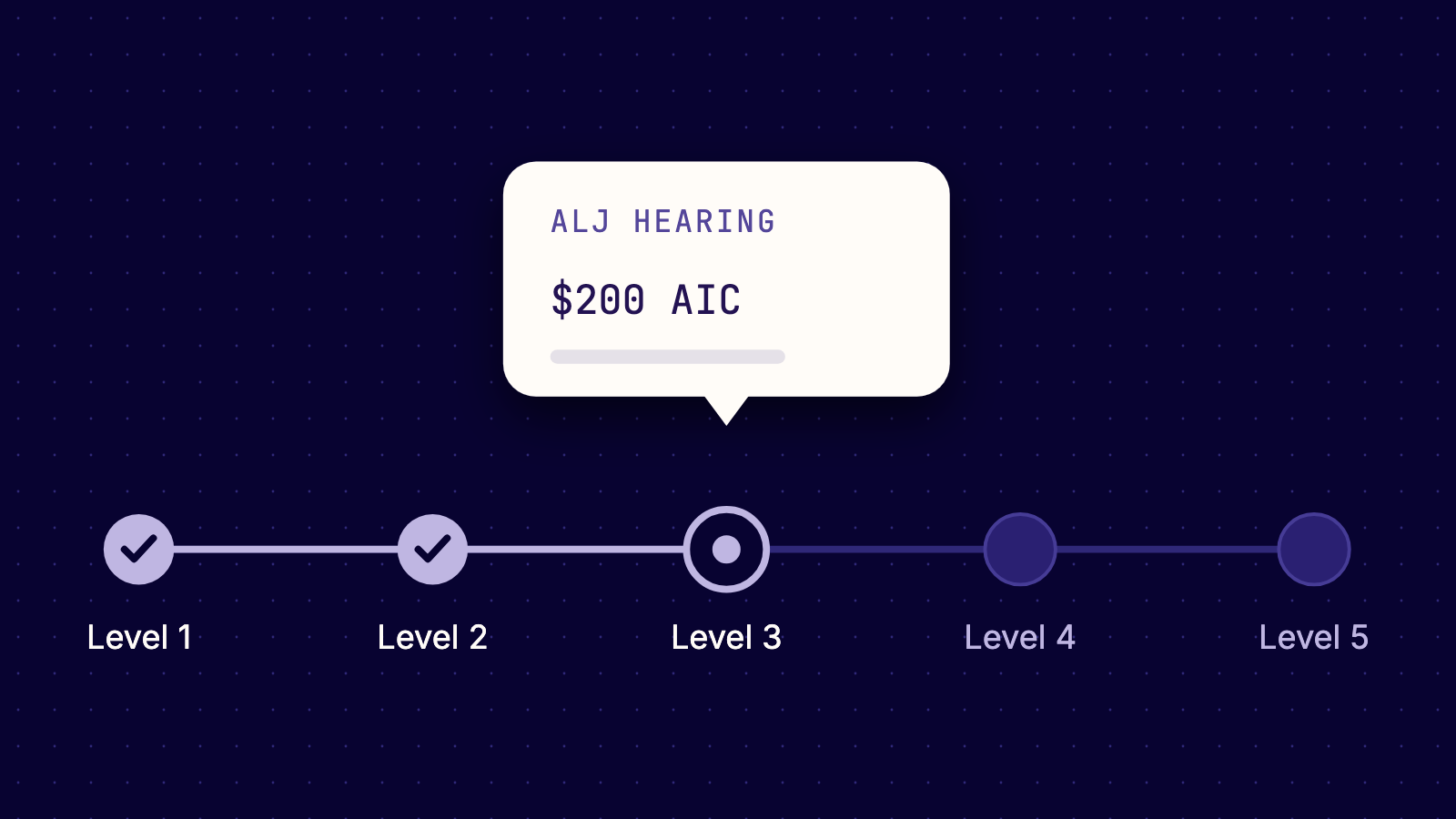
A lot of billing teams treat a Medicare appeal as one letter to the MAC: send it, wait, and write the claim off if the answer is still no. That letter is only the first of five levels, each with its own decision maker, filing window and evidence rules, and what you submit early shapes what you can argue later.
For Original Medicare Part A and Part B claims, the appeals process under 42 CFR Part 405, Subpart I runs from the Medicare Administrative Contractor (MAC) to a Qualified Independent Contractor (QIC), the Office of Medicare Hearings and Appeals (OMHA), the Medicare Appeals Council and federal district court. Only the third and fifth levels carry a dollar minimum, and CMS has already published the figures for requests filed in 2027.
TL;DR
- Five levels, not one letter. Redetermination (MAC), reconsideration (QIC), OMHA hearing or review, Council review, then federal court.
- Filing windows shrink after level one. You get 120 days to request a redetermination and 180 days for a reconsideration, then 60 days at each later level, with receipt of each notice presumed 5 days after its date.
- Dollar thresholds apply at levels three and five. For 2026 the amount in controversy is $200 for an ALJ hearing and $1,960 for judicial review; for requests filed on or after January 1, 2027, it is $200 and $2,000.
- Clerical errors are reopenings, not appeals. Medicare contractors must process minor errors and omissions as reopenings instead of redeterminations.
- Medicare Advantage runs its own track. The plan reconsiders first, contracted providers follow their contract, and non-contract providers must sign a waiver of liability to appeal a payment denial.
The five levels of Medicare appeals
| Level | Who decides | Deadline to file | Decision timeframe | Amount in controversy |
|---|---|---|---|---|
| 1. Redetermination | MAC staff not involved in the initial determination | 120 days from receipt of the initial determination | 60 days from receipt of the request | None |
| 2. Reconsideration | Qualified Independent Contractor (QIC) | 180 days from receipt of the redetermination | 60 days, with an option to escalate to OMHA if missed | None |
| 3. ALJ hearing or attorney adjudicator review | OMHA | 60 days from receipt of the reconsideration | 90 days, or 180 days if escalated from the QIC | $200 (CY 2026 and CY 2027) |
| 4. Council review | Medicare Appeals Council, HHS Departmental Appeals Board | 60 days from receipt of the OMHA decision or dismissal | 90 days, or 180 days if escalated from OMHA | None, per CMS |
| 5. Judicial review | Federal district court | 60 days from receipt of the Council decision or escalation notice | Not specified | $1,960 (CY 2026); $2,000 (CY 2027) |
All of these are calendar days. Decision clocks can be extended, for example when you submit more evidence after filing, so treat them as planning limits.
First decide whether it is an appeal at all
Many Medicare "appeals" should never enter the appeals process. Under 42 CFR 405.980, a contractor "must process clerical errors (which includes minor errors and omissions) as reopenings, instead of as redeterminations." Examples include computational mistakes, inaccurate data entry and duplicate denials. If the contractor disagrees that the issue is clerical, it must dismiss the reopening request and advise you of any appeal rights, as long as the window on the original denial has not closed.
The reopening windows are different from the appeal windows. A party may ask the contractor to reopen an initial determination within 1 year for any reason, within 4 years for good cause, and at any time to correct a clerical error on an unfavorable determination. Once a valid appeal is filed, that issue cannot be reopened until appeal rights are exhausted, so choose first. Our guide to corrected claims, reconsiderations and appeals covers that choice across payers, and the CO-50 denial code post covers medical-review denials for missing records, which Medicare also processes as reopenings.
Level 1: Redetermination by the MAC
A redetermination is a review by MAC personnel not involved in the original decision. Under 42 CFR 405.942, the request must be filed within 120 calendar days from the date you receive the notice of initial determination. Receipt is presumed to be 5 calendar days after the date on the notice, unless there is evidence to the contrary, and the request counts as filed when the contractor receives it.
The request goes in writing to the contractor named on the notice, on form CMS-20027 or in a letter with the same required elements. You must explain why you disagree and should include the evidence you want considered. CMS notes that "Most MACs allow electronic submission of appeals through their website."
The MAC mails or transmits its decision within 60 calendar days of receiving a timely request. Each evidence submission after filing extends that clock by up to 14 calendar days, so send a complete packet the first time.
Level 2: Reconsideration by a QIC
If the redetermination goes against you, the next step is a reconsideration by a QIC, an independent review of the administrative record. 42 CFR 405.962 gives you 180 calendar days from receipt of the redetermination notice, again with receipt presumed 5 days after the notice date. CMS accepts form CMS-20033 or a written request with the same information.
Your record should be complete here. CMS warns that "Any documentation not submitted at the reconsideration level may be excluded from consideration at subsequent levels of appeal unless good cause is shown." You need not resubmit what the MAC already has, but anything the redetermination notice flagged as missing belongs here.
The QIC has 60 calendar days to issue its decision, plus extensions for late evidence. If it cannot finish in time, 42 CFR 405.970 requires it to notify you and offer escalation to OMHA. The QIC keeps working unless you ask in writing to escalate after the period has run.
Level 3: ALJ hearing or attorney adjudicator review at OMHA
The third level moves the case out of the contractor system. Under 42 CFR 405.1002, you have a right to a hearing before an administrative law judge if you file a written request within 60 calendar days after receipt of the reconsideration and you meet the amount in controversy requirement. CMS says you can file by mail on form OMHA-100 or through the OMHA e-Appeal Portal, and you must notify the other parties who received the QIC's reconsideration.
Hearings are generally held by telephone unless the ALJ finds good cause for video or an in-person appearance. If you waive the hearing on form OMHA-104, an attorney adjudicator can decide the case on the record.
The amount in controversy is the amount charged, less Medicare payments and any collectible deductible or coinsurance. The CY 2026 notice set the ALJ threshold at $200, and the CY 2027 notice, published September 16, 2026, says it "will remain $200" for requests filed on or after January 1, 2027.
OMHA's deadline is 90 calendar days from the date the hearing request is received, or 180 days for an appeal escalated from the QIC, under 42 CFR 405.1016. If OMHA misses it, you may escalate to the Council in writing or leave the appeal pending.
Levels 4 and 5: Medicare Appeals Council and federal court
Any party can request Council review of an OMHA decision or dismissal in writing within 60 calendar days of receipt, under 42 CFR 405.1102. CMS states that "There is no requirement regarding the amount of money in controversy for Council review." The Council reviews de novo and generally decides within 90 calendar days, or 180 days for a case escalated from OMHA, and you must copy the other parties or the Council's deadline is tolled.
Judicial review is the last stop. A party may file in federal district court within 60 calendar days after receiving the Council's decision, or after the Council's notice that it cannot decide an escalated case in time. The threshold is $1,960 for 2026 and $2,000 for requests filed on or after January 1, 2027, per the same Federal Register notices.
Who can appeal and when a representative needs paperwork
Under 42 CFR 405.906, the parties to an initial determination include the beneficiary, a supplier that accepted assignment for the items or services at issue, and a provider of services that filed the claim. A provider or supplier can also become a party by accepting the beneficiary's assignment of appeal rights.
If a billing company or outside counsel files for the party, the appointment has to be valid. 42 CFR 405.910 requires it to be in writing, signed and dated by both the party and the representative, and to identify the provider's or supplier's NPI when the provider or supplier is the party. Unless revoked, an appointment is valid for 1 year from the date both signatures appear. Until a defective appointment is cured, the representative cannot act or receive the decision.
Missed deadlines and good cause
A late request is not automatically dead. With good cause, the contractor may extend the window if you ask in writing and explain the delay. The regulation's examples of good cause include when "The party did not receive notice of the determination or decision" and when the contractor gave incorrect or incomplete filing information. The QIC and the Council apply the same standard.
Overpayments: appeal fast to delay recoupment
Appeals of overpayments from post-payment claim denials carry a second clock. 42 CFR 405.379 implements section 1893(f)(2) of the Social Security Act and says contractors "can begin recoupment no earlier than 41 days from the date of the initial overpayment demand," and must stop when they receive a timely and valid redetermination request. CMS's Financial Management Manual states that to delay recoupment, a provider "must submit the redetermination appeal request within 30 days of the demand letter date," and has 60 days from the redetermination decision to file a reconsideration and keep it on hold. After the second level, recoupment resumes even if you appeal further, and interest keeps accruing. Our payer recoupments guide covers offsets across payers.
How Medicare Advantage appeals differ
Medicare Advantage claims follow 42 CFR Part 422, Subpart M, not Part 405. The first level is a reconsideration by the plan itself. Under 42 CFR 422.582, you file within 60 calendar days after receipt of the written organization determination, presumed 5 days after the notice date, which CMS describes as 65 calendar days from the date of the notice. For payment requests the plan has 60 calendar days, and if it upholds its denial in whole or in part it must forward the case to the Part C independent review entity (IRE). For appeals received on or after May 1, 2026, CMS says that entity is C2C Innovative Solutions, Inc.
For payment denials, your contract status decides whether you have a Subpart M appeal at all. CMS's Parts C and D appeals guidance, effective July 6, 2026, says contract provider payment disputes "are governed by the appeals/dispute resolution provisions in the contract between the provider and the plan." A non-contract provider may request a reconsideration of a denied claim "only if the non-contract provider completes a Waiver of Liability (WOL) statement," agreeing not to bill the enrollee whatever the outcome. ALJ, Council and court review follow the IRE, with the same dollar thresholds. Our Medicare Advantage vs. Traditional Medicare guide covers the wider differences.
What to track for every appeal
A strong argument does not help if the request arrives late. Because receipt is presumed 5 days after the notice date and filing counts only when the adjudicator receives the request, your tracker needs both dates for every level.
| Field | Why it matters |
|---|---|
| Notice date and presumed receipt date | Starts the filing window at each level |
| Filing deadline | 120, 180 or 60 days depending on level |
| Date received by the adjudicator | The request counts as filed on this date |
| Appeal number or document control number | Needed for status checks and the next level's request |
| Evidence submissions after filing | Each one can extend the decision clock |
| Decision due date | Shows when escalation becomes available |
| Decision date and outcome | Starts the next filing window or closes the account |
| Overpayment demand letter date | The 30-day mark for delaying recoupment |
Check status on a schedule rather than waiting for mail, and store reference numbers as fields, not free-text notes. A written OMHA hearing request, for example, must include any Medicare appeal number or document control number assigned to the QIC reconsideration.
Where automation fits
Status checks are the repetitive part of this work. SuperDial's claim status workflow covers denial follow-up, using EDI and payer portals where they return a complete answer and calling the payer when they leave out what your team needs. It returns the denial reason and code, the reconsideration or appeal path, the next action and the payer reference number as structured fields, so your team can decide whether to correct, resubmit or appeal.
FAQ
How long does the Medicare appeals process take?
If every adjudicator uses its full standard clock, decision time alone is 300 days across the first four levels: 60 at the MAC, 60 at the QIC, 90 at OMHA and 90 at the Council. Add the filing windows and any extensions, and a fully contested claim can run well over a year before it reaches court.
Can I combine claims to meet the amount in controversy?
Yes, for an ALJ hearing. Under 42 CFR 405.1006, one appellant can aggregate two or more claims that a QIC has reconsidered if they involve similar or related services, and the request is filed within 60 days after receipt of all the reconsiderations. Part A and Part B claims may be combined.
What if the MAC dismisses my redetermination request?
CMS lists two options: ask the QIC to review the dismissal within 60 days of receipt, or ask the MAC to vacate it within 6 months of the notice. A QIC's review of a MAC dismissal is binding and not subject to further review.
Do Medicare Advantage appeals use the same dollar thresholds?
Yes, at the ALJ and judicial review levels. The CY 2026 and CY 2027 Federal Register notices state that the adjusted thresholds also apply to Part C appeals under 42 CFR 422.600 and 422.612.
Sources
- eCFR, 42 CFR Part 405, Subpart I, Determinations, Redeterminations, Reconsiderations, and Appeals Under Original Medicare (up to date as of November 10, 2026): https://www.ecfr.gov/current/title-42/chapter-IV/subchapter-B/part-405/subpart-I
- eCFR, 42 CFR 405.906 Parties to the initial determinations, redeterminations, reconsiderations, hearings, and reviews: https://www.ecfr.gov/current/title-42/section-405.906
- eCFR, 42 CFR 405.910 Appointed representatives: https://www.ecfr.gov/current/title-42/section-405.910
- eCFR, 42 CFR 405.942 Time frame for filing a request for a redetermination: https://www.ecfr.gov/current/title-42/section-405.942
- eCFR, 42 CFR 405.944, 405.946 and 405.950 Redetermination filing, evidence and timeframe: https://www.ecfr.gov/current/title-42/section-405.950
- eCFR, 42 CFR 405.962 Timeframe for filing a request for a reconsideration: https://www.ecfr.gov/current/title-42/section-405.962
- eCFR, 42 CFR 405.970 Timeframe for making a reconsideration: https://www.ecfr.gov/current/title-42/section-405.970
- eCFR, 42 CFR 405.980 Reopening of initial determinations, redeterminations, reconsiderations, decisions, and reviews: https://www.ecfr.gov/current/title-42/section-405.980
- eCFR, 42 CFR 405.1002 Right to an ALJ hearing: https://www.ecfr.gov/current/title-42/section-405.1002
- eCFR, 42 CFR 405.1006 Amount in controversy required for an ALJ hearing and judicial review: https://www.ecfr.gov/current/title-42/section-405.1006
- eCFR, 42 CFR 405.1016 Time frames for deciding an appeal of a QIC reconsideration: https://www.ecfr.gov/current/title-42/section-405.1016
- eCFR, 42 CFR 405.1100, 405.1102 and 405.1106 Medicare Appeals Council review: https://www.ecfr.gov/current/title-42/section-405.1102
- eCFR, 42 CFR 405.1130, 405.1132 and 405.1136 Judicial review: https://www.ecfr.gov/current/title-42/section-405.1136
- eCFR, 42 CFR 405.379 Limitation on recoupment of provider and supplier overpayments: https://www.ecfr.gov/current/title-42/section-405.379
- eCFR, 42 CFR 422.582 and 422.590 Medicare Advantage reconsiderations: https://www.ecfr.gov/current/title-42/section-422.582
- Federal Register, Medicare Appeals; Adjustment to the Amount in Controversy Threshold Amounts for Calendar Year 2026, 90 FR 55869 (December 4, 2025): https://www.federalregister.gov/documents/2025/12/04/2025-21879/medicare-program-medicare-appeals-adjustment-to-the-amount-in-controversy-threshold-amounts-for
- Federal Register, Medicare Appeals; Adjustment to the Amount in Controversy Threshold Amounts for Calendar Year 2027, 91 FR 58681 (September 16, 2026): https://www.federalregister.gov/documents/2026/09/16/2026-19016/medicare-program-medicare-appeals-adjustment-to-the-amount-in-controversy-threshold-amounts-for
- CMS, Original Medicare (Fee-for-service) Appeals (page last modified 08/25/2026): https://www.cms.gov/medicare/appeals-grievances/fee-for-service
- CMS, First Level of Appeal: Redetermination by a Medicare Contractor (page last modified 03/10/2026): https://www.cms.gov/medicare/appeals-grievances/fee-for-service/first-level-appeal-redetermination-medicare-contractor
- CMS, Second Level of Appeal: Reconsideration by a Qualified Independent Contractor (page last modified 09/30/2026): https://www.cms.gov/medicare/appeals-grievances/fee-for-service/second-level-appeal
- CMS, Third Level of Appeal: Decision by Office of Medicare Hearings and Appeals (page last modified 10/27/2026): https://www.cms.gov/medicare/appeals-grievances/fee-for-service/third-level-appeal
- CMS, Fourth Level of Appeal: Review by the Medicare Appeals Council (page last modified 09/10/2024): https://www.cms.gov/medicare/appeals-grievances/fee-for-service/fourth-level-appeal
- CMS, Fifth Level of Appeal: Judicial Review in Federal District Court (page last modified 10/27/2026): https://www.cms.gov/medicare/appeals-grievances/fee-for-service/fifth-level-appeal
- CMS, Medicare Financial Management Manual, Chapter 3, Overpayments (Rev. 13825, issued June 11, 2026): https://www.cms.gov/regulations-and-guidance/guidance/manuals/downloads/fin106c03.pdf
- CMS, Medicare Managed Care Appeals and Grievances (page last modified 07/06/2026): https://www.cms.gov/medicare/appeals-grievances/managed-care
- CMS, Reconsideration by the Medicare Advantage (Part C) Health Plan (page last modified 01/07/2025): https://www.cms.gov/medicare/appeals-grievances/managed-care/reconsideration-advantage-health-plan-part-c
- CMS, Parts C and D Enrollee Grievances, Organization/Coverage Determinations, and Appeals Guidance (effective July 6, 2026): https://www.cms.gov/medicare/appeals-and-grievances/mmcag/downloads/parts-c-and-d-enrollee-grievances-organization-coverage-determinations-and-appeals-guidance.pdf
- SuperDial, Claim Status Automation for AR Follow-Up: https://www.superdial.com/workflows/claim-status
Run a pilot on a real workflow.
Bring a representative batch, define the output schema, and validate ROI with your payer mix in 30 to 90 days.
