
No Surprises Act IDR Process: Deadlines, Fees and 2026 Changes
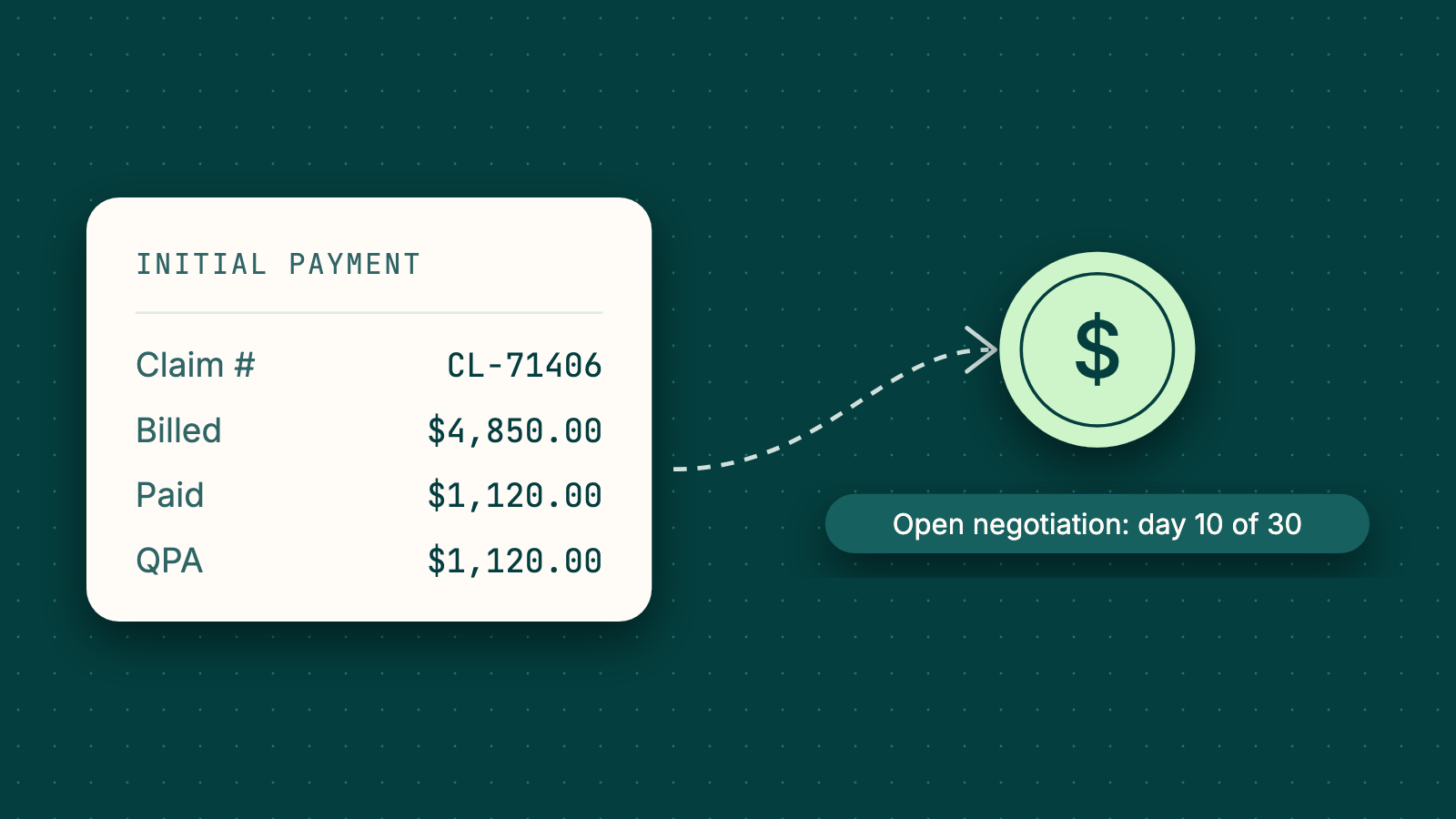
An out-of-network emergency physician claim comes back paid at a fraction of billed charges, and the remit sits in a work queue for two weeks before anyone looks at it. By then, the federal clock has been running for ten business days. Under the No Surprises Act, the 30-business-day window to start open negotiation begins on the day the provider receives the initial payment or notice of denial, not the day someone notices the short pay.
That is the core problem with the Federal independent dispute resolution (IDR) process. The deadlines are short, they run in business days, and they start from documents buried in ordinary remittance traffic. The rules also changed in 2026: a Federal IDR Operations final rule took effect August 3, the administrative fee dropped to $15, new batching limits apply to open negotiation periods starting on or after November 1, and the full Fifth Circuit affirmed parts of a ruling that struck certain rules on calculating the qualifying payment amount (QPA).
TL;DR
- Only certain out-of-network claims qualify. Emergency services, non-emergency services from out-of-network providers at in-network facilities, and air ambulance services can go to Federal IDR, unless a specified state law or All-Payer Model Agreement sets the rate.
- The clock starts at the remit. You have 30 business days from the initial payment or denial to start open negotiation, a 30-business-day negotiation period, then 4 business days to initiate IDR.
- Fees dropped in 2026. The administrative fee is $15 per party per dispute for disputes initiated on or after June 11, 2026.
- Batching tightened on November 1, 2026. Batched disputes with open negotiation starting on or after that date are capped at 50 line items and carry a 30-business-day cooling off period.
- QPA rules are in flux. After the Fifth Circuit's August 11, 2026 en banc decision in TMA III, the Departments say guidance is coming and IDR remains operational.
Which claims can go to Federal IDR
CMS describes Federal IDR as a process providers, facilities and health plans "can use to determine the payment rates for certain out-of-network charges," and adds that "Not all items and services are subject to the Federal IDR process." The regulation at 45 CFR 149.510 limits it to emergency services from a nonparticipating provider or facility, services from a nonparticipating provider at a participating facility, and air ambulance services from a nonparticipating air ambulance provider, each where the surprise billing protections apply. It excludes claims where an All-Payer Model Agreement or a specified state law sets the out-of-network rate.
That carve-out matters. A specified state law provides a method for determining the amount payable for out-of-network care, and a state may let self-funded plans opt in, so whether the state or federal process applies varies by state and plan type. Our post on self-funded vs. fully insured plans covers how to tell them apart. Separately, the patient-provider dispute resolution process for uninsured or self-pay patients billed at least $400 above their good faith estimate is a different track and outside this guide.
What the plan must disclose with the initial payment
For emergency services, the plan generally must send an initial payment or notice of denial within 30 calendar days after the bill is transmitted, unless a specified state law or All-Payer Model Agreement sets another timeframe. Under 45 CFR 149.140(d), that response must come with written disclosures:
- The QPA for each item or service, plus a statement and explanation if the QPA is based on a downcoded code or modifier.
- A statement that you may start a 30-business-day open negotiation period, generally within 30 business days, and may generally initiate IDR within 4 business days after it ends.
- A phone number and email address for the person or office that handles open negotiation.
- For disclosures due on or after August 3, 2026, the legal business name of the plan or issuer (and plan sponsor, if applicable) and its IDR registration number, once assigned.
On request, the plan must also tell you in a timely manner whether the QPA was built from underlying fee schedule rates or a derived amount, and which database it used, if any. Starting with services furnished on or after January 1, 2027, plans must also use specified remark codes on remittance advice to out-of-network providers to signal whether a claim is subject to these rules, which should make eligible claims easier to spot in your remittance advice review.
The open negotiation period
Either party may start open negotiation during the 30 business days beginning on the day the provider receives the initial payment or denial. Under the rules that apply today, you send an open negotiation notice to the other party on the standard federal form, identifying the services, dates, service code and initial payment amount, with an offer and your contact information. The day the notice is first sent starts a separate 30-business-day negotiation period, so keep proof of when and where you sent it.
The 2026 final rule changes this step, but not yet. Once the IDR Gateway supports it, the notice and remittance advice will go to the plan and the Departments through the federal system, and the receiving party will owe a response by the 15th business day. CMS's implementation timeline says these provisions generally apply to disputes with open negotiation periods beginning 90 calendar days after the Departments announce the supporting functionality. The Departments expect to start implementing those Gateway functions in spring 2027, beginning with the IDR registry and then open negotiation. Until then, the earlier requirements stay in force.
Initiating IDR and selecting a certified IDR entity
If negotiation ends without agreement, either party may initiate IDR by sending a notice of IDR initiation to the other party and the Departments. CMS puts it plainly: a dispute "must be initiated within 4 business days after the open negotiation period has ended." The notice names a preferred certified IDR entity, and if the other party does not object within 3 business days, that entity is selected as long as it has no conflict of interest.
Under the current rule, each side submits its offer within 10 business days after selection, and the entity decides within 30 business days after selection. The 2026 rule amends these deadlines too, again tied to future Gateway functionality. The entity list also moves: on November 4, 2026, the Departments announced they are denying recertification of Island Peer Review Organization (IPRO) and Network Medical Review Company, LLC, which are no longer eligible to accept new disputes. Both may appeal before the denial becomes final.
The filing channel is changing as well. Beginning November 13, 2026, organizations with IDR Gateway accounts can submit initiation, selection and offer forms inside the Gateway, and the older web forms stop working outside it after January 15, 2027, except the resubmission form. Whoever files your disputes needs a Gateway account before then.
How offers are decided
Federal IDR is final-offer, or baseball-style, arbitration. Each side submits one offer as a dollar amount and as a percentage of the QPA, and the certified IDR entity "must select from the disputing parties' payment offers." There is no middle outcome, so an offer that overreaches can lose to a modest one.
The entity considers the QPA along with information either party submits on the circumstances the regulation lists: the provider's training, experience and quality measures; market share in the region; patient acuity or service complexity; a facility's teaching status, case mix and scope of services; and good faith efforts to contract, including contracted rates over the previous 4 plan years. It may not consider usual and customary charges, what the provider would have billed absent the surprise billing rules, or public payer rates such as Medicare, Medicaid, CHIP or TRICARE. Build your support around the permitted factors, not a billed-charge comparison.
Batching and the cooling off period
Batching puts multiple items into one determination, and it changed on November 1, 2026. For open negotiation periods starting on or after that date, CMS's batching guidance requires that batched items be billed by the same provider or facility, paid by the same plan or issuer, related to a similar condition, and generally furnished within the same 30-business-day period. "Similar condition" means one patient in a single encounter billed on one claim, the same or a comparable service code, or anesthesiology, radiology, pathology or laboratory codes in a range the Departments specify.
A batched dispute cannot exceed 50 line items. The cooling off period is the pause after a determination during which the initiating party cannot bring a new dispute against the same party for the same service. Single and bundled disputes keep a 90-calendar-day cooling off period, while batched disputes with open negotiation starting on or after November 1 get 30 business days.
What it costs to file in 2026
| Fee | Amount | Applies to |
|---|---|---|
| Administrative fee | $115 per party per dispute | Disputes initiated January 22, 2024 through June 10, 2026 |
| Administrative fee | $15 per party per dispute | Disputes initiated on or after June 11, 2026 |
| Certified IDR entity fee, single | $200 to $840 | Disputes initiated on or after January 22, 2024 |
| Certified IDR entity fee, batched | $268 to $1,173, plus $75 to $250 per additional 25 line items from the 26th | Disputes initiated on or after January 22, 2024 |
Each entity charges a fixed fee within those ranges unless the Departments approve an exception, and the ranges stay until changed by rulemaking. If a party fails to pay the administrative or entity fee on time, its offer is treated as not received and it still owes the fees.
Payment after a determination
If the selected offer exceeds the initial payment plus cost sharing, the plan must pay the difference directly to the provider within 30 calendar days of the determination. If it is lower, the provider owes the plan the difference on the same timeline. A settlement reached after initiation follows the same 30-calendar-day payment rule, and the initiating party must report it within 3 business days, so track the expected payment like any other receivable.
Where the rules stand as of November 6, 2026
- Operations final rule. Published June 4, 2026 at 91 FR 33900 and effective August 3, 2026, it finalizes the November 2023 proposed rules with changes. Many provisions apply only after the Departments announce IDR Gateway functionality.
- Already applicable. The $15 administrative fee (June 11, 2026), expanded QPA disclosures (August 3, 2026), and all batching provisions (open negotiation starting on or after November 1, 2026).
- Coming January 1, 2027. Required remark codes on remittance advice to out-of-network providers, for items and services furnished on or after that date.
- TMA III. On August 11, 2026, the Fifth Circuit en banc affirmed portions of a district court judgment that struck certain QPA calculation regulations and guidance.
The Departments said they "anticipate issuing guidance shortly," and that "The Federal Independent Dispute Resolution process remains operational." As of November 6, 2026, the CMS notices page shows no follow-up QPA guidance, so question the QPA you were given, request the supporting details the rule allows, and watch that page.
What your team should track from the first remit
The easiest way to lose an eligible dispute is to miss a deadline before arbitration starts. A useful IDR record starts at the remit:
| Item to capture | Why it matters |
|---|---|
| Date the initial payment or denial was received | Starts the 30-business-day window to open negotiation |
| Initial payment amount, or the denial | Required on the open negotiation and IDR initiation notices |
| QPA and any downcoding statement | Anchors your offer as a percentage of QPA |
| Plan legal name and IDR registration number | Required content under the 2026 rule |
| Open negotiation contact | Proof you used the disclosed contact |
| Date negotiation notice was sent | Starts the 30-business-day negotiation period |
| IDR initiation deadline | The 4-business-day window after negotiation ends |
| Determination date | Starts the 30-calendar-day payment clock |
Payer calls fill real gaps here. Your team may need to call to confirm the paid amount and date when a remit is incomplete, ask for QPA details or the downcoding explanation, or find the right open negotiation contact when the disclosed one bounces.
Where automation fits
Claim status follow-up is the part of this work that repeats on every out-of-network claim. SuperDial's claim status workflow checks claim status through EDI, payer portals and payer calls, and returns the claim status, paid amount and date, denial reason and code, and check or EFT number as structured fields, with the call recording and transcript when a call was made. Your team still decides which claims to negotiate and files any dispute itself.
FAQ
How long does the IDR process take?
If every regulatory window is used in full, the steps add up to more than five months. There are up to 30 business days to start negotiation, 30 business days of negotiation, 4 business days to initiate, up to 30 business days after entity selection for a decision under the current rule, then 30 calendar days for payment.
Can I start IDR if the plan never sent a QPA?
The current initiation notice asks for the QPA, and the 2026 rule's notices, once they apply, ask for it only if it was provided. The plan was required to disclose it, so document that it was missing, request it, and keep the remit.
Who pays the certified IDR entity fee?
For disputes initiated on or after August 3, 2026, each party pays it no later than the date it submits its offer. After a determination, the entity keeps the losing party's fee and returns the prevailing party's fee within 30 business days.
Does Federal IDR apply to self-funded employer plans?
It can, for qualifying claims. If the plan has opted in to a state's surprise billing law where the state allows it, the plan must say so prominently in its out-of-network coverage materials, and the state process applies to the items that law covers.
What happens if my IDR entity loses its certification?
On November 4, 2026, the Departments said parties with open disputes at IPRO or Network Medical Review Company "should expect further guidance from the Departments on next steps for their case." Choose a different entity for new filings.
Sources
- CMS, About Independent Dispute Resolution (page last modified 09/15/2026): https://www.cms.gov/initiatives/no-surprise-billing/overview/engaging-idr/about-independent-dispute-resolution
- CMS, No Surprises Notices (latest notice November 4, 2026): https://www.cms.gov/initiatives/no-surprise-billing/overview/notices
- CMS, Federal IDR Operations Final Rules Implementation Timeline Guide (August 7, 2026): https://www.cms.gov/files/document/federal-idr-operations-implementation-timeline.pdf
- CMS, Federal IDR Guidance for Treatment of Batched and Bundled Qualified IDR Items and Services (October 29, 2026): https://www.cms.gov/files/document/idr-batching-bundling-guidance.pdf
- CMS, Federal Independent Dispute Resolution Operations Final Rule fact sheet (May 28, 2026): https://www.cms.gov/newsroom/fact-sheets/federal-independent-dispute-resolution-operations-final-rule
- Federal Register, Federal Independent Dispute Resolution Operations, 91 FR 33900, CMS-9897-F (June 4, 2026): https://www.federalregister.gov/documents/2026/06/04/2026-11140/federal-independent-dispute-resolution-operations
- Federal Register, Federal Independent Dispute Resolution Operations; Correction, 91 FR 55462 (August 28, 2026): https://www.federalregister.gov/documents/2026/08/28/2026-17622/federal-independent-dispute-resolution-operations-correction
- eCFR, 45 CFR 149.510 Independent dispute resolution process (amended through August 28, 2026): https://www.ecfr.gov/current/title-45/subtitle-A/subchapter-B/part-149/subpart-F/section-149.510
- eCFR, 45 CFR 149.140 Methodology for calculating qualifying payment amount: https://www.ecfr.gov/current/title-45/subtitle-A/subchapter-B/part-149/subpart-B/section-149.140
- eCFR, 45 CFR 149.110 Preventing surprise medical bills for emergency services: https://www.ecfr.gov/current/title-45/subtitle-A/subchapter-B/part-149/subpart-B/section-149.110
- eCFR, 45 CFR 149.30 Definitions: https://www.ecfr.gov/current/title-45/subtitle-A/subchapter-B/part-149/subpart-A/section-149.30
- CMS, Providers: payment resolution with patients: https://www.cms.gov/initiatives/no-surprise-billing/overview/policies-resources/providers-payment-resolution-patients
- SuperDial, Claim Status Automation for AR Follow-Up: https://www.superdial.com/workflows/claim-status
Run a pilot on a real workflow.
Bring a representative batch, define the output schema, and validate ROI with your payer mix in 30 to 90 days.
