
Healthcare has $265 billion in administrative waste. AI can end it or multiply it.


When The New York Times covered healthcare’s AI billing battle in September, Emory Healthcare CEO Joon Lee described hospital bots and insurer bots arguing with each other without end. “A whole data center could be occupied just doing that,” he said.
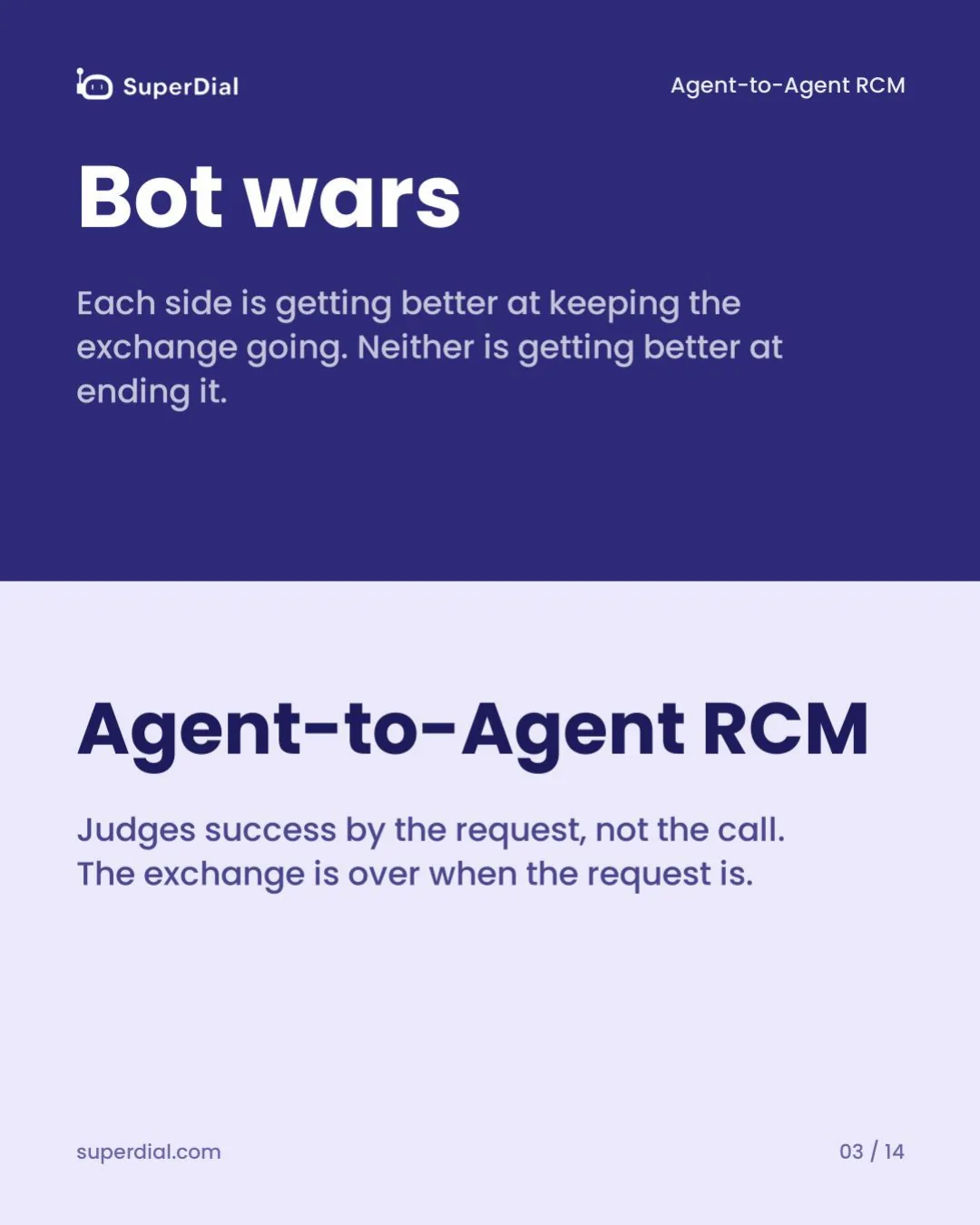
The scenario already has a name: the bot wars. One side deploys AI to secure approvals and payment for care. The other deploys AI to review those requests and, at times, deny them. Neither has a reason to stop. Every extra round costs more in AI spend, pulls in staff on both sides to handle what the bots can’t settle, and can delay payment and care. The result is more friction, not less.
I run a company whose agents talk to payers all day, so I take that risk seriously. But the problem is not that two agents are in a conversation. The problem is that nothing in the conversation is built to end it. Change that, and Agent-to-Agent communication becomes the way out of the bot wars rather than their fuel.
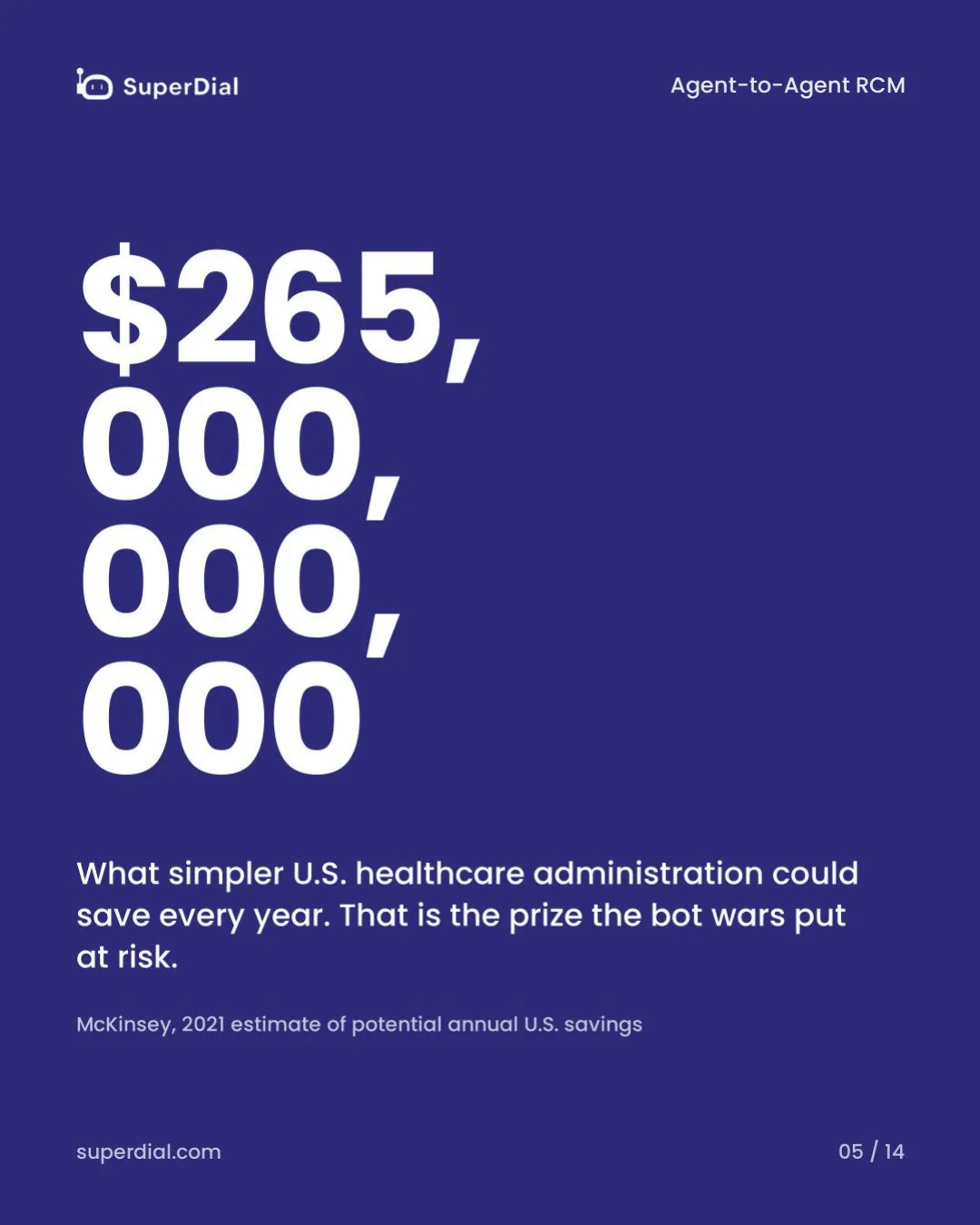
The stakes were enormous before generative AI arrived. Administrative costs are estimated at roughly a quarter of U.S. healthcare spending—about $1.2 trillion at 2023 spending levels. In 2021, McKinsey estimated that simpler administration could save up to $265 billion annually. Nearly four years after ChatGPT’s debut, we face a choice: use AI to simplify that work, or give the existing complexity more processing power.
A costly system with more at stake
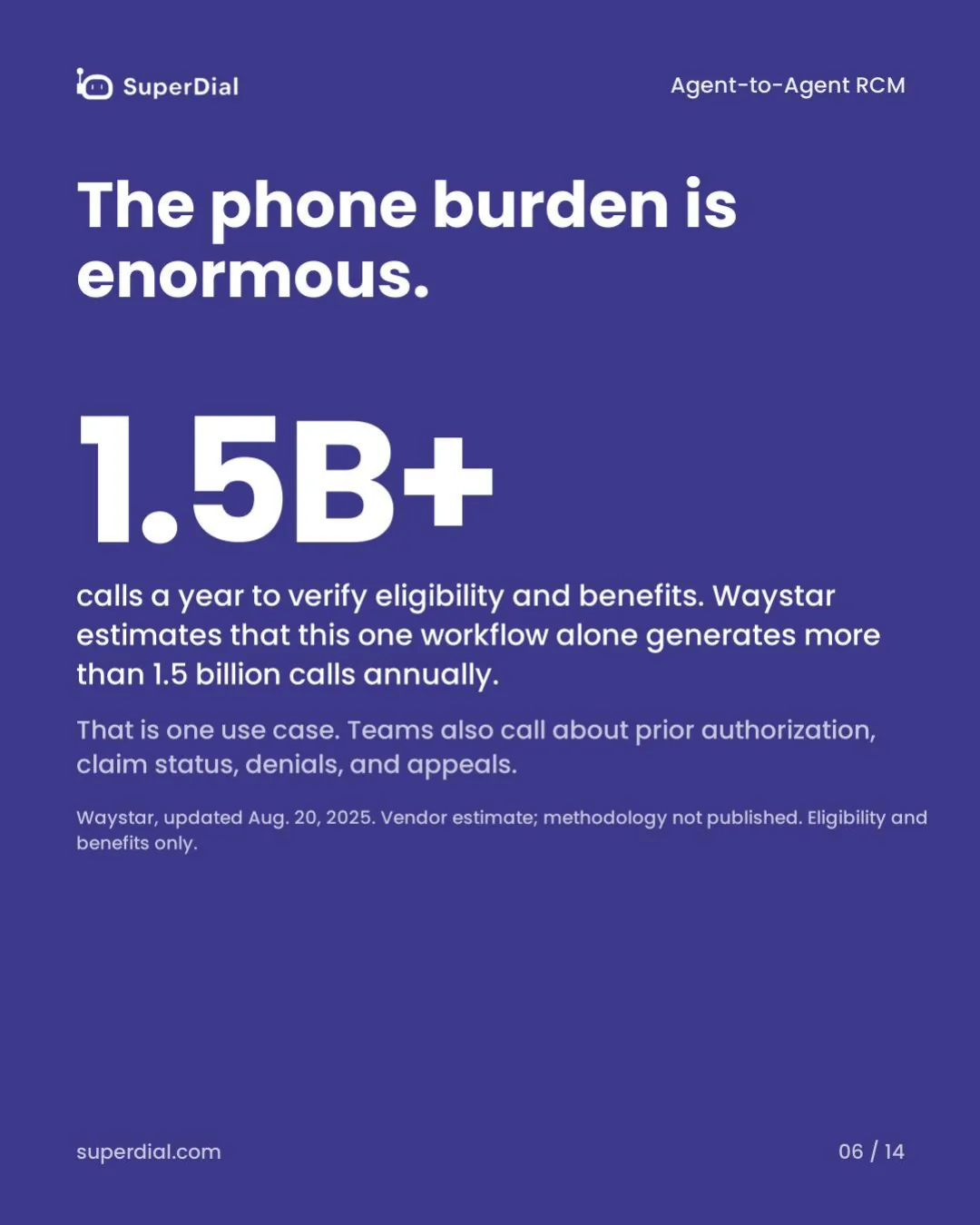
The money is already flowing. CAQH’s 2024 Index tracked roughly $90 billion in annual spending on routine administrative transactions across medical and dental care, including eligibility checks, claims, and payments. That is only a slice of total healthcare administration. Eligibility and benefits verification alone accounts for more than 1.5 billion calls a year, according to Waystar.
The burden reaches down to the individual practice. A 2018 JAMA study at one academic health system put billing costs at nearly $100,000 per primary care physician per year. A ten-physician group, at that rate, spends about $1 million annually just getting paid.
Families are absorbing the consequences. KFF’s latest survey puts the average worker’s contribution to employer-sponsored family coverage at $7,471 this year, up 9% from 2025. Marsh projects total health benefit costs per employee to rise another 8.2% in 2027, even after employers’ planned cost-cutting.
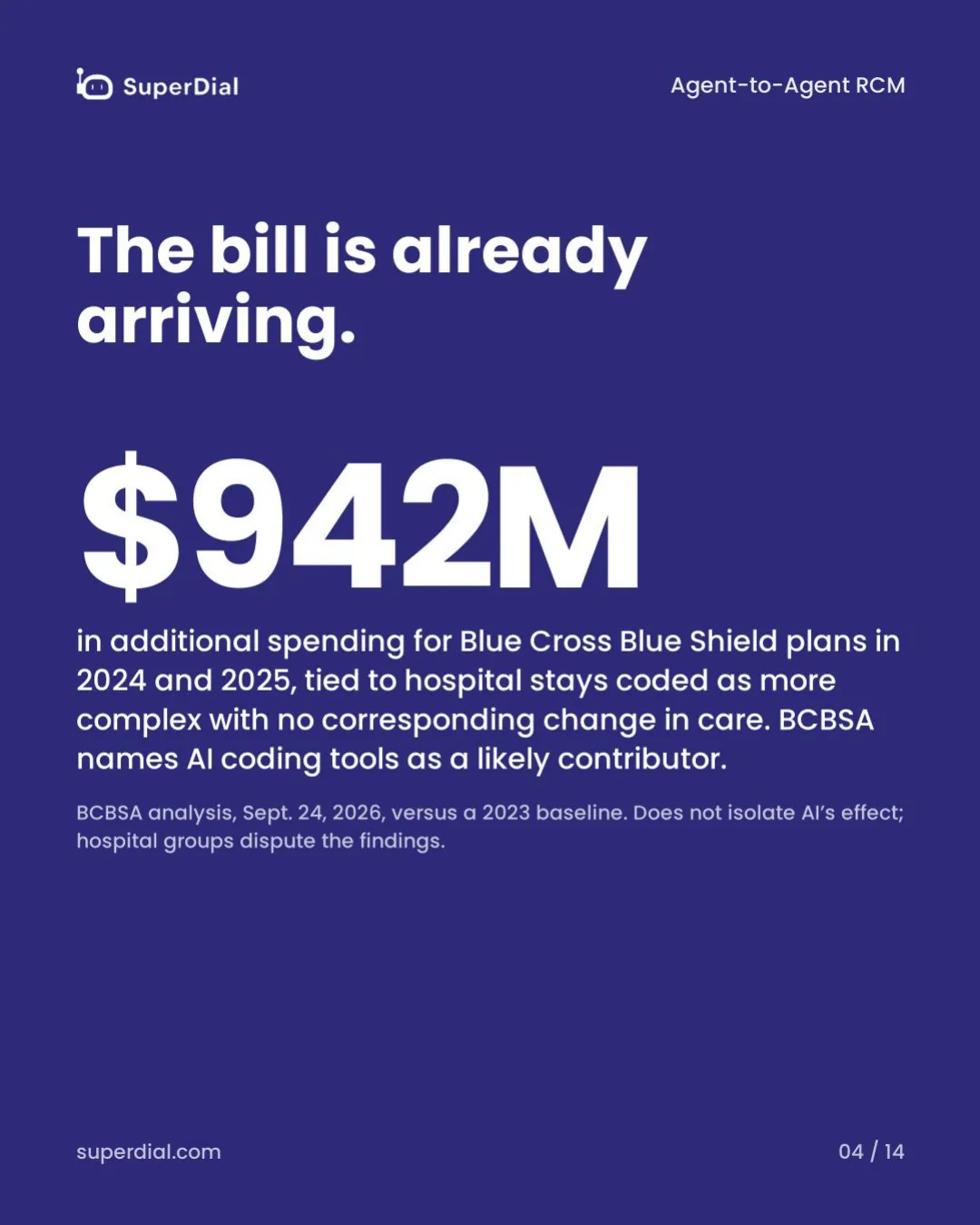
AI is now a line item in those forecasts. Marsh’s actuaries estimate that AI-enabled claims-submission tools, associated with more claims and higher-level coding, are adding as much as a full percentage point to cost growth. BCBSA has raised the same concern about coding intensity. The billing battle has become an affordability problem.
Consider how a single dispute compounds. A request triggers a review. The response prompts an appeal. A missing field spawns another inquiry, and a different team has to reconstruct what happened. Automating each step makes the exchange cheaper to continue. It does nothing to make it end.
Automating each step makes the exchange cheaper to continue. It does nothing to make it end.
For a health system or RCM company, this is the risk hiding inside impressive activity metrics. More accounts touched can mean more exceptions to chase. A lower cost per interaction can sit alongside a higher cost to resolve the account. The savings on one dashboard become the backlog on someone else’s.
Patients pay for that backlog in time. KFF Health News reported that Arman Shahriar, an internal medicine resident, spent hours securing approval for his father’s cancer-staging PET scan. The request was ultimately granted, but the scan had slipped several weeks, with appointments scheduled and canceled along the way. The approval did not give the weeks back.
That is how an automation boom becomes an affordability crisis: every organization gets more efficient at generating work for the next one, and patients keep paying in money and time.
What Agent-to-Agent RCM is, and what it isn’t
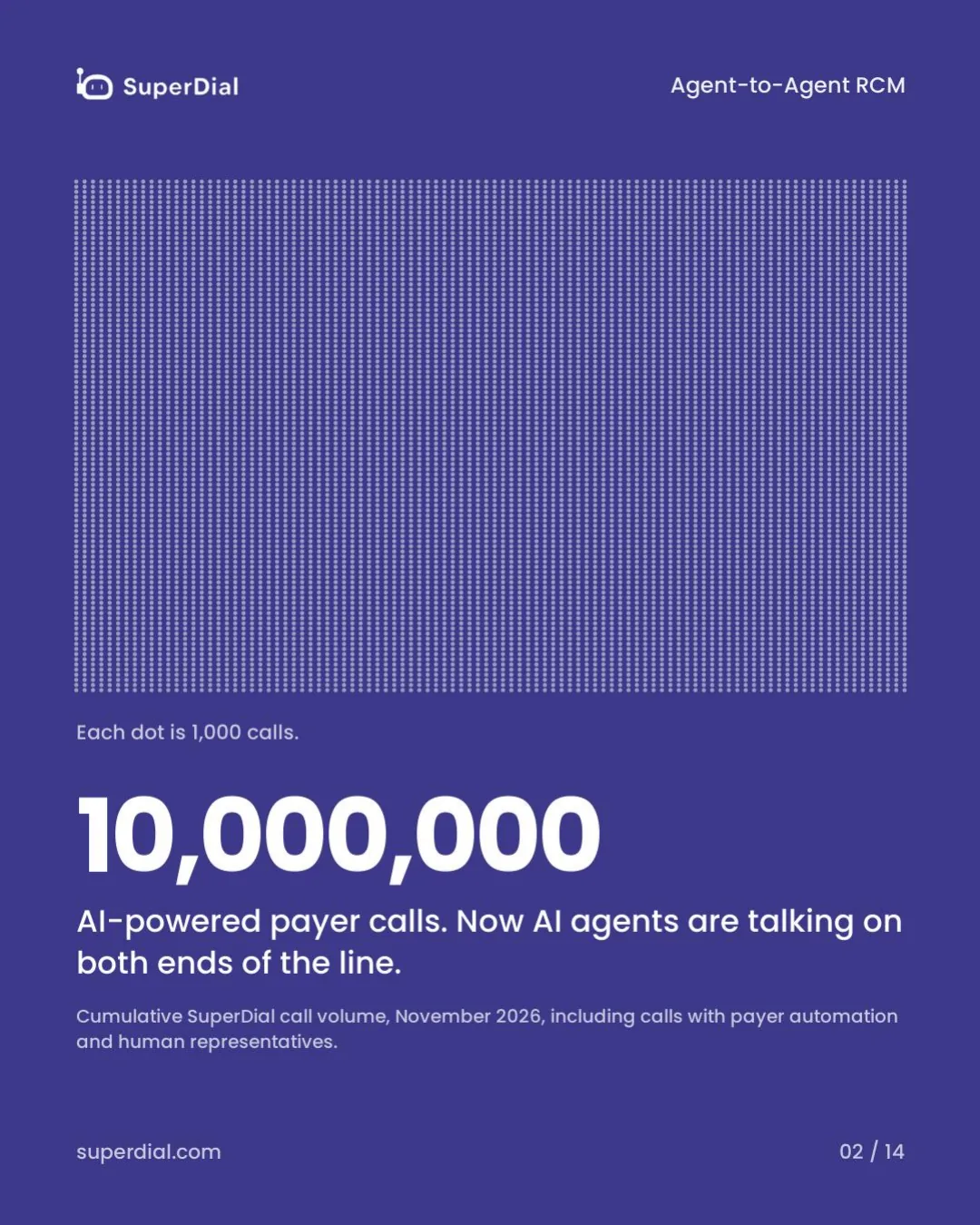
We are building SuperDial to break that cycle. We started because our own billing team was doing this work; we knew the phone trees and hold music firsthand. Ten million payer calls later, we have arrived at a conviction that is unusual for a call-automation company: one of the most valuable things we can do is make the call unnecessary.
We call the approach Agent-to-Agent RCM. A provider’s agent and a payer’s system connect to resolve an administrative request with less work on both sides.
The difference from the bot wars is the definition of done. Two agents arguing are optimizing for their own side of the exchange. Two agents resolving are optimizing for a usable answer: the information a provider needs to move the account forward, delivered in response to a request a payer can actually answer. Our customer tells us what it needs and holds us responsible for getting it. How we get it is our problem, not theirs.
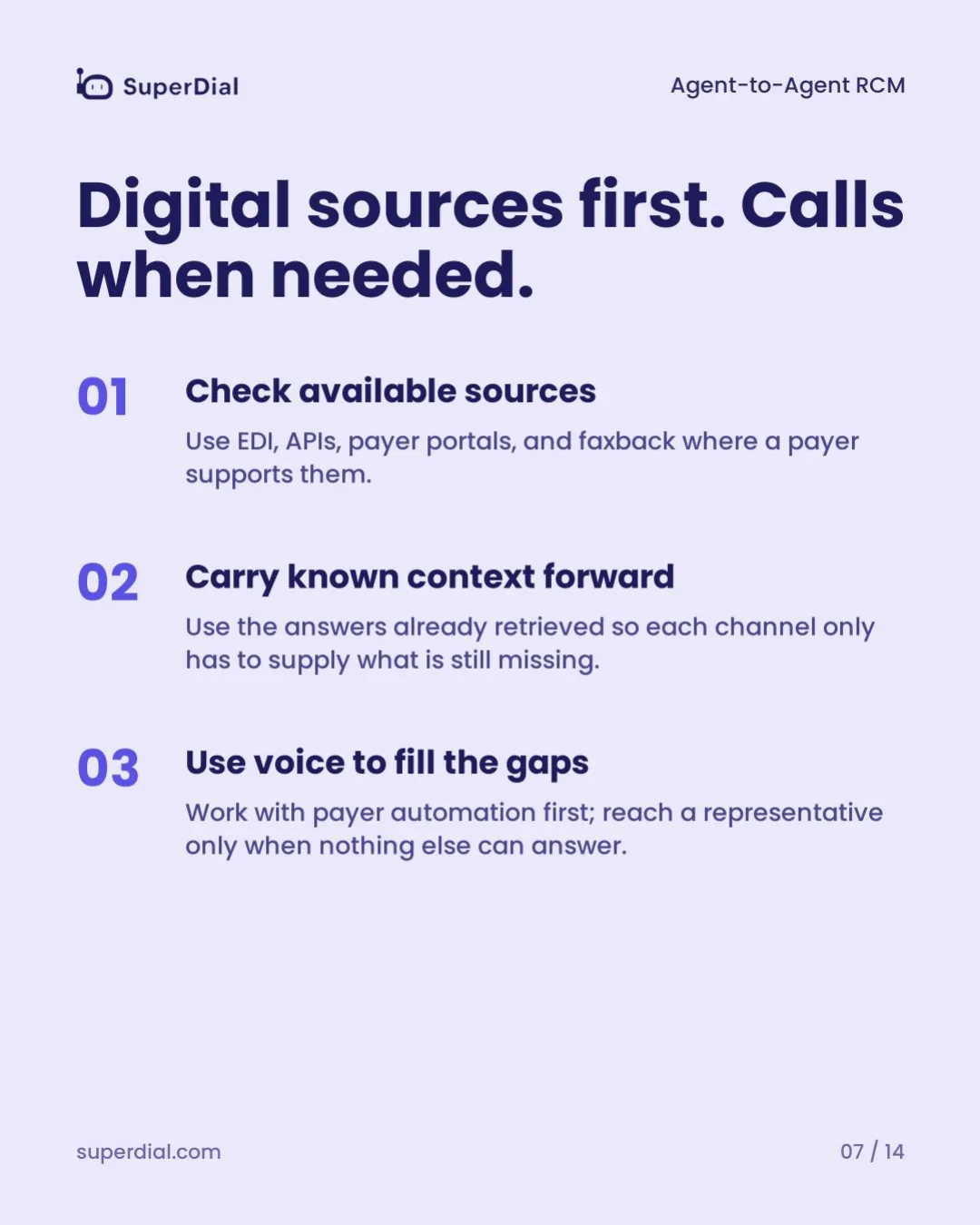
That changes how we build. If an established electronic transaction supplies the answer, use it. If the information lives in a supported portal or faxback, retrieve it there. When a conversation is unavoidable, carry forward everything already known and ask only for what remains. The customer receives the result without managing each channel separately.
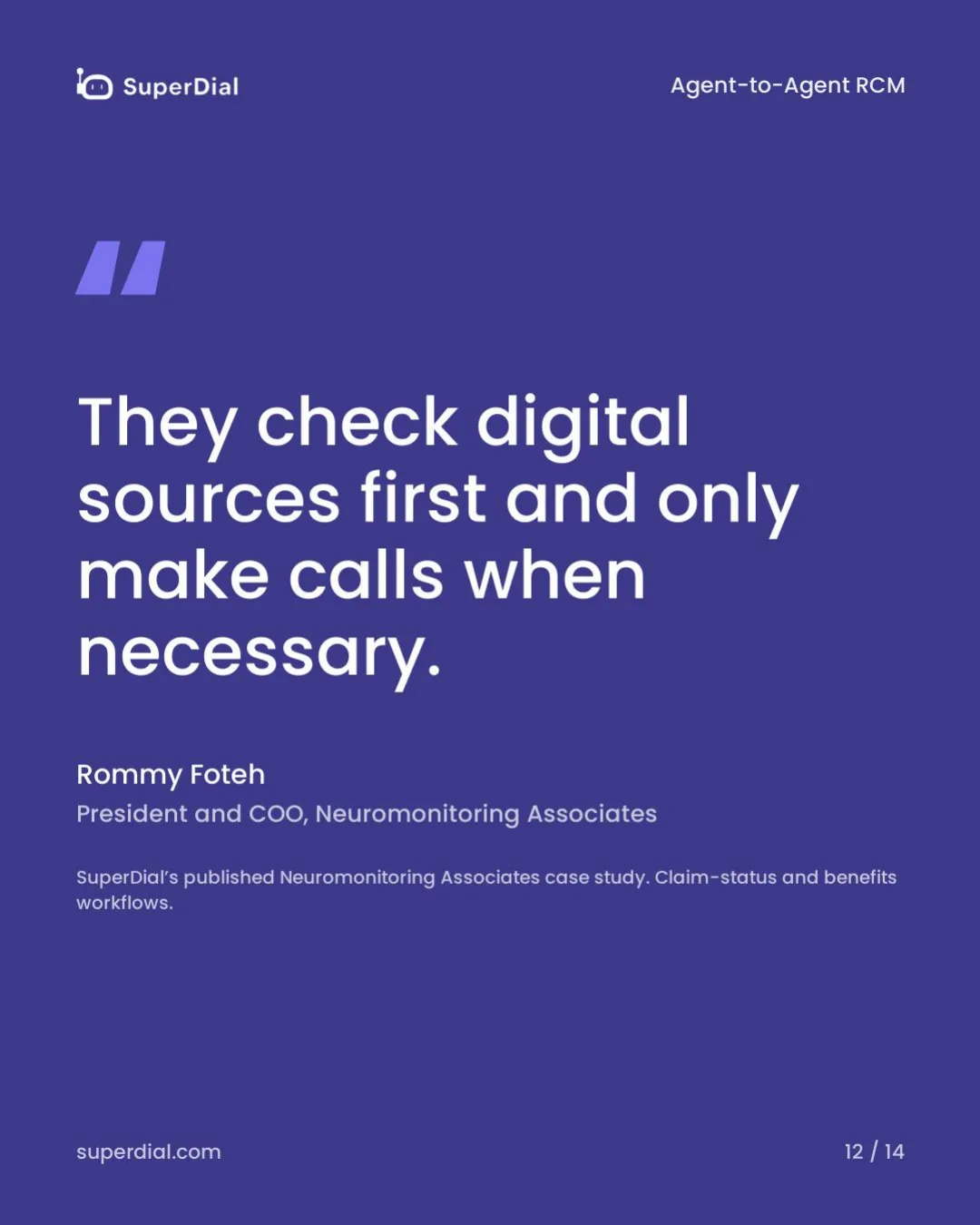
Neuromonitoring Associates works this way today. NMA’s clinical job is protecting patients’ nervous systems during surgery: its teams track nerve signals in real time and alert surgeons to changes that could signal injury. Behind that work is a revenue cycle that has to keep moving. NMA staff submit claim-status and benefits requests to SuperDial; we check digital sources first, carry those answers forward, and use voice only to fill the gaps. President and COO Rommy Foteh puts it simply: “They check digital sources first and only make calls when necessary.” His team reports less time chasing payer information.
Inside a request: claim status, end to end
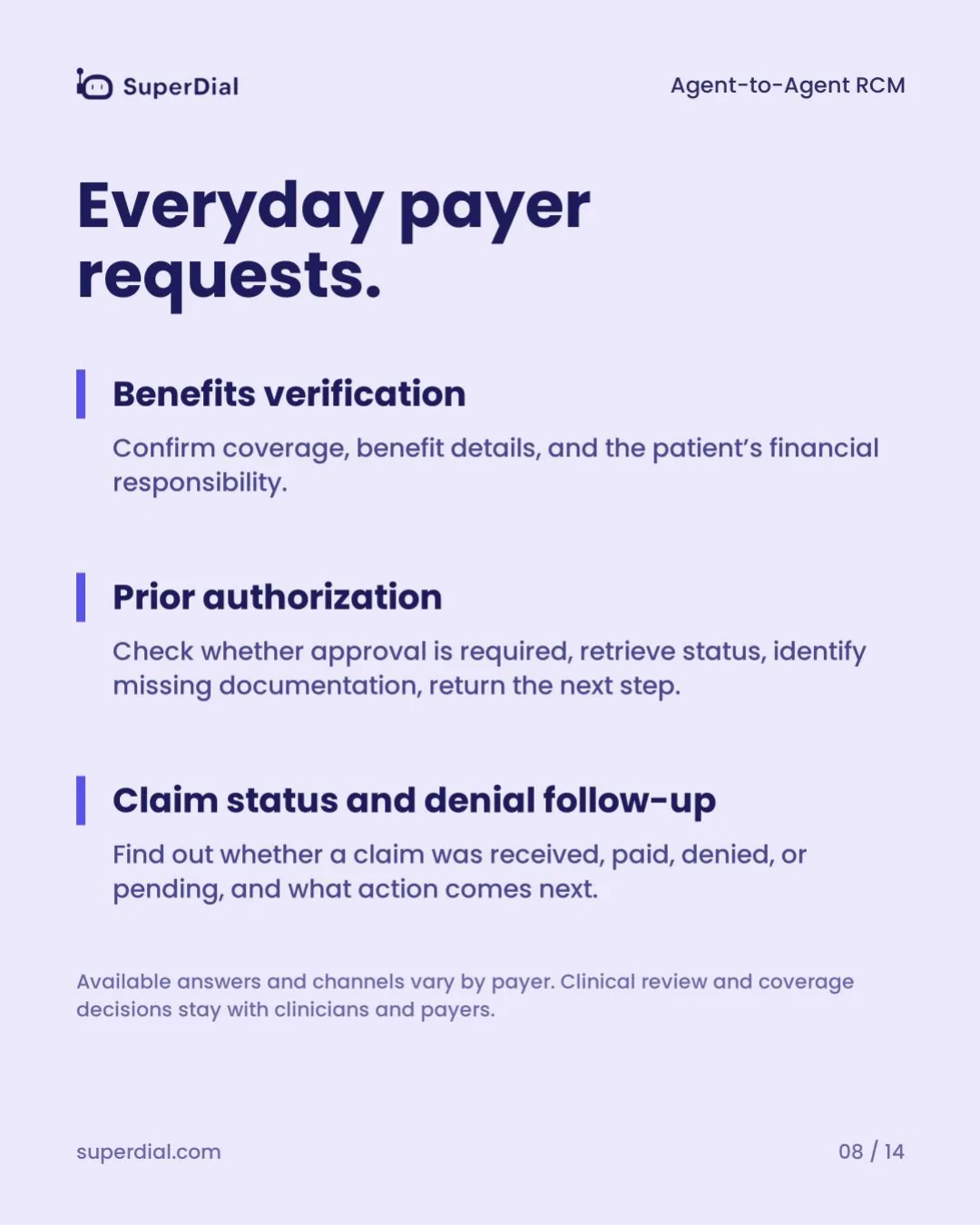
Take one of the most common requests in the revenue cycle: a claim that has gone quiet. A billing team needs to know whether it is in process, paid, pended, or denied, and if it was denied, why. Every payer can answer that question. What differs is how, how completely, and how long it takes to get there.
The request starts with a definition of done, not a channel. The customer sends the identifiers they already hold, such as payer, member, date of service, billed amount, and claim number when there is one. They also tell us what a usable answer includes for that account: the claim’s status, the paid or allowed amount, any denial or pend reason, payment details, and a reference number for the record. That list is what we are held to, whatever route gets us there.
Routing then depends on the payer more than the request. Payers differ in what they expose and how completely. A standard electronic claim-status response may carry the full answer, or only a status code without the reason behind it. Some payers publish the detail in a portal, some answer through voice automation, and some only through a representative. We use multiple channels, including electronic sources, payer portals, and phone calls, and the right one varies by payer and by the answer required.
The customer sees none of that variation. Whatever the route, the result comes back in a consistent, structured format their team can review and act on. If a request can’t be fully resolved, it comes back with context and next steps rather than as an open ticket.
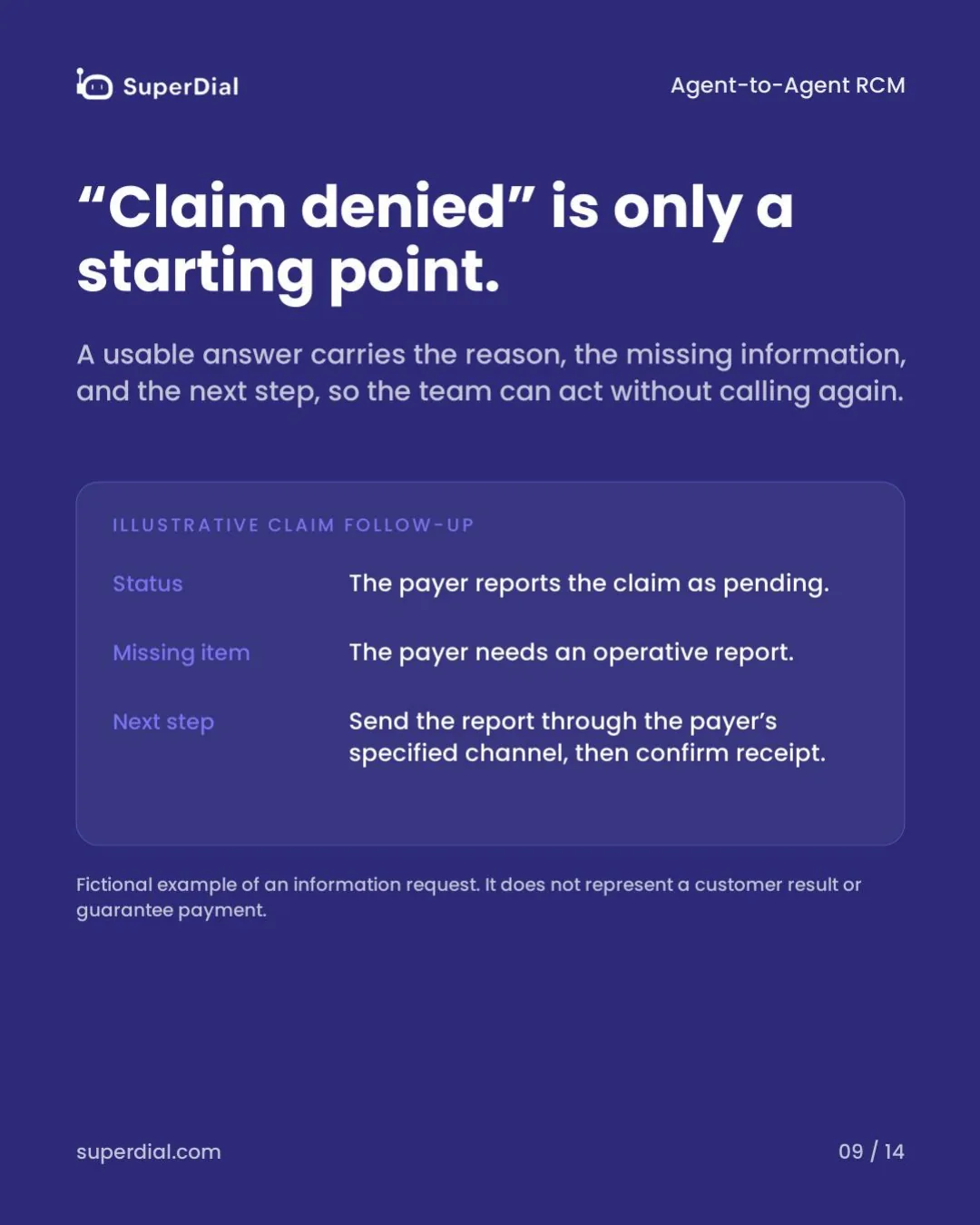
This is where the definition of done matters most. A claim-status check that returns “in process,” with no reason and no expected date, has not resolved anything. It has only scheduled the next call. We count a request as successful when the required information is retrieved, and that is the same standard we would ask a payer’s system to meet in an Agent-to-Agent exchange.
Making the connections
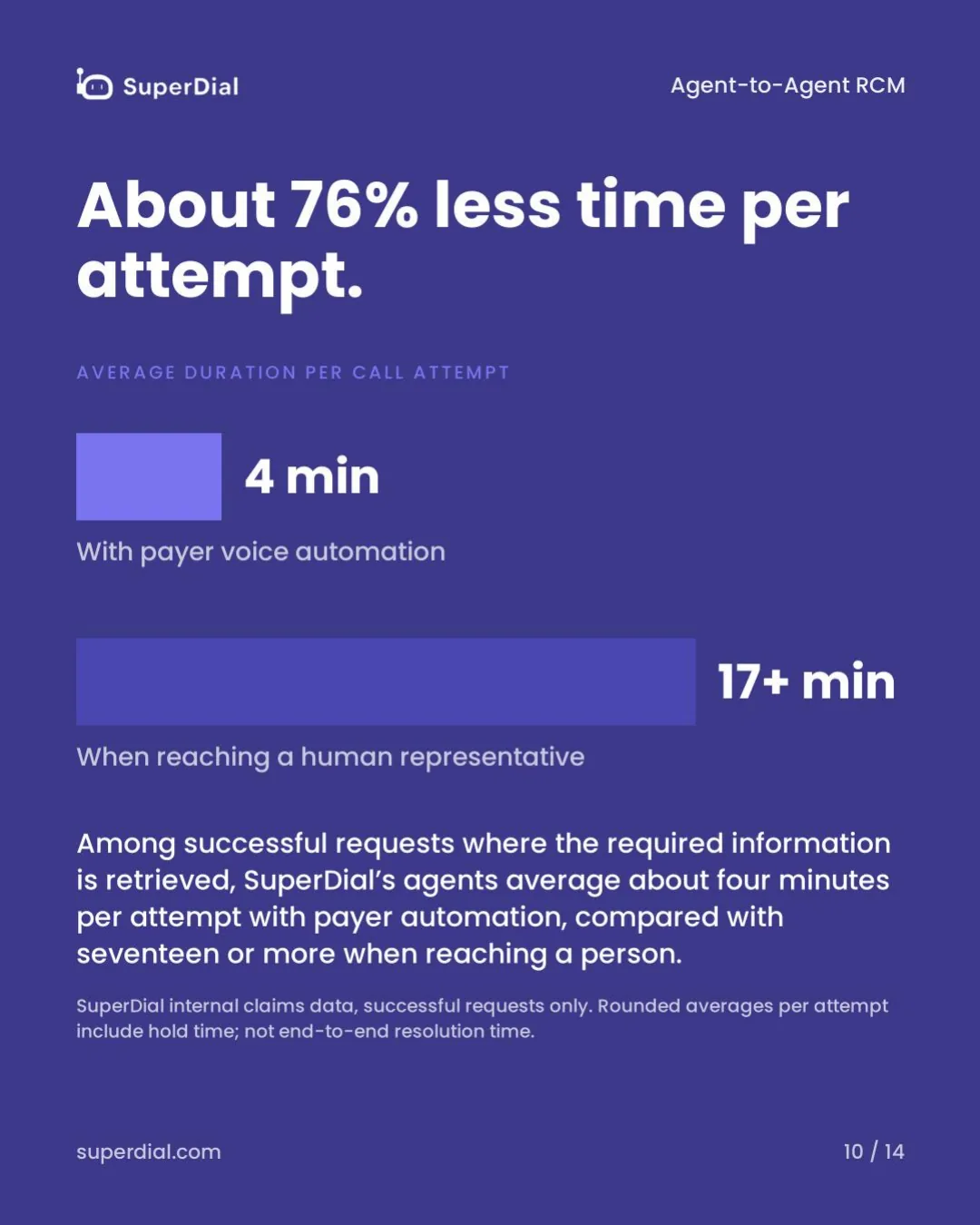
The first Agent-to-Agent links are already forming. Our agents interact with payer voice automation every day, and the difference is measurable: among successful requests where we retrieve the required information, call attempts with payer automation average about four minutes, while those reaching a human representative average seventeen minutes or more. Two payers have given us dedicated lines and product-manager support for those exchanges. When their automated systems cannot supply an answer, we can name the exact information that is missing and bring that gap to the team responsible for closing it. That gives both sides a concrete problem and a shared reason to solve it.
That gap of about thirteen minutes per call attempt is the first installment of the work we want to remove, not the last. The next step is direct exchange of the required data: a provider’s agent sends a clear request, receives an authoritative answer from the payer’s system, and returns it to the team that needs it. Every fact carried forward is one less thing for someone to ask again.
The test is simple: did the exchange resolve the request, or at least make the remaining action clear? If not, it was just another call, however automated.
In HFMA earlier this year, I described our long-term direction as an AI-native payer-provider network. Building it means earning access one payer at a time and making every exchange reliable. Today, coverage and answer quality vary by payer, so existing transactions, portals, voice, and human fallback all have a role. The route must serve the result.
Payers have every reason to participate. When their systems answer a question completely, fewer requests reach their staff. Providers spend less effort chasing. Both sides can continue to disagree about coverage or payment without paying people to re-establish the same facts.
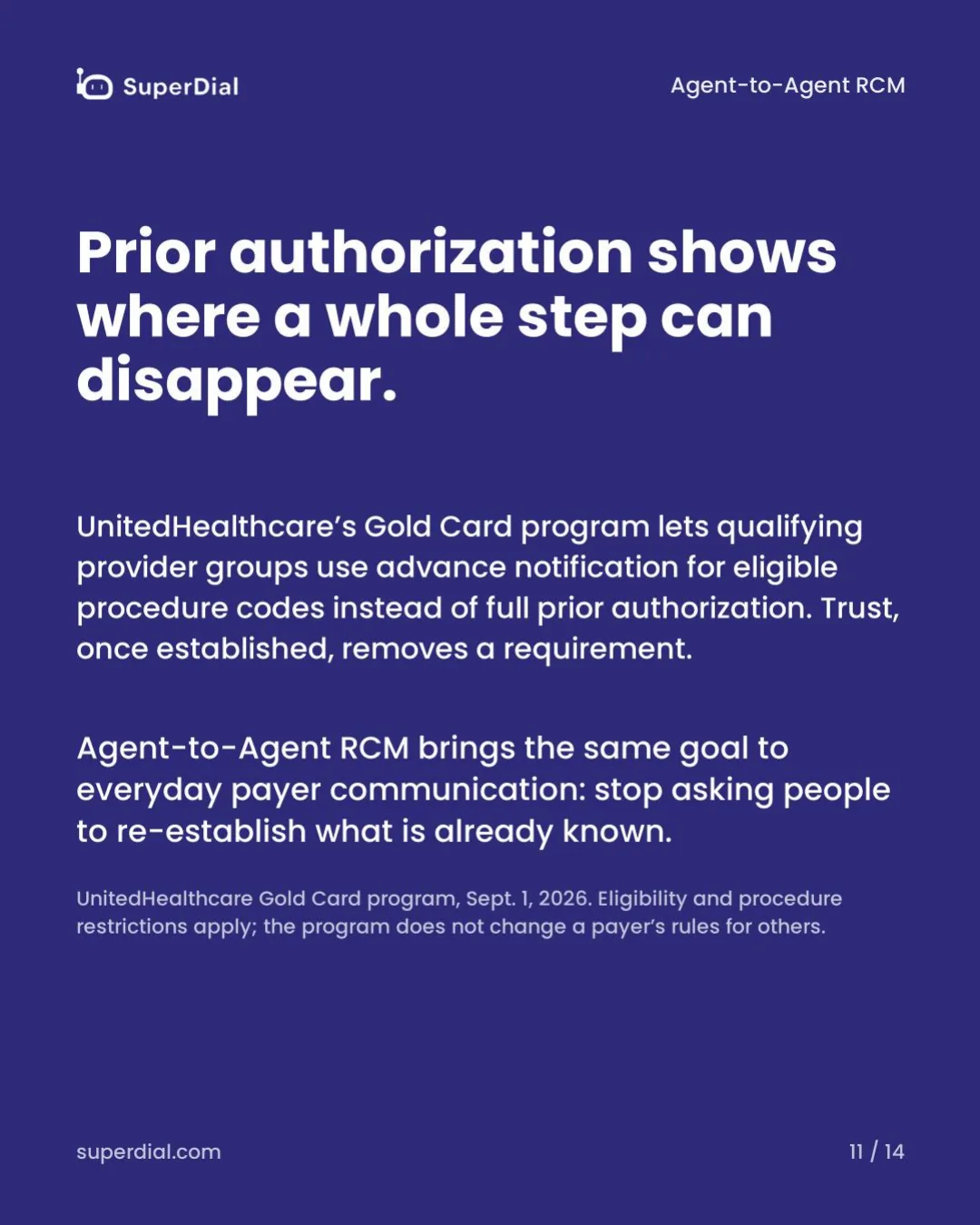
Gold carding shows what happens when trust changes the process. UnitedHealthcare lets qualifying provider groups use advance notification for eligible procedures instead of full prior authorization. The gain comes from removing a requirement under defined conditions. Agent-to-Agent RCM applies the same principle to routine payer communication.
My bet is that the next leaders in RCM will change how organizations work together, not merely how fast each completes its own tasks. A reliable answer should move through the workflow without being chased, reconstructed, and requested again. That is the standard we want SuperDial held to.
A common language for healthcare
Our ambition is to do for payer-provider communication what Swift did for financial messaging: give different institutions a trusted way to understand and act on the same request. Healthcare already has transaction standards. What it lacks is the intelligence and the connections to use what is available, obtain what is missing, and carry the answer forward. Agent-to-Agent RCM is how we bring that to the revenue cycle.
Across health systems, RCM companies, and payers, it would mean fewer workarounds for the same question. The value of a connection would be measured not by the calls it handles but by the repeat work it prevents.
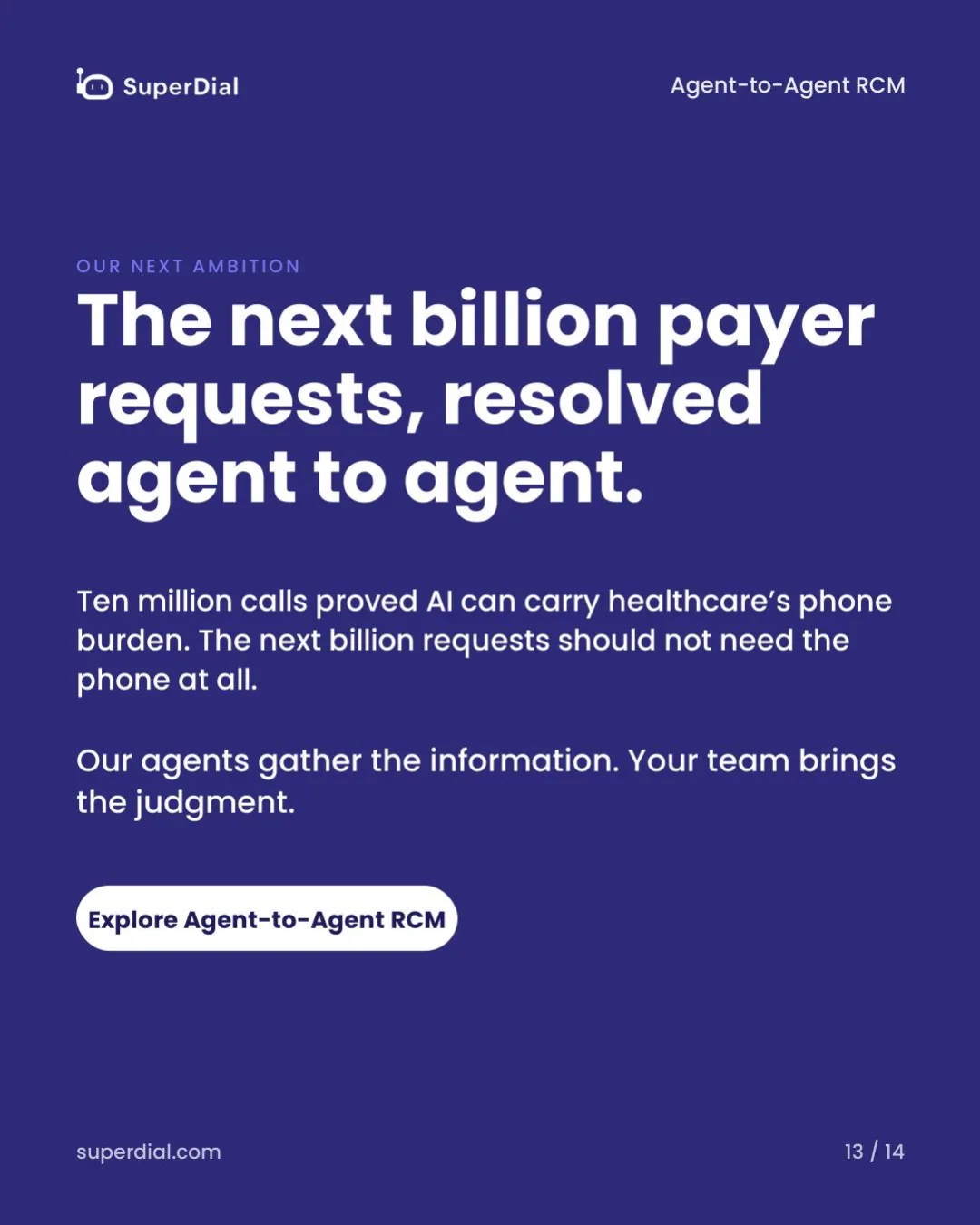
Ten million calls have shown us how much effort goes into getting healthcare organizations to understand one another. The next chapter of SuperDial is about making that effort unnecessary.
The bot wars are agents talking past each other. Agent-to-Agent RCM is agents finishing the conversation, while there is still time to keep the patient’s appointment.
Sources and notes
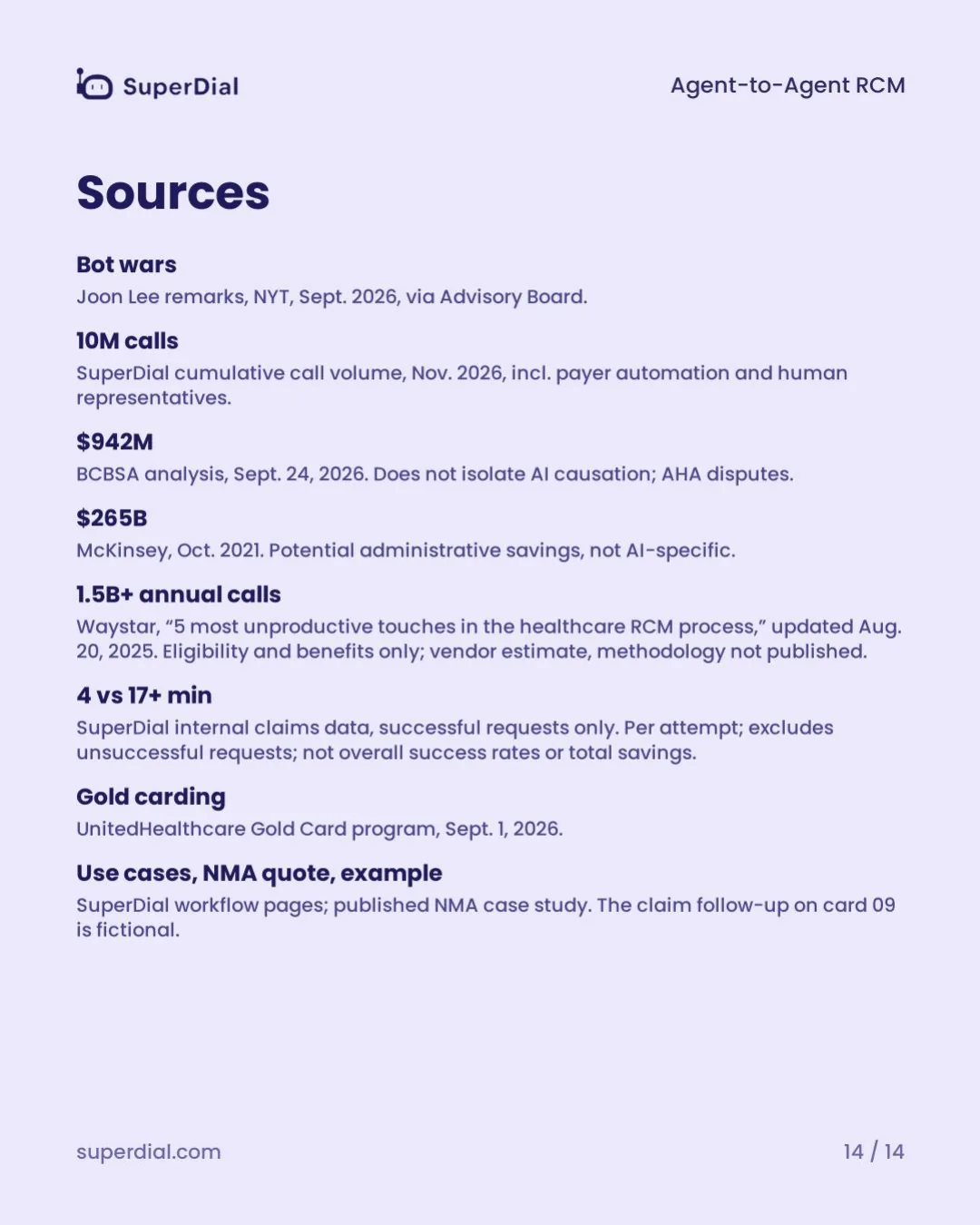
- Joon Lee remarks in September 2026 New York Times reporting, via Advisory Board.
- Illustrative calculation: applying McKinsey’s estimated 25% administrative share to CMS’s reported $4.9 trillion in U.S. healthcare spending in 2023 gives approximately $1.2 trillion. This assumes the share is unchanged; it is not a direct measurement of administrative costs or a 2026 estimate. CMS spending report.
- McKinsey, October 20, 2021. Historical estimate of potential annual savings across healthcare administration, not AI-specific savings. McKinsey analysis.
- CAQH, 2024 Index, based on 2023 data. Approximately $90 billion covers tracked medical and dental administrative transactions, not all RCM or all healthcare administration. Report.
- Waystar, “5 most unproductive touches in the healthcare RCM process,” updated August 20, 2025. Covers eligibility and benefits verification only; the article does not provide the underlying methodology. Article.
- Tseng et al., JAMA, February 20, 2018. One academic health system; estimated $99,581 annually per primary care physician. Ten times that rate is $995,810, an illustration rather than a national practice average. Study.
- KFF, 2026 Employer Health Benefits Survey, October 22, 2026. Worker contribution is distinct from the total family premium. The survey does not attribute the increase to administrative costs alone. Survey.
- Marsh, August 31, 2026. Projected 2027 health benefit cost growth and actuarial assessment of AI-enabled claims submission. The one-percentage-point estimate concerns billing intensity, not a measured cost of repeated bot exchanges. Analysis.
- Blue Cross Blue Shield Association, September 24, 2026. Insurer analysis of coding intensity and spending; does not isolate AI’s causal effect. BCBSA analysis.
- Lauren Sausser, KFF Health News, March 31, 2025. Patient account.
- SuperDial / Neuromonitoring Associates. Company-published customer account. NMA case study. Intraoperative neuromonitoring tracks neural signals and alerts the surgical team to changes; this describes NMA’s clinical service, not a measured clinical benefit from SuperDial. NMA patient information.
- SuperDial internal call data. Successful requests only (the required information was retrieved). Average call-attempt duration: approximately four minutes with payer voice automation versus seventeen minutes or more when reaching a live representative. Averages include hold time; rounded; per attempt, not a measure of end-to-end resolution.
- Sam Schwager, HFMA supplement, April 2026, PDF p. 11. Current voice interactions are distinct from the planned broader network. Published perspective.
- UnitedHealthcare, September 1, 2026. Eligibility and procedure restrictions apply. Gold Card program.
- Swift, What is Swift. Analogy concerns shared financial messaging; SuperDial’s comparable role is an ambition, not an achieved network scale or a claim to replace healthcare transaction standards. Swift.

Sam Schwager co-founded SuperBill in 2021 and serves as CEO. Having personally experienced the frustrations of health insurance claims, his mission is to demystify health insurance and medical bills for other confused patients. Sam has a Computer Science degree from Stanford and formerly worked as a consultant at McKinsey & Co in San Francisco.
Run a pilot on a real workflow.
Bring a representative batch, define the output schema, and validate ROI with your payer mix in 30 to 90 days.
