
CO-45 Denial Code: Contractual Adjustments and Underpayments
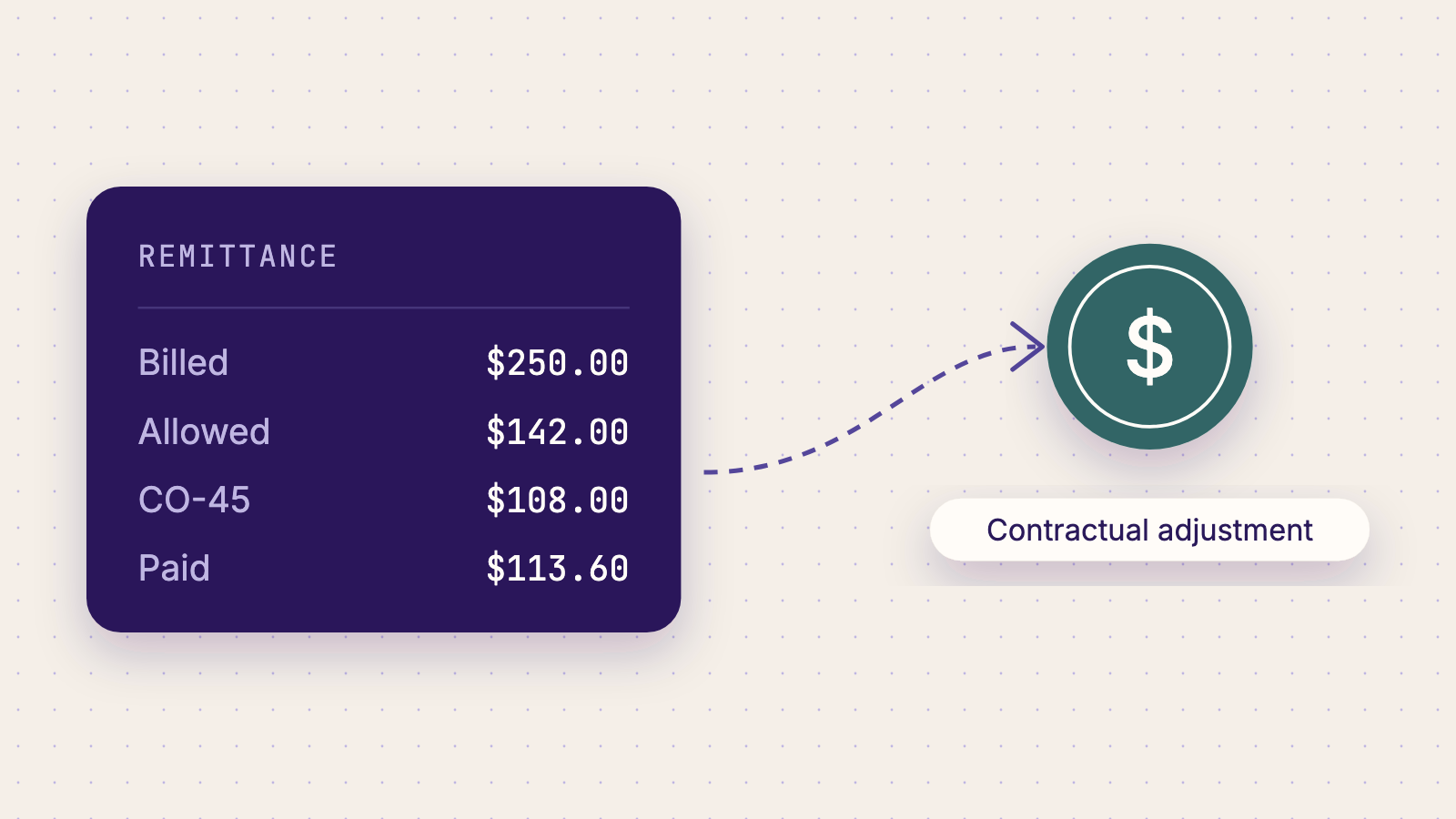
Here is one service line from a commercial remittance: billed $250.00, allowed $140.00, CO-45 $110.00, PR-2 $28.00, paid $112.00. Read left to right, the payer priced the service at $140, removed the $110 above that price as a contractual write-off, assigned $28 of coinsurance to the patient and paid the rest. The line balances to the penny, and nothing on it was denied.
That is what CO-45 usually means. X12 words CARC 45 as "Charge exceeds fee schedule/maximum allowable or contracted/legislated fee arrangement," and the CO group code keeps that amount with the provider. Most CO-45 lines need nothing more than posting.
The exception costs money. If your contract says that service should allow $155 and the payer allowed $140, the missing $15 is sitting inside the CO-45 amount, and an auto-post rule will write it off unseen. The only way to catch it is to check the allowed amount against what you expected.
TL;DR
- CO-45 is usually a pricing adjustment, not a denial. CARC 45 means the billed charge was higher than the fee schedule, maximum allowable or contracted rate, and CO assigns the difference to the provider.
- X12 allows only two group codes with it. The usage note says to use CARC 45 "only with Group Codes PR or CO depending upon liability," so an OA-45 is worth a question to the payer.
- You generally cannot bill the patient for CO-45. Medicare's remittance manual says CO adjustments are generally "considered a write off for the provider and are not billed to the patient," and commercial contracts set their own hold-harmless terms.
- The code can hide an underpayment. A CO-45 amount that is too large means the allowed amount is too small, for example from a wrong fee schedule year, locality, place-of-service rate or modifier reduction.
- Check allowed against expected, then dispute. Compare each line's allowed amount to your contract rate, and send variances through the payer's reconsideration or appeal process.
What CARC 45 says, word for word
The full X12 entry reads: "Charge exceeds fee schedule/maximum allowable or contracted/legislated fee arrangement. Usage: This adjustment amount cannot equal the total service or claim charge amount; and must not duplicate provider adjustment amounts (payments and contractual reductions) that have resulted from prior payer(s) adjudication. (Use only with Group Codes PR or CO depending upon liability)." The code list shows it as active since 01/01/1995, last modified 07/01/2017.
Because the adjustment "cannot equal the total service or claim charge amount," a line where CARC 45 wipes out the entire charge is not a normal contractual adjustment, and you should find out what the payer meant. The second clause matters on secondary claims, where the secondary payer should not repeat the primary's contractual reduction.
Why CO-45 is usually a write-off
Every 835 has to balance. CMS's Medicare Claims Processing Manual, Chapter 22, §30, says "the total paid amount is equal to the total submitted charges plus or minus payment adjustments," and §60 explains that the difference "between the submitted charge and the actual payment must be accounted for." CARC 45 is how a payer accounts for the part of your charge it never intended to pay, because your chargemaster price sits above its rate.
The group code says whose problem that amount is. Chapter 22, §60.1, defines CO as used "when a contractual agreement between the payer and payee, or a regulatory requirement, resulted in an adjustment," adding that "Generally, these adjustments are considered a write off for the provider and are not billed to the patient." For Medicare, the participating physician or supplier agreement reproduced in Chapter 1, §30.3.12.2, states that "Under an assignment, the approved charge, determined by the MAC/carrier, shall be the full charge for the service covered under Part B."
So CO-45 is normally posted, not worked as a denial. Our guide to reading a remittance advice covers where each amount sits on the line; the posting question is whether the allowed amount matches what you agreed to.
CO-45, PR-45 and OA-45
X12 defines four group codes: CO (Contractual Obligation), OA (Other Adjustment), PI (Payor Initiated Reduction) and PR (Patient Responsibility). Only CO and PR are valid with CARC 45.
A CO-45 keeps the excess with the provider, so on a Medicare remittance the §60.1 language applies: generally a write-off, not billed to the patient. Commercial participation agreements set their own patient billing terms, so read yours before treating any CO amount as collectible.
A PR-45 tells you the payer considers the excess the patient's responsibility. Chapter 22 defines PR as "an amount that may be billed to the patient or insured." On Medicare claims, a non-participating provider is capped by the limiting charge, which Chapter 1, §30.3.12.3, calls "the maximum that the non-participating provider may charge the beneficiary." On commercial claims, the No Surprises Act rules at 45 CFR 149.410 and 149.420 generally bar nonparticipating providers from billing patients more than the cost-sharing requirement for emergency services and for certain non-emergency services at participating facilities, with a notice-and-consent exception in some non-emergency cases. Before you move a PR-45 balance to a statement, confirm your network status, the plan type and whether those protections apply.
An OA-45 is outside the X12 usage note. It may be a payer mapping choice or an error, so ask the payer which party it holds liable before posting it either way.
How CO-45 shows up on an 835 and an EOB
On an ERA, CO-45 appears in the adjustment detail for a service line or claim. Chapter 22, §60, says group codes, CARCs and remark codes "are used to explain adjustments at the claim or service line level." On a paper EOB or portal the labels vary by payer, so match on the group code and CARC rather than the column heading.
The CARC 45 usage note does not require a remark code, so a CO-45 line may arrive with none. When a remark code is present, it may point to how the rate was set. Remark codes you may see include:
- N381: "Alert: Consult our contractual agreement for restrictions/billing/payment information related to these charges."
- N442: "Payment based on an alternate fee schedule." This one deserves a second look, because it says the payer used an alternate schedule.
- N82: "Provider must accept insurance payment as payment in full when a third party payer contract specifies full reimbursement."
The payer chooses which, if any, to send. A related code, N448, reads "This drug/service/supply is not included in the fee schedule or contracted/legislated fee arrangement," which is a pricing gap to raise with the payer, not a routine write-off.
When CO-45 hides an underpayment
A CO-45 amount is simply billed minus allowed, less any other adjustments on the line. If the allowed amount is wrong, the CO-45 amount grows by the same number of dollars and still looks routine. These are the usual places the allowed amount goes wrong.
The wrong fee schedule year or version. Chapter 12, §20.6, notes that "CMS provides updates to the MPFSDB and other fee schedules annually or as otherwise necessary," and commercial contracts may tie rates to a percentage of a specific Medicare year or to a payer schedule with its own effective dates. A payer that loads a new schedule late, or applies an old year to new dates of service, will price every affected line off. For Medicare-based contracts, CMS's Physician Fee Schedule Look-Up Tool is a starting point for the benchmark rate.
The wrong locality or setting. CMS says it adjusts PFS pricing amounts "to reflect the variation in practice costs from area to area," and Chapter 12, §20.4.2, of the Medicare Claims Processing Manual explains that "some procedures have separate rates for physicians' services when provided in facility and nonfacility settings," chosen by the place of service code. A wrong POS, or a facility rate applied to an office visit, lowers the allowed amount without any denial.
Modifier and multiple-procedure reductions. Under Chapter 12, §40.6, the standard multiple surgery rules base Medicare payment on the lower of the billed amount or "100 percent of the fee schedule amount" for the highest valued procedure and "50 percent of the fee schedule amount for the second through the fifth highest valued procedures." X12 has a separate code for those reductions, CARC 59, which reads "Processed based on multiple or concurrent procedure rules." When a reduction lands in a CO-45 amount instead, or the payer ranked the procedures differently than you expected, check the math line by line.
A recoded procedure or wrong product. If the remittance shows the payer adjudicated a different procedure code from the one you billed, compare the two. A lower-valued code means a lower allowed amount. On commercial plans, a claim priced under the wrong network, product or contract tier does the same.
How to check CO-45 against your contract
Underpayment review only works if your system knows what each line should have allowed. Load contract rates by payer, product, code, modifier and effective date, compute an expected allowed amount per line and compare it to the payer's. Flag variances above a threshold your team sets.
For each flagged line, first confirm the claim itself was right (code, modifier, units, POS and rendering provider). Then confirm the payer used the right schedule for the date of service, the right locality and the right multiple-procedure ranking. If the claim was wrong, correct it; if the payer's pricing was wrong, dispute it.
Look for patterns first. A variance on one CPT code across a payer's claims suggests a schedule load problem, while a variance on one provider or location points to your own setup, such as a POS default or modifier habit.
| What you see | Likely meaning | What to check | Action |
|---|---|---|---|
| CO-45 and allowed amount matches the contract rate | Normal contractual adjustment | Nothing beyond routine posting | Post and write off |
| CO-45 and allowed amount below the contract rate | Possible underpayment | Fee schedule year, locality, product and contract tier | Dispute the underpayment with the payer |
| CO-45 with N442 | Priced from an alternate fee schedule | Which schedule the contract says applies | Dispute if the contract names a different schedule |
| CO-45 with a lower rate on a POS 11 office service | Facility rate may have been applied | POS on the claim and the payer's facility/nonfacility rules | Correct and resubmit if POS was wrong; otherwise dispute |
| CO-45 larger than expected on a multi-procedure claim | Reduction folded into CO-45 or ranked differently | Modifier 51 use, procedure ranking, presence of CARC 59 | Correct and resubmit or dispute the ranking |
| CO-45 equal to the full billed charge | Outside the X12 usage note | Other CARCs and RARCs on the line | Ask the payer what the adjustment means |
| PR-45 | Payer assigns the excess to the patient | Network status, plan type, No Surprises Act protections | Bill the patient only if contract and law allow |
| OA-45 | Group code not listed in the CARC 45 usage note | Payer's intended liability | Ask the payer before posting |
Disputing a CO-45 underpayment
For commercial and Medicare Advantage plans, the dispute route and the deadline come from the provider manual and your participation agreement. Some plans offer a payment dispute step before a formal appeal. Send the contract rate, its effective date, your expected-allowed calculation and the claim number, so the reviewer can see exactly where the pricing differs.
For Original Medicare, a payment amount you disagree with generally goes through the appeals process unless correcting the claim fixes it. 42 CFR 405.942 requires a redetermination request "within 120 calendar days from the date a party receives the notice of the initial determination." Our explainer on corrected claims, reconsiderations and appeals covers which tool fits when the error is yours and when it is the payer's.
CO-45 is easy to confuse with nearby codes. A CO-97 means the payer considers the service included in another service, not that its price was reduced. A CO-96 means the service is not covered at all, which is a different conversation from a rate dispute.
Where automation fits in CO-45 follow-up
Underpayment work often starts with getting the payer's own account of how a line was priced. SuperDial's claim status workflow lists underpayment checks among its use cases, retrieving payment details and supporting information for review, including the allowed amount, paid amount and patient responsibility. Exceptions route back to your team, and the decision on whether a variance is worth disputing stays with your billers and contract analysts.
FAQ
Where can I look up Medicare's allowed amount for a CPT code?
Use CMS's Physician Fee Schedule Look-Up Tool. CMS says you can search one code, a range or a list "for national payment amounts through a specific MAC or a specific MAC locality," and that "The PFS gives the limiting charge for nonparticipating providers and suppliers who treat Medicare patients." Use the year that matches the date of service.
Can I bill the patient for a CO-45 adjustment?
Generally no. For Medicare, Chapter 22 of the claims processing manual says CO adjustments are generally a write-off for the provider and not billed to the patient, while PR marks an amount that may be billed. For commercial plans, your participation agreement controls, so check its hold-harmless and balance billing terms before sending anything to the patient.
Why does CO-45 appear on a secondary payer's remittance?
A secondary payer may report its own contractual adjustment, but X12 says CARC 45 "must not duplicate provider adjustment amounts (payments and contractual reductions) that have resulted from prior payer(s) adjudication." If the secondary's CO-45 simply repeats the primary's write-off, ask the secondary payer how it calculated its allowance.
How long do I have to dispute a CO-45 underpayment?
For Original Medicare, a redetermination request is due within 120 calendar days of receiving the initial determination, under 42 CFR 405.942. Commercial and Medicare Advantage dispute windows are set by the plan and your contract, so check the provider manual for each payer.
Sources
- X12, Claim Adjustment Reason Codes: https://x12.org/codes/claim-adjustment-reason-codes
- X12, Remittance Advice Remark Codes: https://x12.org/codes/remittance-advice-remark-codes
- X12, Claim Adjustment Group Codes: https://x12.org/codes/claim-adjustment-group-codes
- CMS, Medicare Claims Processing Manual, Chapter 22, Remittance Advice (Rev. 11427, 05-20-22), §§30, 60, 60.1: https://www.cms.gov/regulations-and-guidance/guidance/manuals/downloads/clm104c22.pdf
- CMS, Medicare Claims Processing Manual, Chapter 1, General Billing Requirements (Rev. 13725, issued 04-10-26), §§30.3.12.2, 30.3.12.3: https://www.cms.gov/regulations-and-guidance/guidance/manuals/downloads/clm104c01.pdf
- CMS, Medicare Claims Processing Manual, Chapter 12, Physicians/Nonphysician Practitioners (Rev. 13753, issued 05-07-26), §§20.4.2, 20.6, 40.6: https://www.cms.gov/regulations-and-guidance/guidance/manuals/downloads/clm104c12.pdf
- CMS, Physician Fee Schedule Look-Up Tool overview (last modified 02/09/2026): https://www.cms.gov/medicare/physician-fee-schedule/search/overview
- eCFR, 45 CFR 149.410, Balance billing in cases of emergency services: https://www.ecfr.gov/current/title-45/section-149.410
- eCFR, 45 CFR 149.420, Balance billing in cases of non-emergency services performed by nonparticipating providers at certain participating health care facilities: https://www.ecfr.gov/current/title-45/section-149.420
- eCFR, 42 CFR 405.942, Time frame for filing a request for a redetermination: https://www.ecfr.gov/current/title-42/section-405.942
- SuperDial, Claim Status workflow: https://www.superdial.com/workflows/claim-status
Run a pilot on a real workflow.
Bring a representative batch, define the output schema, and validate ROI with your payer mix in 30 to 90 days.
