
Dental Insurance Verification Services: What to Verify and How
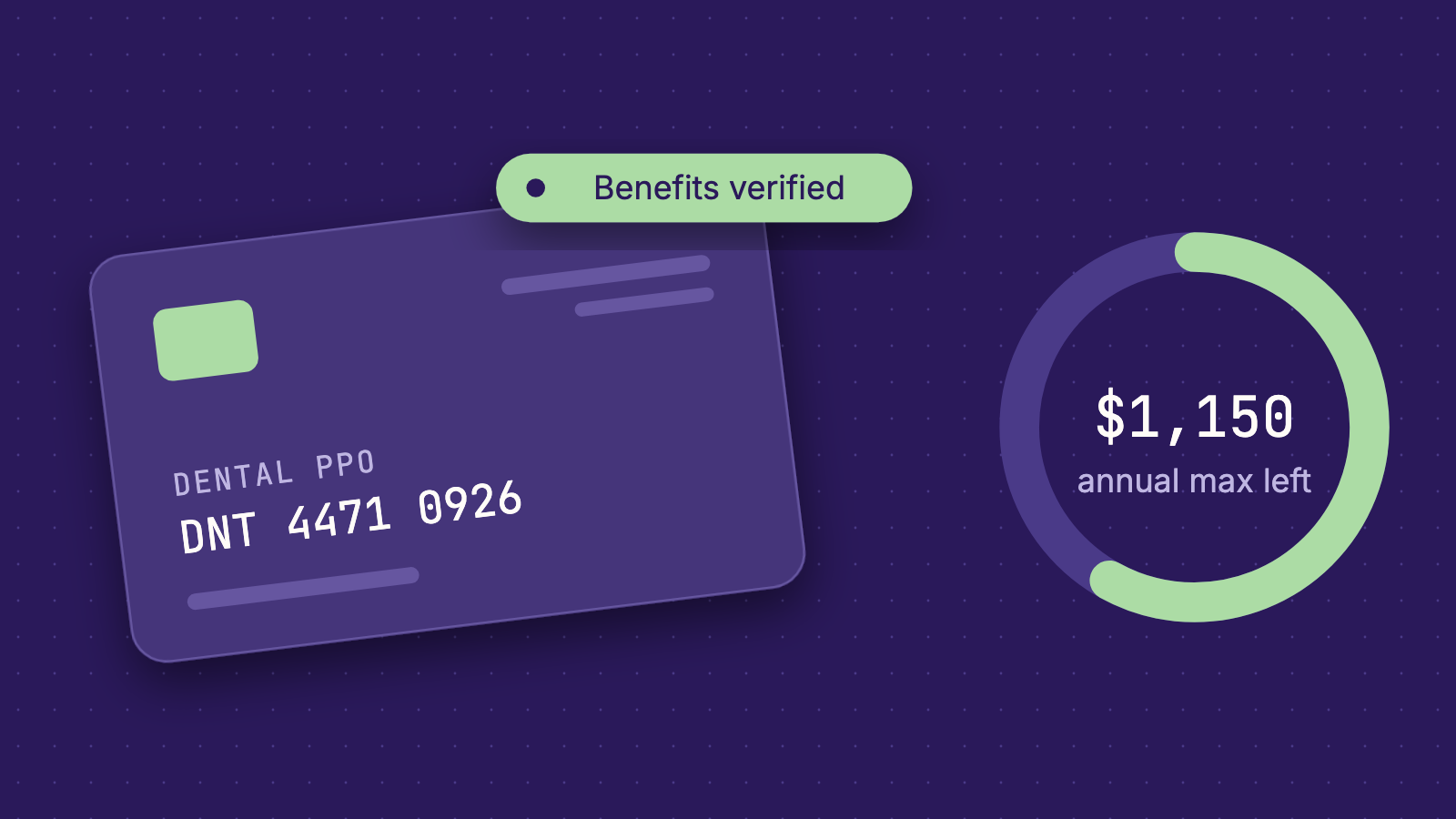
The prep is done, the temporary crown is going on, and the treatment coordinator pulls up the breakdown on file. It says major services at 50 percent, deductible met, plenty of annual maximum left. It says nothing about whether the plan pays a posterior crown at the rate of a cheaper alternative, and nothing about whether the frequency limit on replacing the old crown has run out. Both answers will show up later, on the explanation of benefits, after the patient has left.
Dental insurance verification services exist to close that gap. They confirm that coverage is active and then build a procedure-level breakdown before the visit: remaining maximum, deductible, coverage by category, frequency and age limits, waiting periods, missing tooth clauses, downgrade rules, service history and whether a predetermination makes sense. The work can sit with your own front desk or insurance coordinators, an outsourced verification team, automated eligibility checks, or AI voice agents. The hard part is rarely eligibility; it is the limitations.
TL;DR
- Eligibility is the easy part. An X12 271 response can confirm active coverage, plan dates and cost sharing, but dental teams still need procedure-level limitations that many responses do not fully return.
- A complete breakdown is field by field. Remaining maximum, deductible, coverage percentages by category, frequency and age limits, waiting periods, missing tooth clauses, alternate benefit rules, history and ortho lifetime maximum each change what the patient owes.
- Breakdowns go stale. Coverage can end, maximums get used and plans change at open enrollment, so verify close to the appointment and again when anything about the plan changes.
- Service models differ in where answers come from. In-house staff, outsourced teams, automated eligibility checks and AI voice agents draw on different mixes of electronic responses, portals and payer phone lines.
- SuperDial uses AI voice agents for dental benefits verification. It returns dental benefit fields such as frequency limits, waiting periods and downgrade rules as structured results, starting from a CSV batch and moving to APIs, webhooks or PMS write-back.
Why dental verification is harder than an eligibility check
Most dental verification starts with an electronic inquiry. X12 describes the 271 response as carrying "benefit status, explanation of benefits, coverages, dependent coverage level, effective dates, amounts for co-insurance, co-pays, deductibles, exclusions and limitations." X12's service type codes include dental categories such as 25 Restorative, 36 Dental Crowns and 38 Orthodontics, but how much detail a payer populates varies. Our post on why eligibility checks still fail covers the general problem; dental has its own version of it.
In the 2024 CAQH Index, which reflects calendar year 2023 data, 82 percent of dental plan eligibility and benefit verifications were fully electronic, 15 percent ran through portals or IVR, and 3 percent were fully manual. Eligibility checks were the most common dental transaction, at 24 percent of total dental volume and 1.2 billion verifications, and dental spending on them rose 15 percent to $2.1 billion, driven by higher volume and the cost of checking benefits through portals.
High electronic adoption has not translated into trust. CAQH reports that without dental-specific information, dental providers "often do not receive robust enough information leading them not to trust the accuracy of automated response." A dental practice quoted in the Index: "When it comes to eligibility and benefits, I don't have an automated tool that I can trust, so I don't use it."
The standards are moving. CAQH CORE's Eligibility and Benefits Data Content Rule version EB.2.1, dated June 2025 and developed with the ADA and the National Dental EDI Council, says that when a 270 includes a procedure code in a CORE-required dental category, the information source (the health plan or its contracted vendor) "must return the dental benefit limitations," including frequency limitations, waiting periods, age limitations and maximum and remaining benefits. CORE describes the rule as approved through its voting process and "now available for adoption." It is not federally mandated: the eligibility operating rules HHS adopted at 45 CFR 162.1203 are the 2011 CORE Phase I and II versions. Until your payers return those fields consistently, someone still has to get them another way.
What a complete dental breakdown includes
A useful breakdown answers one question for each procedure on the treatment plan: what will this plan pay, and what will the patient owe? Definitions come from the administrative terms in the ADA's Glossary of Dental Terms and its Introduction to Dental Benefits guide unless noted.
| Field | Why it matters | Common sources (vary by payer) |
|---|---|---|
| Eligibility, plan type and effective dates | Confirms coverage on the date of service and the plan design (PPO, DHMO, indemnity or other) | 271 response or payer portal |
| Annual maximum and amount remaining | The yearly reimbursement cap, individual or family; what remains decides how much of a large case is covered | 271 when returned; portal or phone otherwise |
| Deductible and amount met | Paid by the patient before the plan pays; annual or one-time, and in the ADA's sample PPO it skips preventive and ortho | 271 response |
| Coverage percentages by category | Coinsurance for preventive, basic and major services, and for orthodontics | 271 by service type when populated; portal or phone |
| Frequency limits | How often the plan pays for a procedure, such as radiographs or crown replacement | Plan limitations; portal or phone when the 271 does not carry them |
| Service history | Prior procedure dates, which show whether a frequency limit is used up | Payer records via portal or phone, checked against your own chart |
| Age limits | Procedures covered only above or below a stated age | Plan limitations; portal or phone |
| Waiting periods | Time after enrollment before a benefit becomes available | Plan limitations; portal or phone |
| Missing tooth clause | Exclusion for replacing teeth missing before enrollment | Plan contract; portal or phone |
| Alternate benefit (downgrade) rules | Whether the plan pays a proposed procedure at the rate of a less expensive alternative | Plan contract; portal or phone |
| Predetermination guidance | Whether the plan requires or recommends a predetermination for the planned treatment | Payer policy; portal or phone |
| Orthodontic lifetime maximum and status | Ortho may carry a separate lifetime maximum, as in the ADA's sample PPO, and prior treatment draws it down | Portal or phone |
| Coordination of benefits | Whether a second plan exists and which plan pays first | Patient-reported coverage, 271, portal or phone |
Alternate benefits and downgrades
The ADA defines an alternate benefit as "a provision in a dental plan contract that allows the third-party payer to determine the benefit based on an alternative procedure that is generally less expensive than the one provided or proposed." Its Introduction to Dental Benefits guide gives an example: "the dentist may recommend a fixed bridge, but the plan may allow reimbursement only for a removable partial denture."
This is the provision behind the downgrade rules on a breakdown, and the ADA draws a line worth knowing. A payer may acknowledge the code submitted and pay an alternate benefit, but "what they cannot do is substitute a different code without acknowledging the original code submitted." The ADA treats changing the code itself, which it calls downcoding, as a separate practice. The ADA's FAQ addresses a posterior composite reimbursed as an amalgam, which it says is usually based on the benefits purchased in a given plan.
Frequency limits and history
A frequency limit is only useful with history attached. A limit such as one crown per tooth in a set number of years means little without the date of the last one. The ADA claim form asks the same question at billing time: Item 43 asks whether a crown or prosthesis replaces an existing one, and Item 44 asks for the date of prior placement.
Missing tooth clauses and waiting periods
The ADA describes restrictions on conditions present before enrollment, "such as missing teeth," as preexisting condition exclusions, and this is the missing tooth clause on a breakdown. It matters when the treatment plan replaces a tooth with a bridge, implant or partial. A waiting period, in the ADA's words, is "the period between employment or enrollment in a dental program and the date when a covered person becomes eligible for a given benefit," so a new enrollee may have active coverage and still have no benefit for major work yet.
Orthodontic maximums
The ADA's sample PPO design shows "50% coverage for orthodontics subject to separate lifetime maximum of $1,000" alongside a separate annual maximum for everything else. Because the ortho maximum is lifetime, a patient who started treatment with another provider may have little of it left.
When to verify, and why a breakdown goes stale
The ADA's predetermination guidance shows how quickly a breakdown can drift: a predetermination may not be honored if the patient was eligible when it was processed but no longer employed by treatment, or had benefit dollars then but "had exceeded his/her annual maximum benefit" by the time treatment was provided. The ADA also notes that predetermination "is not a guarantee of benefits" and "does not consider any coordination of benefits."
Three things make a breakdown stale. Coverage changes, for example at an employer's annual open enrollment. Benefit years reset, and the ADA notes the contract term "may or may not be the same as a calendar year." And maximums get consumed by other treatment, so a remaining maximum checked weeks ago may not hold.
For many groups that means verifying shortly before the appointment rather than at scheduling, and re-verifying when the patient reports a new plan, when a new benefit year starts, and before major treatment if other work has happened since the last check. A recall hygiene visit needs eligibility, frequency and history for exams, cleanings and radiographs, while a crown, implant or ortho case needs the full set of limitations and possibly a predetermination.
Service models for dental insurance verification
Dental insurance verification services come in four broad models. They differ mainly in where answers come from and what form they arrive in, and groups can pair an electronic check with deeper work for complex cases.
| Model | How it gets answers | What it typically returns |
|---|---|---|
| In-house front desk or insurance coordinators | PMS eligibility tools, payer portals and payer phone calls | A breakdown form or notes entered in the PMS |
| Outsourced verification teams | Work from your appointment schedule using portals and payer calls | Completed breakdown forms, notes or PMS entries |
| Automated eligibility checks | X12 270/271 through a clearinghouse or PMS integration | Eligibility, plan dates and whatever benefit detail the payer populates |
| AI voice agents | Software agents that call payer phone lines and, in some setups, use portals and electronic data | Structured fields with supporting records such as transcripts or recordings |
The useful exercise is deciding, field by field, which source can supply each answer for each payer. Centralized teams working across many locations, as described in our post on scaling dental insurance operations across 20+ locations, feel the gap most when the electronic response stops short.
How SuperDial handles dental benefits verification
SuperDial's dental and DSO benefits verification covers "eligibility, remaining annual maximum, deductible, coverage percentages by category, frequency limits, waiting periods, missing tooth clauses, and downgrade rules before the patient is in the chair." The benefits verification page also lists benefit limitations and accumulators among the data returned. SuperDial's AI agents make the payer calls, wait on hold, and write the results back to your practice management system.
On the benefits verification side, SuperDial runs after your clearinghouse eligibility check and uses the payer portal or the phone for the fields the 271 left out. Results come back as structured JSON through the API and webhooks, written back to your EHR or PMS where an integration is in place, or as CSV, and can include summary notes, call recordings, transcripts and source documents. When a payer cannot give a complete answer, the request comes back to your team as an exception with a summary of what happened and the recommended next action.
SuperDial suggests starting with a batch upload from your eligibility work queue, sent as a CSV, and moving to APIs, webhooks or PMS write-back when the workflow is ready. SuperDial states that it is HIPAA compliant, SOC 2 Type II attested and HITRUST e1 certified, and a BAA is standard before any PHI is exchanged.
Interested in evaluating SuperDial?
The simplest test is the one SuperDial lists first among its dental pilot workflows: benefits verification for the next three days of appointments. Bring that batch and define the fields you need back. Book a demo to set one up.
FAQ
How far ahead can a dental eligibility check be run?
Under the CORE Eligibility and Benefits rule, a 270 inquiry "may request a benefit coverage date 12 months in the past or up to the end of the current month." A payer that does not support dates outside that range returns a rejection, so a check for an appointment two months out may come back rejected, which is one more reason to verify close to the visit.
Is a predetermination the same as verifying benefits?
No. The ADA defines predetermination as a process where the dentist submits a treatment plan and the payer reports on one or more of eligibility, covered services, amounts payable, deductibles and plan maximums. It is specific to a planned case, and the ADA notes it is not a guarantee of benefits and does not account for coordination of benefits. Verification still has to confirm that nothing changed before treatment.
How does verification work when a patient has two dental plans?
The ADA describes coordination of benefits as integrating benefits payable for the same patient under more than one plan, with benefits from all sources that should not exceed total charges. When both plans have COB provisions, the plan covering the patient as the employee or main policyholder is primary, and the plan covering them as a dependent is secondary. Verify both plans, because each has its own maximums and limitations.
Why does the CDT code matter for verification?
CDT, maintained by the ADA, is the HIPAA-adopted code set for dental services under 45 CFR 162.1002. The CORE rule requires health plans to support an inquiry for an explicit procedure code, including CDT, that maps to a CORE-required category of service, so verifying by the codes on the treatment plan is how plans that support the rule can return procedure-level limitations.
Sources
- X12, Transaction Sets (270 Eligibility, Coverage or Benefit Inquiry; 271 Eligibility, Coverage or Benefit Information): https://x12.org/products/transaction-sets
- X12, Service Type Codes: https://x12.org/codes/service-type-codes
- CAQH, 2024 CAQH Index Report: https://www.caqh.org/hubfs/Index/2024%20Index%20Report/CAQH_IndexReport_2024_FINAL.pdf
- CAQH CORE, CORE Eligibility & Benefits (270/271) Data Content Rule Version EB.2.1 (June 2025): https://www.caqh.org/hubfs/CORE%20Eligibility%20&%20Benefits%20%28270_271%29%20Data%20Content%20Rule%20vEB.2.1.pdf
- CAQH CORE, Updated Rule Webinar: CORE Eligibility & Benefits (270/271) Data Content Rule (July 1, 2025): https://www.caqh.org/hubfs/CORE/CORE%20Eligibility%20&%20Benefits%20Rule%20Update%20Webinar%20Deck%2007.01.2025.pdf
- American Dental Association, Glossary of Dental Terms: https://www.ada.org/publications/cdt/glossary-dental-terms
- American Dental Association, Introduction to Dental Benefits: https://www.ada.org/-/media/project/ada-organization/ada/ada-org/files/resources/practice/dental-insurance/intro-to-dental-benefits.pdf
- American Dental Association, Dental Plan Benefits & Limitations: https://www.ada.org/resources/practice/dental-insurance/typical-dental-plan-benefits-and-limitations
- American Dental Association, Dental Insurance Frequently Asked Questions: https://www.ada.org/resources/practice/dental-insurance/dental-insurance-resources/dental-insurance-frequently-asked-questions
- American Dental Association, ADA Dental Claim Form Completion Instructions (Version 2024): https://www.ada.org/-/media/project/ada-organization/ada/ada-org/files/publications/cdt/2024_completioninstructions_adaclaimform_2024.pdf
- eCFR, 45 CFR 162.1002, Medical data code sets: https://www.ecfr.gov/current/title-45/subtitle-A/subchapter-C/part-162/subpart-J/section-162.1002
- eCFR, 45 CFR 162.1203, Operating rules for eligibility for a health plan transaction: https://www.ecfr.gov/current/title-45/subtitle-A/subchapter-C/part-162/subpart-L/section-162.1203
- SuperDial, Payer Call Automation for Dental Groups and DSOs: https://www.superdial.com/dental-dsos
- SuperDial, Benefits Verification: https://www.superdial.com/workflows/benefits-verification
Run a pilot on a real workflow.
Bring a representative batch, define the output schema, and validate ROI with your payer mix in 30 to 90 days.
