
SuperDial vs. Infinitus: Which Fits Your Payer Follow-Up?
Every hour your team spends on hold is an hour it cannot spend resolving denials, moving claims forward, or clearing the AR queue. AI payer-call platforms promise to give that time back. But not every platform is designed for the same kind of work.
SuperDial and Infinitus both use AI agents to communicate with payers, including for benefits verification and prior authorization follow-up. The important difference is where each platform puts its focus. SuperDial is built around revenue cycle operations and the AR queue. Infinitus places more emphasis on patient support and specialty medication access, alongside its work with payors and providers.
For buyers, the question is not simply whether an AI agent can complete a call. It is whether your team gets the information it needs to take the next step without repeating the work.
TL;DR
- SuperDial focuses on payer operations for revenue cycle teams. It covers claim status and AR follow-up, benefits verification, prior authorization and credentialing, using digital channels first and calling when the needed answer is not available.
- The output is designed for action. SuperDial returns structured fields, a summary, and a recommended next step, so staff can move the account forward rather than interpret an unstructured conversation.
- Customers report measurable results. MBW RCM cut costs in half; West Coast Dental cleared a 70,000-claim no-status backlog; and NMA increased claim follow-ups by 500%.
- Infinitus is particularly oriented toward patient access. Its work includes specialty medication benefit verification and prior authorization follow-up for pharma programs, as well as solutions for payors and providers.
- The best way to compare them is with your own work. Give each vendor the same real-world batch and measure the number of actionable, complete outcomes, not just calls placed.
SuperDial or Infinitus: Which is built for your team?
If your priority is keeping the revenue cycle moving, payer communication is not a standalone task. It is part of a larger workflow: identify what is holding up a claim, obtain the missing information, and route the next action to the right person.
SuperDial serves RCM companies, provider groups, health systems, digital health organizations, dental groups and DSOs, as well as payer network teams and pharma patient access teams. Its central use case is the payer-facing work that consumes AR capacity and slows cash flow.
Infinitus serves pharma and life sciences, payors and providers. Much of its published benefit verification emphasis is on specialty medications, with customer examples from pharma, specialty pharmacy and health plan organizations. The aim is often to help patients start and stay on therapy.
There is meaningful overlap. Both platforms support pharma patient access and payer-related workflows, including benefit verification and prior authorization. The distinction is the operational center of gravity: SuperDial focuses on getting the next step into a revenue cycle workflow; Infinitus focuses heavily on medication access and patient support.
SuperDial vs. Infinitus: A buyer-focused comparison
The real test: Can your team act on the answer?
A payer call is only valuable if it changes what happens next. The 2024 CAQH Index found that a telephone claim status inquiry took medical providers and staff 25 minutes, longer than any other task measured. That is a substantial investment for an answer that still leaves a biller guessing.
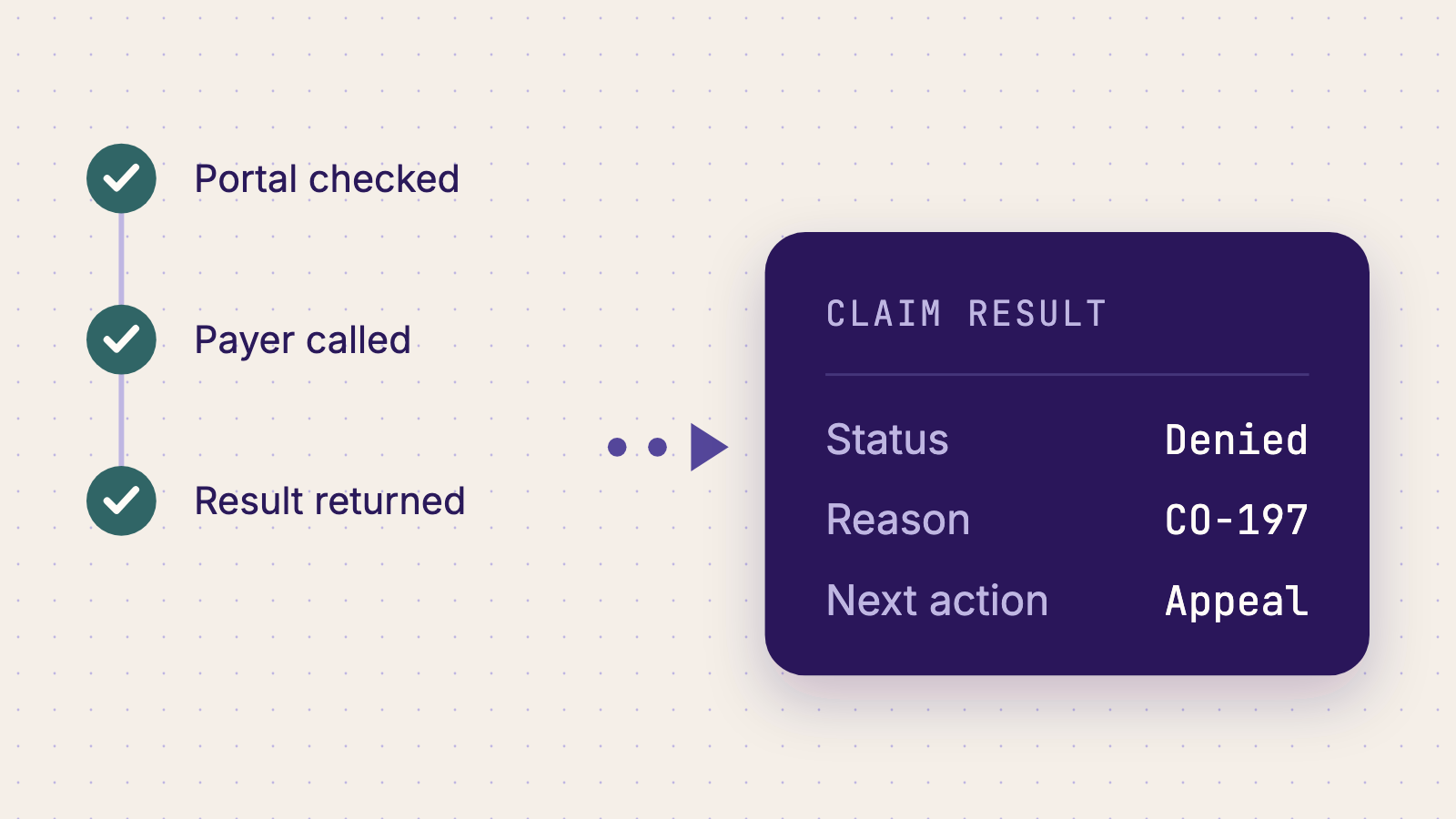
SuperDial's claim status workflow is designed to provide the details needed to move a claim forward. Where the payer provides them, results include status, paid and allowed amounts, payment date, check or EFT number, denial reason, reconsideration or appeal path, and the recommended next action. That changes how the queue can be worked:
- Paid or underpaid? Route the claim to reconciliation or underpayment review with payment details already attached.
- Denied? Give the right team the denial reason and available appeal or reconsideration path so it can decide whether to correct, resubmit or appeal.
- Still pending or missing? Establish whether the payer received the claim and what is needed next rather than sending someone back to the phone without context.
The same principle extends beyond claim status. Benefits verification can capture deductible remaining, carve-outs and authorization requirements when the electronic eligibility response is incomplete. Prior authorization workflows check whether approval is needed and then track submitted requests. Credentialing follow-up captures status, effective dates and missing items by provider and payer.
The buyer benefit is not simply fewer calls. It is fewer calls that your staff need to revisit.
How SuperDial gets the missing details
SuperDial checks supported EDI transactions, APIs and payer portals before calling. Information found digitally pre-fills the request; the phone agent focuses on what is still missing. When a call is necessary, the voice agent works through the IVR, hold time and authentication using identifiers such as NPI, Tax ID or member ID, then asks the representative for the remaining fields. Requests can run in parallel, so one lengthy hold does not stall the rest of the queue.
Outputs can reach teams via API, webhooks, CSV, the dashboard or work queue notes. Where write-back is configured, structured notes and statuses can populate EHR or PMS fields. SuperDial lists integrations with Epic, athenahealth, eClinicalWorks, ModMed, Dentrix and OpenDental; other systems can connect through API, webhooks or CSV.
What results have revenue cycle teams seen?
These customer examples show why it matters to evaluate operational outcomes, not just automation activity.
MBW RCM: With more than 700 medical billers, coders and AR professionals supporting over 40 customers, MBW now makes over 1,000 monthly calls through SuperDial for claim follow-up and insurance verification. It reports cutting costs in half without adding staff, freeing its team to focus on complex denials and AR acceleration.
West Coast Dental: Facing more than 70,000 claims without status updates, the dental group began with test calls and scaled to over 10,000 calls per month. SuperDial reports that the no-status backlog was cleared; its case study also reports significantly lower AR days and costs offset equivalent to five full-time employees.
Neuromonitoring Associates (NMA): NMA reported a 500% increase in claim follow-ups, with structured outputs supporting AR workflows and dispute resolution. Its leadership highlighted SuperDial's digital-first approach and ability to take over claim status and benefits requests.
These are customer-reported results, not a guarantee of identical outcomes for every organization. They do, however, establish concrete measures a buyer can use when designing a pilot.
How Infinitus handles payer calls
Infinitus operates an agentic AI platform. On payer calls, key workflows include specialty medication benefit verification and prior authorization follow-up for medications, procedures and diagnostic tests.
Its benefit verification agents contact commercial and government payors and PBMs. Its platform also supports prior authorization follow-up after submission, claims status calls for clearinghouses and utilization management platforms through Infinitus Studio, and pharma benefit investigations, follow-up and appeals.
For benefit verification, Infinitus can collect plan and network details, drug and administration coverage, coordination of benefits, authorization requirements and specialty pharmacy requirements. Prior authorization outputs include requirements, status and updates. Its agents collect data digitally before calling, including through payer and clearinghouse partnerships.
Teams can submit requests through a bulk portal upload or API and retrieve results in the Infinitus Portal or through API. Infinitus also offers connectors to CRMs, payer portals and EHRs. Calls can escalate to a human operator when needed, while copilots assist staff on complex cases.
How to choose: Run a pilot that reflects your real workload
Choose a queue where manual payer follow-up is costing the most time: no-status claims, authorization follow-ups or specialty benefit checks. With a BAA in place before sharing PHI, send both platforms the same set of real requests.
Ask each vendor to demonstrate four things: the exact payer workflows and payers it supports; the fields and evidence returned; how results enter your EHR, PMS or work queue without re-keying; and who takes ownership when an AI agent cannot complete the request.
Then score complete, actionable outcomes, not call counts. A structured answer that tells staff what to do next is more valuable than a transcript that creates another research task.
Frequently asked questions
Does SuperDial replace the clearinghouse?
No. SuperDial complements 270/271 eligibility and 276/277 claim status transactions. It uses electronic and portal answers where complete and calls the payer when a response does not answer the operational question, for example, why a claim is pending or why the payer cannot find it.
What if SuperDial cannot finish a call?
AI agents work first and escalate to a real person when needed. Remaining issues return to your team with a summary of what was attempted, what was captured, what is missing and the next recommended step.
Does SuperDial support pharma patient access too?
Yes. Although Infinitus emphasizes pharma patient access, SuperDial also supports pharma teams with benefits verification, prior authorization, payer and PBM follow-up and provider-office follow-up, combining digital retrieval and phone outreach as needed.
What about security and PHI?
SuperDial states that it is HIPAA compliant, SOC 2 Type II attested and HITRUST e1 certified; it signs a BAA before PHI is shared and uses TLS in transit, AES-256 at rest, SSO, MFA and role-based access. Infinitus states that it maintains SOC 2 Type II compliance, follows HIPAA Security and Privacy rules, and signs a BAA when processing customer PHI.
Put SuperDial to the test on your own queue
You do not have to judge payer automation from a scripted demo. Bring the claims, prior authorizations or benefit checks your team still chases by phone. SuperDial can help define the fields you need, perform the payer follow-up and show what comes back for each request. Book a demo to scope a pilot around one real workflow.
Run a pilot on a real workflow.
Bring a representative batch, define the output schema, and validate ROI with your payer mix in 30 to 90 days.
