
SuperDial vs. Prosper AI: Which Fits Your Payer Operations?
Your team does not need another tool that simply makes phone calls. It needs payer answers that help move claims forward, resolve denials and keep staff focused on work that requires their expertise.
That is where the distinction between SuperDial and Prosper AI becomes important. SuperDial is designed around high-volume payer operations for revenue cycle and RCM teams. Prosper AI combines payer calls with AI agents for the broader patient journey, including front-office and patient-access workflows. Both can help with benefits, prior authorization and claims; the better fit depends on which work you need to improve and what happens after the call ends.
TL;DR
- Choose your use case first. SuperDial focuses on claim status, AR, denials, benefits, prior authorization and credentialing. Prosper AI combines payer work with scheduling, intake and patient billing agents.
- Look beyond call completion. SuperDial returns structured fields, evidence, a summary and next action in a schema your team defines, so the result fits the next stage of the revenue cycle.
- Know who owns exceptions. SuperDial's AI agents work requests first and escalate to a real person when needed; unresolved cases return to your staff with context. Prosper AI flags ambiguous or failed calls for your staff with a transcript and confidence score.
- Check the destination. Both offer API and webhook paths, but actual EHR or PMS write-back and configuration should be demonstrated in your environment.
- Pilot the hardest real claims. Judge the number of claims ready for the next action, not only the number of calls automated.
Start with the biggest problem you are buying AI to solve
SuperDial is an enterprise platform for payer operations. Its customers include RCM firms, provider groups, health systems, digital health organizations, dental groups and DSOs, payers and pharma teams. It addresses the payer- and provider-facing work that can keep AR specialists tied up in repetitive communication. Across customers, SuperDial reports more than 10 million phone calls made, a 90% reduction in payer call time and up to 4x team throughput without adding headcount.
Prosper AI approaches the market through the broader patient journey. It serves outpatient groups, health systems, and EHRs and partners, with patient-facing agents for scheduling, reminders, no-show recovery and other access work alongside payer-focused agents. Its payer workflows include benefits checks, prior authorization and claim or denial follow-up.
Some health systems and specialty groups have needs on both sides. The purchasing decision becomes clearer when you identify whether the core problem is working payer queues at scale or automating patient access and payer-related tasks together.
Side-by-side: What will your team get?
Why structured payer answers matter for your AR team
Think about the typical no-status claim. A staff member spends time tracking down the payer, learns that the claim is pending or denied, and then has to determine what to do with that response. If the output is incomplete, the next person may need to make another call.
SuperDial is designed to close that gap between getting an answer and taking action. Requests can start through CSV, API or a work queue export in its claim status workflow. The platform checks EDI and payer portals first, carries over any relevant information, and calls when the needed answer is not available digitally. Each result is returned with structured fields, a summary and recommended next action, plus a recording and transcript when a phone call takes place.
For staff, that means different claim outcomes can lead directly to different workflows:
- Paid claims: Paid and allowed amounts, patient responsibility, payment date and check or EFT number equip the team to start reconciliation or underpayment review.
- Denied claims: Denial reason and code, appeal or reconsideration path and next action help the team choose whether to correct, resubmit or appeal.
- Pending or missing claims: Received date and processing status help establish whether the payer has the claim and what must happen next.
These results can feed existing fields where write-back is configured. Teams can sort aged AR work queues by status and next action rather than repeatedly deciphering notes. SuperDial also uses structured outputs for prior authorization status (including authorization number, approved units, validity dates and missing items) and for credentialing status by provider and payer.
The buying question is simple: Does the platform return a finished piece of work, or another task for your staff to interpret?
Results from SuperDial customers
Customer-reported numbers give buyers practical benchmarks for an evaluation, not universal promises of ROI.
CBS Medical Billing uses SuperDial for high-volume insurance verifications, claim follow-ups and prior authorization calls in orthotics and prosthetics. At 1,000 calls per month, it reports saving more than 100 hours monthly. With call volume projected to double, it is scaling those workflows without proportional headcount growth.
Apex IONM adopted SuperDial for AR follow-up and benefits verification, so staff could spend less time on hold and more time on next actions. Its case study reports 1,500 hours of payer call time, approximately 1,000 benefits verification calls in addition to AR calls, and successful payer engagement on about $12 million in billed claims. The company expanded usage after consistent payer responses.
United Medical Monitoring used SuperDial to handle more than 5,900 payer calls and 5,400 hours of payer outreach in just over three months. Standardized outputs made it easier to understand claim outcomes and next steps without manually reconstructing call notes or rerouting work.
How Prosper AI handles payer calls
Prosper AI combines patient-facing and payer-facing agents on one platform. In addition to payer work, it offers tools for scheduling, intake and patient billing.
On the payer side, its published workflows include benefits verification, prior authorization follow-up, claim status calls for claims not adjudicated after 30 days, and denial follow-up to collect information needed for filing. Prosper AI also offers agents for payers that answer claims and prior authorization questions by connecting to payer systems.
Its voice agents navigate phone trees, wait on hold and communicate with payer representatives. Results are entered into the EHR or system of record, and its API provides call logs with transcripts, configuration-based extracted data and QA results. Benefits workflows check clearinghouse information first, then payer portals, and call when necessary. Its API covers campaigns, call logs and webhook notifications.
For exceptions, Prosper AI routes ambiguous or failed calls to the customer's staff with a transcript and confidence score. Its published materials also list HIPAA compliance, a BAA and SOC 2 Type II.
Where SuperDial fits, and how to run a fair pilot
If the work you most need to solve involves aged AR, no-response claims, denials or credentialing across many payers and clients, SuperDial is purpose-built for those operations. Its outputs emphasize the next action, its agents escalate to a real person when needed, and unresolved cases return to the customer with context.
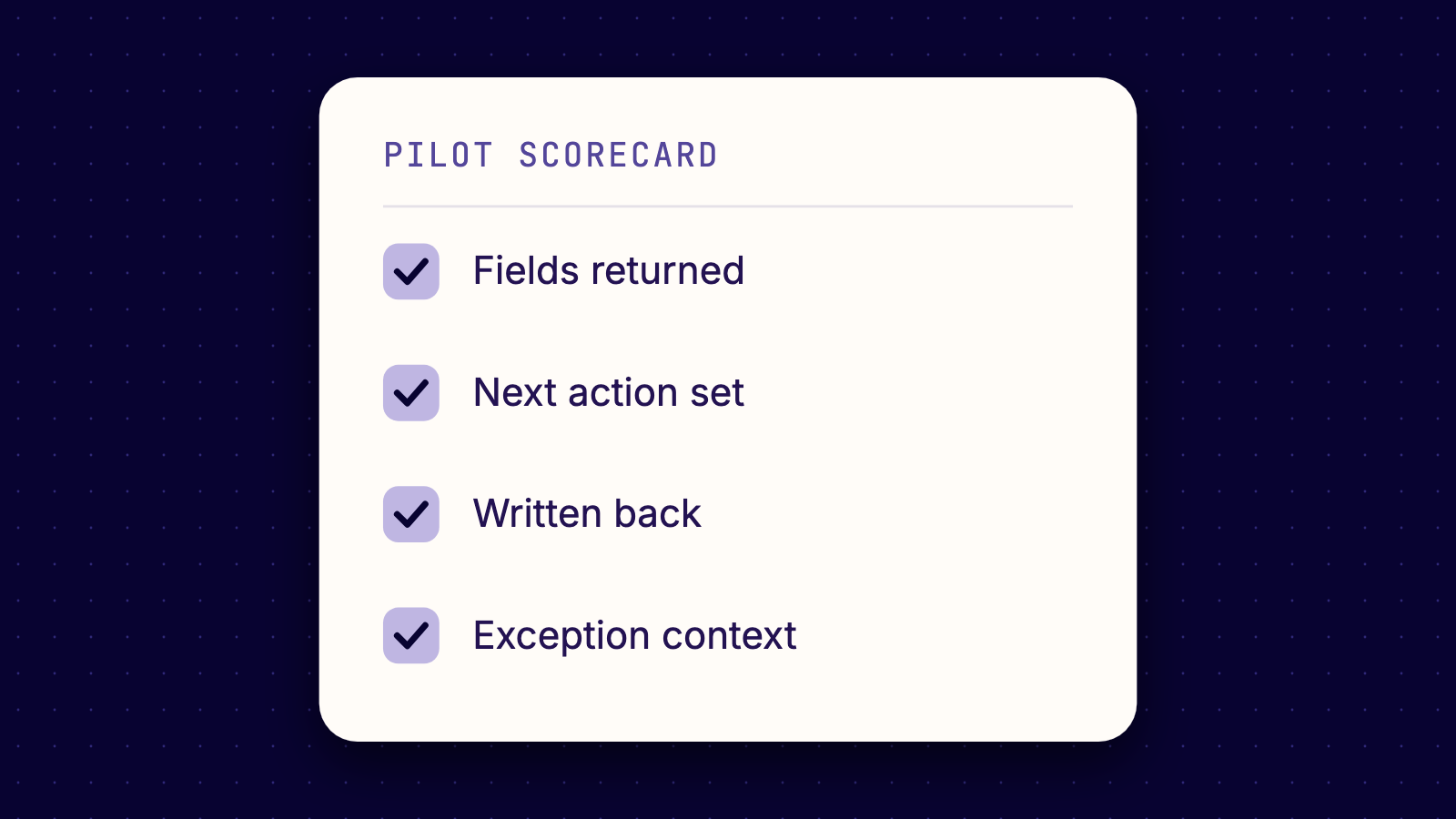
Whichever platforms you evaluate, ask each vendor to run the same real batch and demonstrate five things: which fields and evidence come back; whether every outcome has a usable next action; who handles incomplete calls; how results enter your systems on day one; and whether the vendor provides a BAA and appropriate security documentation before PHI is shared.
Frequently asked questions
Does SuperDial replace eligibility and claim status transactions from our clearinghouse?
No. SuperDial complements 270/271 eligibility and 276/277 claim status checks. It uses the digital response where complete and contacts the payer if a critical operational question, such as the reason for a pending claim, remains unanswered.
Can SuperDial support many clients and payers simultaneously?
Yes. Requests run in parallel, so a lengthy hold with one payer does not block the queue. Credentialing status can be checked across provider-payer combinations, and configuration includes scripts, client-specific rules, retries and escalation policies.
What security controls does SuperDial offer?
SuperDial is HIPAA compliant, SOC 2 Type II attested and HITRUST e1 certified, with a BAA before PHI exchange. It uses TLS encryption in transit, AES-256 at rest, SSO, MFA and role-based access.
How does a SuperDial pilot work?
A typical pilot starts with one real claim follow-up queue delivered through CSV or API. The BAA and security review happen upfront. Teams validate the output schema, ROI and exception handling before expanding to API-triggered workflows, webhooks or write-back.
See what comes back from your own claims
The easiest way to judge payer-call AI is to put it against the work that already eats up your team's day. Bring SuperDial an active claim follow-up queue. Together, define the information your staff needs, run the requests and review the results claim by claim. Book a demo to plan a pilot around a real payer workflow.
Run a pilot on a real workflow.
Bring a representative batch, define the output schema, and validate ROI with your payer mix in 30 to 90 days.
