
7 AI Dental Insurance Verification Tools for DSOs in 2026
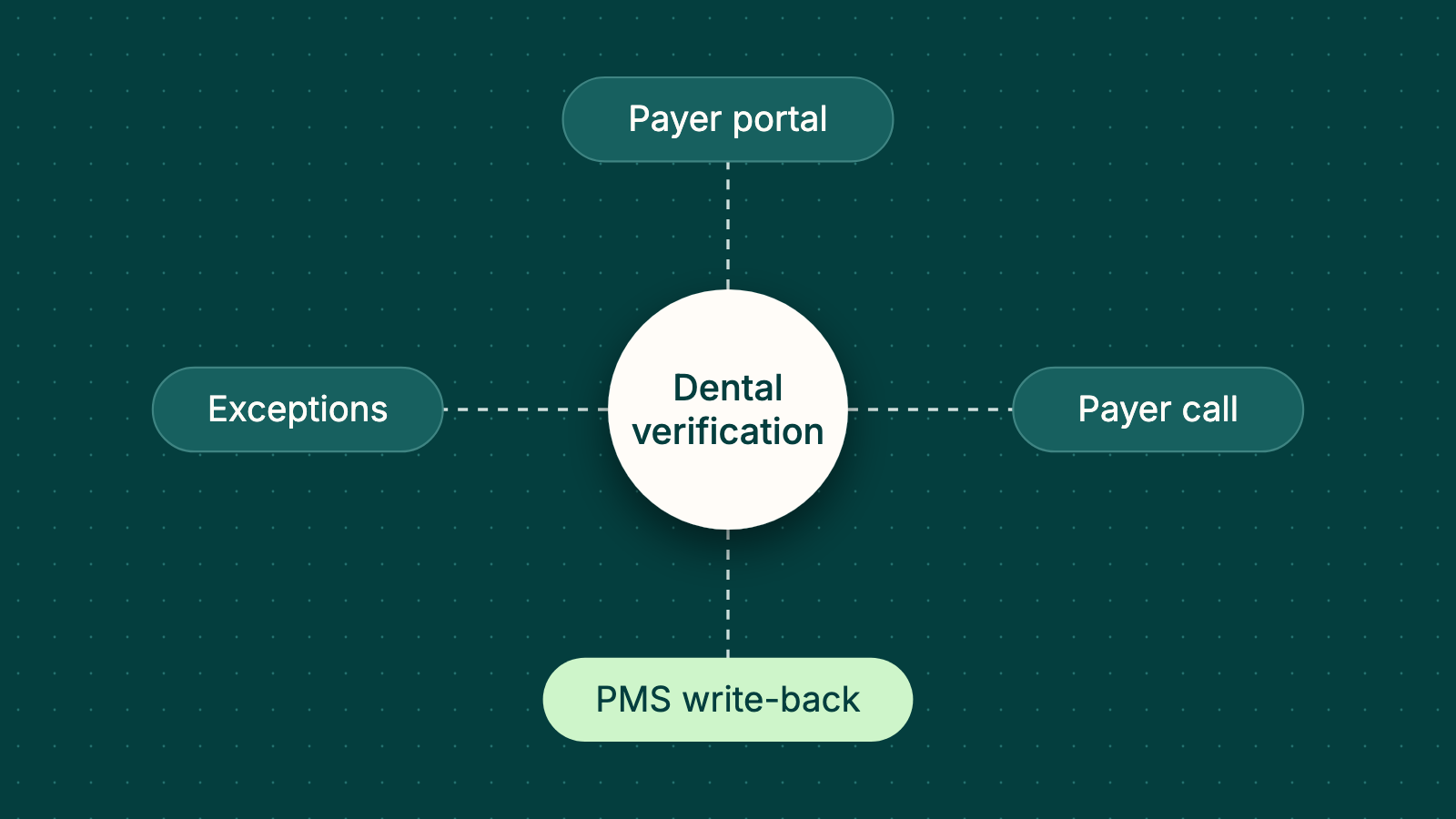
Every office a DSO adds brings its own appointment book, payer mix and insurance coordinators toggling between portals and hold queues. An eligibility response can confirm that a plan is active, but the details that decide a treatment plan, such as frequency limits, waiting periods, downgrades and the remaining maximum, often take another lookup or a phone call.
AI tools promise to take that work off the front desk. The useful measure is not how many patients a tool checks. It is how many breakdowns arrive complete enough for your team to present treatment and collect the right amount, without a coordinator redoing the work. Our guide to dental insurance verification services covers the fields worth verifying and the service models; here, the focus is the vendors.
This roundup covers SuperDial, Azops Dental, dentalrobot, Needletail AI, Pearl, Ventus AI and VoiceCare AI. Each one uses AI to verify dental benefits for groups or DSOs, but they differ in the payer channels they use, the benefit detail they return, how results reach your practice management system and what happens when a payer leaves gaps. They are not ranked; the goal is to help you choose what to pilot.
TL;DR
- Judge the breakdown, not the check. A finished verification answers what the plan pays and what the patient owes for each planned procedure, so staff do not have to look it up again.
- Channels differ more than marketing suggests. Some tools work from clearinghouse and portal data; others add payer calls when the portal leaves out a limitation. SuperDial checks EDI, APIs and portals first and calls only for what is still missing.
- Dental groups use SuperDial at scale. West Coast Dental moved its payer calls to SuperDial, cleared a backlog of 70,000 claims with no status and scaled to over 10,000 calls per month. That was claim status work, not verification, and results are customer-reported, not a guarantee of identical outcomes.
- Delivery decides adoption. A breakdown that reaches coordinators where they already work gets used; one that has to be re-keyed does not.
- Pilot with your own appointment book. Send the same batch of upcoming appointments to each vendor and count the breakdowns your team can use as delivered.
How this list was selected
Each tool included here uses AI to verify dental insurance eligibility and benefits for dental groups, DSOs or the billing teams that serve them, is active today, and has published product details on four buyer-critical questions: which verification workflows it supports, what information it returns, how results reach your systems and how exceptions are handled.
The 7 tools at a glance
| Vendor | Verification workflows | What comes back | Delivery | Exception handling |
|---|---|---|---|---|
| SuperDial | Dental benefits verification through EDI, APIs, portals and payer calls; also pre-determination status, claims and denials, credentialing | Eligibility, remaining annual maximum, deductible, coverage by category, frequency limits, waiting periods, missing tooth clauses, downgrade rules; notes, transcripts, recordings, source channel and timestamp | CSV batch, API, webhooks, SuperDial portal; PMS write-back where the setup allows, including Dentrix Ascend and Open Dental | Automation first, human judgment second; exceptions return with what was tried, captured and missing, plus a next step |
| Azops Dental | Full benefit breakdowns for new patients and new plans, via portals and payer calls | Breakdown built on the practice's own verification form | Write-back into the dental software, including benefit tables, notes and PDFs | Anything still needing attention flagged before results reach staff |
| dentalrobot | Eligibility and full breakdown checks across portals, API/EDI, IVRs and payer calls; instant or scheduled | Eligibility and full breakdown data, mapped to the DSO's verification form, with a printout | PMS write-back and a central dashboard | Error detection and flagging, with configurable oversight |
| Needletail AI | Eligibility and benefits through a portal agent and a voice agent working in parallel | Completed verification forms and notes | Write-back into patient records in the PMS | Portal and call data cross-checked; inconsistencies flagged for human review |
| Pearl | Automated eligibility and code-level benefit checks from clearinghouses and carrier portals | Remaining benefits and frequency limits, shown on the appointment card and schedule view | Inside the PMS workflow | In-schedule alerts that flag coverage gaps, plus action items per patient |
| Ventus AI | Portal-first verification, with payer calls when the portal lacks the answer | Procedure-level benefits by code, frequency limits, waiting periods, downgrades, deductibles, remaining maximum; source shown for each field | PMS write-back of configured fields, notes and evidence | Missing fields returned as unknown; identity or eligibility mismatches sent to the office to correct |
| VoiceCare AI | Eligibility and code-level benefit breakdowns through voice and payer portals | Remaining maximums, deductibles and out-of-network benefits | EHR integrations with audit-ready logs | Human-in-the-loop safety net |
Vendor profiles: 1 through 7
Each profile covers workflows, outputs, delivery and exceptions. The numbers keep the list organized and say nothing about performance.
1. SuperDial: Payer answers for every office in the group
SuperDial's dental and DSO offering is built for groups that verify benefits for thousands of patients a week, chase claims across dozens of payers and credential new dentists every month. For verification, it returns eligibility, remaining annual maximum, deductible, coverage percentages by category, frequency limits, waiting periods, missing tooth clauses and downgrade rules before the patient is in the chair. The same agents also handle pre-determination status, claim status and denials, and credentialing status for new associates and acquired offices.
The benefits verification workflow runs after your clearinghouse 270/271 check and uses the portal or the phone to fill in the fields the eligibility response left out. Results are normalized into your output schema and can include summary notes, call recordings, transcripts and source documents, along with the source channel and timestamp. Groups usually start with a CSV batch from the eligibility work queue, then add the API, webhooks or a PMS connection when the workflow is ready.
SuperDial works with Henry Schein One on Dentrix Ascend, and with an office's authorization it reads the work you choose from Open Dental and returns outcomes there where your setup allows. The full result is always in the SuperDial portal. Its voice agents follow a simple rule: "Automation first. Human judgment second." When a request needs judgment, is missing critical inputs or needs a manual step, SuperDial routes a packet to the right person or team with what was tried, what was captured, what is missing and the recommended next step.
2. Azops Dental: Breakdowns on the practice's own form
Azops Dental serves dental practices across general and specialty care, and also works with multi-specialty practices and DSOs. Its AI agent checks payer portals, then calls the insurance representative for the coverage details the portal did not show, producing a full breakdown for every new patient and every new plan. Results follow the practice's own verification form template and are written back into the dental software, including benefit tables, notes and PDFs. Anything that still needs attention is flagged before it reaches the team.
3. dentalrobot: Configurable verification for DSO operating models
dentalrobot is built for DSOs and dental groups, whether verification is centralized or handled office by office. Its verification automation runs instant, scheduled and customized eligibility and full breakdown checks across payer portals, API/EDI, IVRs and payer calls. Output can be tailored to a DSO's own verification form and write-back rules, and results flow to the PMS or a central dashboard, with a printout uploaded to the patient record. The platform adds error detection and flagging with configurable oversight.
4. Needletail AI: Portal and voice agents side by side
Needletail AI serves group practices and DSOs with eligibility and benefits verification run by two AI agents in parallel: one logs into payer portals and one calls payers and IVRs. Completed verification forms and notes are written back to the PMS. On its platform, a QA agent cross-checks portal and call data and flags inconsistencies, and flagged edge cases go to human review before sign-off.
5. Pearl: Benefit checks inside the daily schedule
Pearl offers Pearl RCM for dental practices and DSOs. Its Precheck component confirms eligibility and code-level benefits from clearinghouses and carrier portals. Remaining benefits and frequency limits appear on the appointment card and in the schedule view inside the existing PMS workflow. A companion feature, Claim Actions, places in-schedule alerts that flag coverage gaps ahead of the visit and lists action items for each patient.
6. Ventus AI: Procedure-level benefits with the source attached
Ventus AI focuses on DSOs and specialty groups. Its agent reads the payer's portal first and calls the payer when the portal lacks the answer. Results cover benefits by procedure code, frequency limits, waiting periods, downgrades, deductibles and remaining annual maximums, and each field shows whether it came from the portal, EDI or a call. Configured fields, notes and attachments are written back to the PMS. A missing field comes back as unknown rather than not covered, and patient identity or eligibility mismatches go to the office to correct.
7. VoiceCare AI: One agent across verification and the wider revenue cycle
VoiceCare AI serves dental groups and DSOs alongside specialist practices, RCM enterprises and health systems. Its agent, Joy, handles benefit verification with eligibility and code-level benefit breakdowns, extracting details such as remaining maximums, deductibles and out-of-network benefits. Joy talks with payers by voice and logs into payer portals where APIs do not exist. Its platform offers EHR integrations with audit-ready logs, backed by a human-in-the-loop safety net.
How to choose a verification tool for a multi-location group
Start with your own data. Pull a week of upcoming appointments from two or three offices and mark which breakdowns your coordinators had to finish by phone or portal. That mix shows where automation will remove the most work.
If your gaps are limitations, not eligibility
Most groups already confirm active coverage electronically. The rework comes from frequency limits, waiting periods, missing tooth clauses and downgrades on major cases. Give extra weight to tools that can reach the payer by phone when a portal or 271 response stops short, and watch how a missing field is labeled when no channel returns it.
If verification is centralized for the whole group
A central team needs one view across offices and a way to route problems back to the right location. As our post on scaling dental insurance operations across 20+ locations explains, centralization concentrates variability, so verification queues and payer follow-up grow in one place. Look at how exceptions are queued, who receives them and whether they arrive with enough context to finish without starting over.
If the same payers drive claim and credentialing calls
If coordinators also chase no-status claims, pre-determinations and panel status for new dentists, the same platform can cover more of the queue. Include a few of those items in the pilot so the comparison reflects your full workload.
How to score the pilot
Send each vendor the same batch of upcoming appointments across several offices and payers. Count breakdowns that arrived with every field your team needs, fields left unknown, exceptions returned with a usable next step, and write-back accuracy in the PMS. Then divide the total cost by the number of breakdowns your coordinators used without touching them.
Frequently asked questions
Does AI verification replace our clearinghouse eligibility check?
No. The electronic 270/271 exchange stays the quickest way to confirm active coverage, and for many visits it is all your team needs. SuperDial runs after that response, when the reply is missing the detail your team needs, and goes to the portal or the phone to get it.
What comes back when a payer can't give a complete answer?
With SuperDial, the request returns to your team as an exception, with a summary of what happened and the recommended next action. The audit trail, including any call recording and transcript, shows what was attempted. Your coordinators can pick up from there instead of starting over.
How does SuperDial connect to Dentrix Ascend or Open Dental?
SuperDial works with Henry Schein One on Dentrix Ascend, and which details land there is set up with you. In Open Dental, with your office's authorization, it works the items that match the filters you set, such as age and payer. In both cases the full result stays in the SuperDial portal, and you can turn the connection off at any time.
What security should a DSO expect before sharing patient data?
SuperDial states that it is HIPAA compliant, SOC 2 Type II attested and HITRUST e1 certified, and a BAA is standard before any PHI is exchanged. Data is encrypted in transit with TLS and at rest with AES-256. Access is controlled with SSO, MFA and role-based permissions.
Interested in evaluating SuperDial?
The clearest test is a pilot on your own work: a batch of upcoming appointments, or no-status claims, from a few offices, sent by CSV or API. Define the benefit fields you need back, then review the output, the exceptions and the write-back before expanding to more locations. You can book a SuperDial demo to scope that pilot.
Run a pilot on a real workflow.
Bring a representative batch, define the output schema, and validate ROI with your payer mix in 30 to 90 days.
