
SuperDial vs. Droidal: Which Fits Your Revenue Cycle Team?
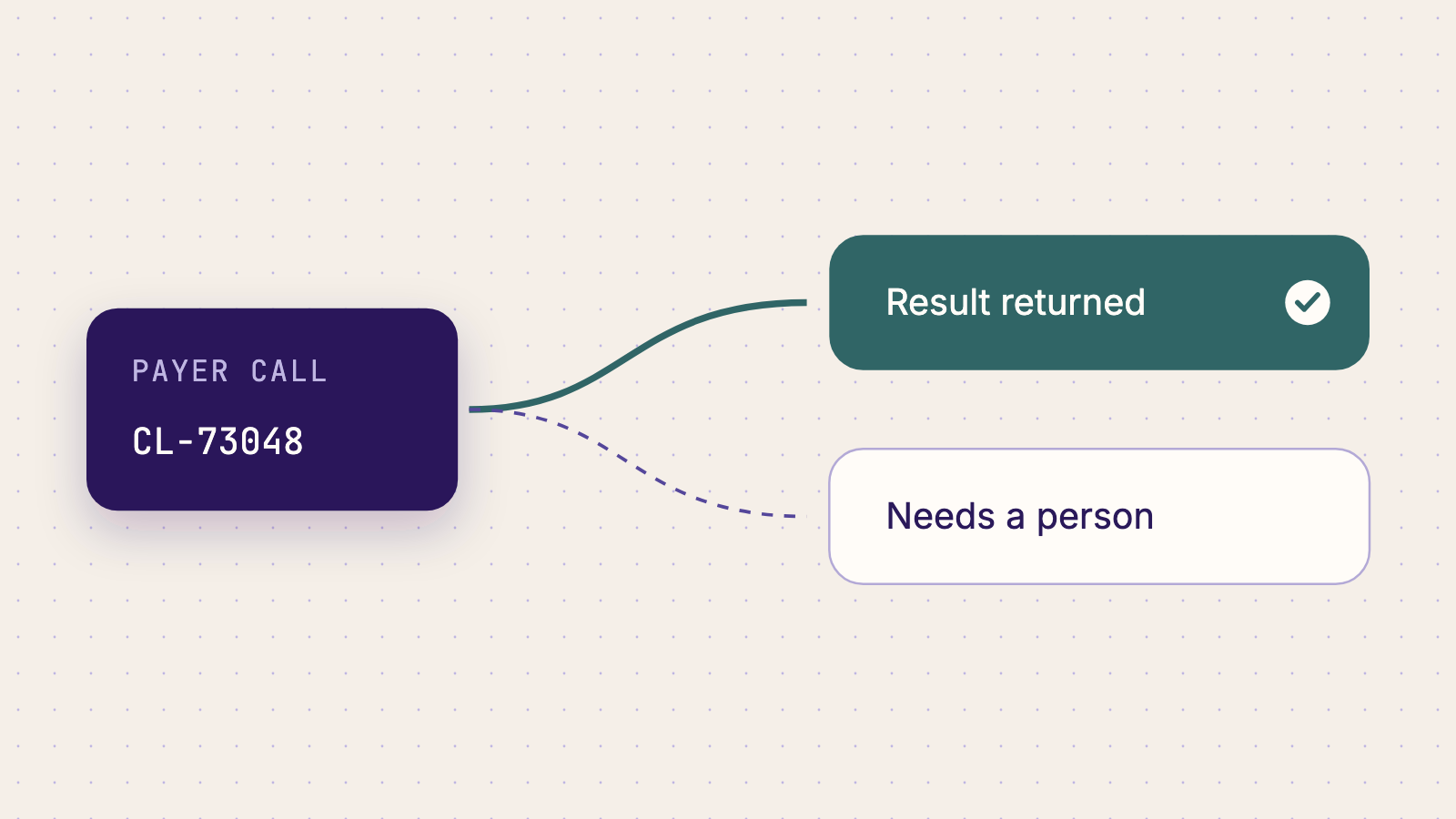
Aged AR rarely stalls because nobody knows a claim is open. It stalls because the detail that would move it, a denial reason or a check number, sits with the payer, and getting it means another call and another hold.
SuperDial and Droidal both use AI agents to take that payer work off your staff. SuperDial is built around payer operations: it retrieves answers across phone, portals, APIs and EDI and returns them in a structured form. Droidal offers AI agents for revenue cycle workflows that run on top of a provider's existing EHR and practice management systems.
So the useful question is not which platform automates more steps. It is which one returns payer answers your team can act on the first time, in the queue it already works.
TL;DR
- Start with the payer conversation. SuperDial covers claim status and AR follow-up, benefits verification, prior authorization and credentialing, checking digital channels before it calls.
- Judge what comes back. Each SuperDial result arrives as structured fields with a summary and next action, so staff can route the claim instead of rereading notes.
- Look at customer results. CBS Medical Billing's case study reports 1,000 calls a month and more than 100 hours saved each month; Apex IONM reports 1,500 hours of payer call time completed.
- Droidal works inside existing workflows. Its agents monitor claims, verify insurance and follow up on authorizations on top of the systems a provider already uses.
- Run both on the same queue. Score the number of claims and verifications ready for the next action, not the number of calls placed.
Where each platform puts its focus
SuperDial serves RCM companies, provider groups, health systems, digital health organizations, dental groups and DSOs, payers and pharma teams. For RCM companies working many clients at once, the goal is faster payer data across claims, benefits, authorizations and credentialing, while staff focus on exceptions, clients and cash.
Droidal offers AI agents for healthcare revenue cycle workflows and markets them to physician groups, dental service organizations, home health agencies and other care settings. Its Epic integration page is written for medical practices and multispecialty groups, and its agents work on top of the systems a team already uses.
The overlap is real: both platforms call payers for verification, authorization follow-up and claim status. The difference is the center of gravity. SuperDial is built to get the payer's answer and hand it back in a consistent, structured format; Droidal frames its agents as an automation layer that monitors and works revenue cycle queues inside existing systems. For a wider view of the category, see our comparison of AI claim status follow-up vendors.
SuperDial and Droidal side by side
| What to evaluate | SuperDial | Droidal |
|---|---|---|
| Who it serves | RCM companies, provider groups, health systems, digital health, dental groups and DSOs, payers, pharma | Physician groups, multispecialty practices, DSOs, home health and other care settings |
| Payer workflows | Claim status and AR follow-up; denial follow-up; benefits verification; prior authorization requirement checks and status tracking; credentialing and enrollment status | Claim status monitoring and follow-up; denial follow-up; insurance verification; prior authorization follow-up |
| What comes back | Fields in your output schema; summary and next action; timestamps and confidence markers; recording and transcript when a call is made | Claim status and next action; eligibility and benefits summaries with call outcomes and transcripts; authorization status and decisions |
| Delivery into systems | API and webhooks, CSV, SuperDial portal and dashboard; EHR or PMS write-back where an integration is in place | Written into the configured workflow, EHR or PM system through API or front-end automation |
| When automation hits a limit | AI agents work first; requests needing judgment go to the right person or team with context | Calls escalate to a person with the transcript and context |
What your AR team can do with a structured payer answer
Picture a claim that has sat for 60 days. A 276/277 inquiry says it is pending, without a reason, so someone opens the portal, then calls, then writes a note the next person has to interpret. The status alone did not move the claim; the details behind it would have.
SuperDial's claim status workflow returns those details as fields rather than prose. Where the payer provides them, a result includes claim and processing status, paid and allowed amounts, payment date, check or EFT number, denial reason, the appeal path and the next action. Your team can then sort the queue by what needs to happen:
- Paid, or paid less than expected: payment details travel with the claim into reconciliation or underpayment review.
- Denied: the denial reason, code and appeal path let the team correct, resubmit or appeal.
- Pending or not on file: the received date and processing status confirm whether the payer has the claim.
The same structure carries into other payer work. Benefits verification picks up where the 270/271 response stops, returning deductible and out-of-pocket remaining, carve-outs, benefit limitations and authorization requirements. Prior authorization results carry the status, authorization number, approved units, valid dates and anything still missing. Credentialing follow-up returns status, dates and missing items by provider and payer, so each result closes a task instead of opening one.
How SuperDial reaches the payer answer
Work arrives as a CSV, through the API or as a work queue export. SuperDial retrieves payer information across electronic sources, payer portals and phone calls. When a call is needed, the voice agent navigates the IVR, waits on hold, authenticates with identifiers such as NPI, Tax ID or member ID, and asks the representative for the details your team needs.
Requests run in parallel, so a two-hour hold with one payer does not delay the rest of the queue. Scripts, escalation rules, retry logic and client-specific policies are all configurable, which matters when one team works many payers for many clients.
Results come back through the API and webhooks, as CSV files, in the SuperDial portal, or as structured notes and statuses mapped into existing EHR or PMS fields where an integration is in place. SuperDial lists integrations including Epic, athenahealth, ModMed, NextGen and Open Dental, and a system that is not listed can start with a CSV batch upload, adding the API, webhooks or an EHR or PMS connection when the system supports it.
Results from SuperDial customers
CBS Medical Billing is an RCM company focused on orthotics and prosthetics. It brought in SuperDial to automate the payer calls behind its verifications, claim follow-ups and prior authorizations. The case study reports 1,000 calls a month and more than 100 hours saved each month, and with volume expected to double in the coming year, CBS is streamlining operations without growing headcount.
Apex IONM provides intraoperative neuromonitoring, a payer-dependent revenue cycle where out-of-network dynamics mean many payers don't offer the same self-serve portals. It started SuperDial on AR follow-up and benefits verification calls, and its case study reports 1,500 hours of payer call time completed and roughly 1,000 benefit verification calls in addition to AR calls. The team expanded usage after seeing consistent payer responses, without hiring additional staff.
These are customer-reported results, not a promise of the same outcome for every organization. They do give you concrete pilot targets: hours of payer time and monthly call volume.
How Droidal handles payer calls
Droidal's Claims Status AI Agent monitors submitted claims across configured payer workflows and interprets the status codes that come back. It flags stalled, rejected or at-risk claims, prioritizes follow-up and routes rejected claims into correction, denial or resubmission workflows. Each update is written into the configured workflow with a next action. Its Epic integration page adds that the agent checks claim progress through payer portals and calls.
For phone work, Droidal's voice AI agents take payer calls for insurance verification, prior authorization follow-up, claim status and denial follow-up. The agents navigate IVRs, wait on hold, speak with representatives and record reference numbers.
Its voice AI for insurance verification captures active coverage, deductibles, copays, coinsurance, out-of-pocket amounts, visit limits and prior authorization requirements, then writes a summary and transcript to the EHR. If details are missing, it calls back. For prior authorization, the agent checks whether a service needs authorization, follows up on pending requests through API or voice AI, logs calls and transcripts to the patient record, and alerts your team when a request is approved.
Droidal connects with EHRs and PM systems such as Epic and athenahealth through API or front-end automation, with Epic workflows confirmed against each customer's access and setup. When the voice AI still cannot get an answer, the case escalates with the call context so a person can pick it up.
How to run a fair pilot between them
Pick the queue where manual payer follow-up costs your team the most: no-status claims, pending authorizations or verifications that stall after the 270/271. With a BAA in place, send both platforms the same batch of real requests, including the payers your staff least want to call.
Score the results claim by claim. Count how many came back with every field you need, how many carried a usable next action, and how many landed in your EHR, PMS or work queue without re-keying. Then check whether each exception returned with enough context to pick up where the agent stopped. Complete, actionable outcomes are the measure that matters, not calls placed.
Frequently asked questions
Does SuperDial work alongside our clearinghouse?
Yes. SuperDial complements 270/271 eligibility and 276/277 claim status transactions rather than replacing them. It adds a payer call when a reply leaves out what your team needs, such as why a claim is pending.
Can SuperDial return results into Epic?
It depends on your Epic environment. SuperDial scopes the connection with your IT and revenue cycle teams and commits only to what your setup supports. Results go back into your system where it allows, and the full result is always available in the SuperDial portal.
What happens when a payer will not give a complete answer?
SuperDial's rule is "Automation first. Human judgment second." When a request needs judgment, a missing input or payer escalation, SuperDial routes it to the right person or team with what was tried, what was captured, what is missing and the next step. A wrong member ID, NPI or claim number comes back flagged as an input error to fix and resubmit.
How does SuperDial protect PHI?
SuperDial states that it is HIPAA compliant, SOC 2 Type II attested and HITRUST e1 certified, and a BAA is standard before any PHI is exchanged. Data is encrypted in transit with TLS and at rest with AES-256, and SSO, MFA and role-based permissions control access. Droidal states that it is HIPAA compliant and SOC 2 Type II certified and signs a BAA with every customer.
Test SuperDial on the claims your team keeps calling about
A scripted demo only goes so far; your aged AR shows more. Bring SuperDial one real follow-up queue, define the fields your staff need back, and review every result before you decide. Book a demo to scope a pilot around that queue.
Run a pilot on a real workflow.
Bring a representative batch, define the output schema, and validate ROI with your payer mix in 30 to 90 days.
