
8 AI Voice Agent Vendors That Call Payers for RCM Teams in 2026
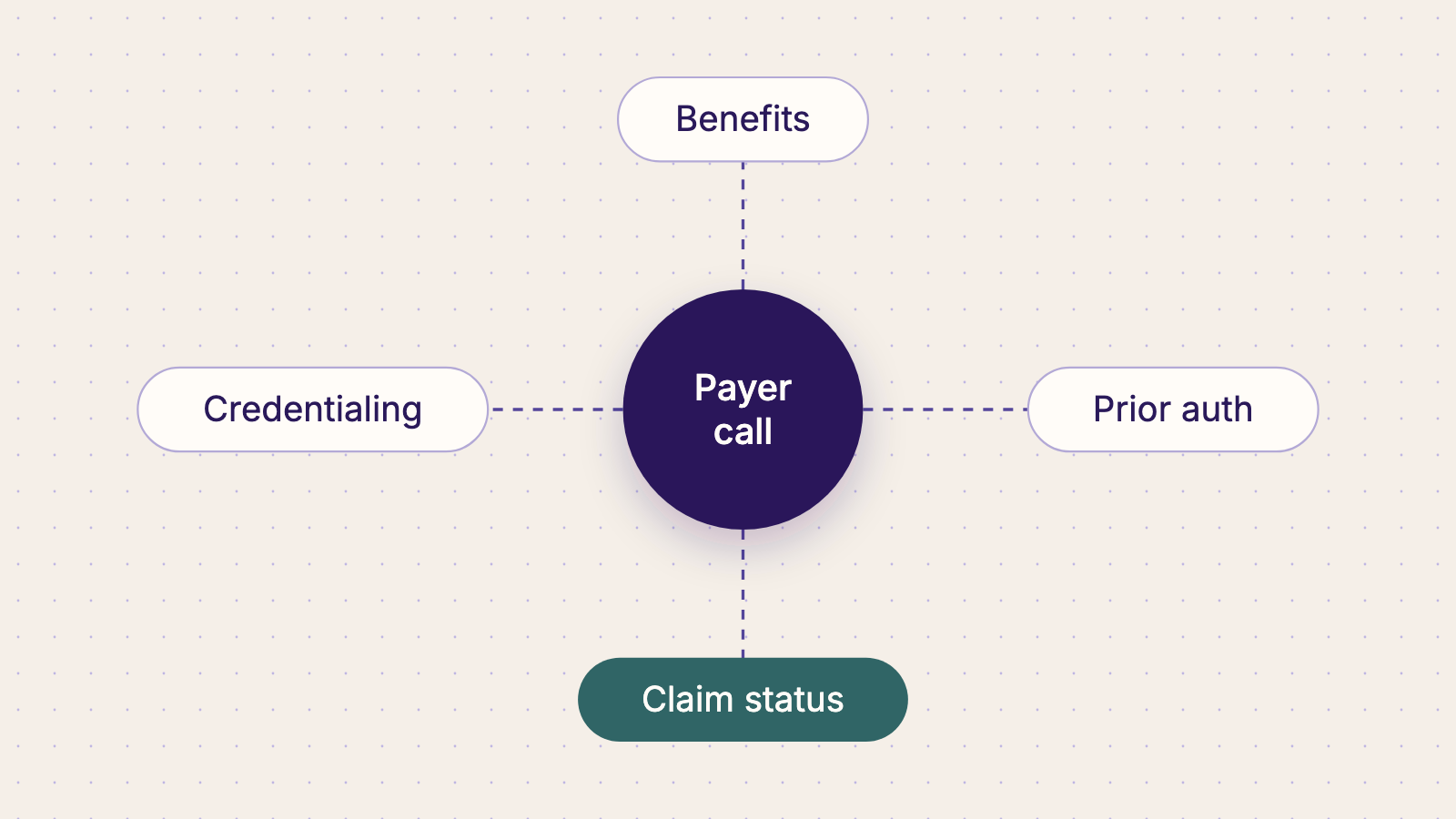
A payer call rarely starts with a question. It starts with a phone tree, a hold queue, authentication and a transfer, and only then can your staff ask what they called to find out. The 2024 CAQH Index found that a single claim status inquiry by phone took medical providers and staff 25 minutes. Add benefits checks and authorization follow-ups, and the phone becomes a bottleneck across your revenue cycle.
AI voice agents now take on that work, and getting through the IVR is the easy part to demonstrate. The harder question is what your team receives when the call ends: a structured answer it can act on, or a recording someone still has to review.
This guide compares SuperDial, Health Harbor, Infinitus, LunaBill, Operator Labs, Prosper AI, Synthpop and VoiceCare AI. Each sells AI agents that call payers, but they differ in workflows covered, what they capture from the representative, where results land and who picks up an unfinished call. They are not ranked; the goal is to help you choose what to pilot.
TL;DR
- Judge the call by its output. Navigating the IVR and holding are table stakes. What matters is whether the result carries the fields, reference numbers and next step your staff needs.
- Match the agent to the workflow. Some vendors focus on claims and AR, others on benefits and authorizations, and some span several payer workflows.
- Customers report concrete results. Orderly Health moved its provider data attestation calls from CSV uploads to an API-first workflow with results returned by webhook, and reports a 25% lower per-call cost than its previous offshore call center. West Coast Dental scaled to over 10,000 calls a month. These are customer-reported results, not a guarantee of identical outcomes.
- Ask where the phone fits. Several vendors check EDI, APIs or portals first and call for what is still missing; others center on the call.
- Pilot with the calls you dread. Send each vendor the same real requests and count results your team can act on without a second call.
How this list was selected
Each vendor here sells AI voice agents that call insurance payers on behalf of providers, RCM firms or other healthcare organizations, is active today and publishes details on four buyer-critical questions: which payer workflows it covers, what comes back, how results reach your systems and what happens when a call cannot be completed. Developer toolkits for building voice agents are not included, because they do not sell a payer-call workflow themselves.
Payer-call agents compared at a glance
| Vendor | Payer workflows called on | What comes back from the call | Delivery into your systems | When the call cannot finish |
|---|---|---|---|---|
| SuperDial | Benefits; prior auth requirements and status; claim status, AR and denials; credentialing and enrollment; provider data | Workflow-specific fields, summary, next action, source evidence, confidence indicators; recording and transcript | API, webhooks, CSV/PDF, portal dashboard, work queue notes, EHR/PM write-back | AI agents first; edge cases escalated to human agents when needed; context returned to your team |
| Health Harbor | Benefits, prior auth requirements and status, claim follow-up | Answers, reference number, transcript, recording | API, webhooks, web portal | Reason returned when a result cannot be retrieved |
| Infinitus | Benefit verification, prior auth follow-up; claim status calls for clearinghouses and UM platforms | Plan and network details, authorization requirements, PA status | API or Infinitus Portal | Agent can escalate to a human operator |
| LunaBill | Claim status and AR, plus eligibility | Status, denial codes, payment details, reference numbers | Scoped EHR write-back | Your team keeps escalations; audit trail |
| Operator Labs | Eligibility and benefits, prior auth status, claims and denials | Claim status, denial codes, auth numbers, next steps | EHR/PM integration, CSV, REST API | Escalation with summary and recommended next action |
| Prosper AI | Benefits, prior auth requirements and status, claims and denials | Results in the EHR or system of record; call logs and transcripts | EHR or system of record, API | Ambiguous or failed calls routed to staff with transcript and confidence score |
| Synthpop | Eligibility, benefits and authorization requirements | Code-level result, call and confirmation IDs, transcript, audit trail | PM, EHR or billing write-back; exports | Exceptions to your team with transcript and reference numbers |
| VoiceCare AI | Benefits, prior auth status, claim status | Code-level benefits, claim status, recordings, transcripts, logs | Bidirectional EHR integrations | Exceptions escalated to humans |
Vendor profiles: 1 through 8
Each profile covers audience, calls made, what is captured and where answers go. The numbering is not a ranking.
1. SuperDial: Payer calls across the full revenue cycle
SuperDial's voice agents make payer calls for RCM companies, provider groups, health systems and other teams that work payer queues at volume. They cover benefits verification, prior authorization requirement checks and status tracking, claim status and denial follow-up, credentialing and enrollment, and provider data. Teams configure question blocks, call flows, escalation rules, retry logic and client-specific policies, and a managed payer phone book supplies the numbers.
Each request checks EDI, APIs and the payer portal before a call. On the phone, the agent navigates IVRs and transfers, waits on hold, authenticates with identifiers such as NPI, Tax ID, date of birth, member ID or claim ID, and asks the representative clarifying questions. The result fits the workflow: remaining deductible and carve-outs for benefits, auth number and valid dates for authorizations, denial reason and check or EFT number for claims, effective dates and missing documents for credentialing. Each carries a summary, next action, source evidence and confidence indicators, plus the recording and transcript.
Requests arrive by CSV, API, work queue export or EHR/PMS trigger and run in parallel, so one long hold does not stall the queue. Results return through API and webhooks, CSV or PDF files, the dashboard, work queue notes or EHR/PM write-back. AI agents handle requests first, and, as Orderly Health's case study puts it, edge cases are escalated to human agents when needed; requests it cannot complete return to your team with the reason and a written call summary.
2. Health Harbor: Live-representative calls with verification details
Health Harbor serves medical, behavioral health and pharmacy teams. Its AI agent works through the IVR, waits on hold and speaks with a live representative for benefits verification, prior authorization requirements and status, and claim follow-up. Every call captures a reference number, and results include the transcript and recording. Results go out by API, webhook or web portal. When a result cannot be retrieved, Health Harbor returns the reason.
3. Infinitus: Benefit verification and PA follow-up for specialty care
Infinitus serves pharma and life sciences, payors and providers, focusing on specialty medication access. Its benefit verification agents call commercial and government payors and PBMs, collecting plan and network details and authorization requirements. Prior authorization follow-up begins after your team submits. Requests arrive by portal upload or API, results return by API or the Infinitus Portal, and the agent can escalate to a human operator. For a direct comparison, see SuperDial vs. Infinitus.
4. LunaBill: Claim follow-up inside the hospital EHR
LunaBill serves hospital revenue cycle teams and RCM and BPO firms. Its agents work the AR queue, checking payer portals first and calling a live representative when a claim is stalled. Outputs include status, denial codes, payment details and reference numbers, with write-back to systems such as Epic scoped during onboarding. Your team keeps escalations and judgment calls, and every agent action carries an audit trail.
5. Operator Labs: Phone-based AR from your existing worklists
Operator Labs serves hospitals, health systems and RCM teams with voice agents that select IVR options, enter member IDs and reach a live representative. They cover eligibility and benefits, prior authorization status and claim status and denials. Each call produces a structured outcome, such as claim status, denial codes and next steps, or an auth number with effective dates. Worklists can come from EHR/PM integration, CSV or REST API. Calls that need human judgment escalate with a summary and recommended next action.
6. Prosper AI: Payer agents that call when portals fall short
Prosper AI serves outpatient groups and health systems with agents for patient-access work and payer calls. Its payer agents call when portals fall short to verify benefits, check prior authorization requirements and status, and follow up on claims not adjudicated after 30 days. Results are entered into the EHR or system of record, with an API option. Ambiguous or failed calls are routed to staff with a transcript and confidence score. For more detail, see SuperDial vs. Prosper AI.
7. Synthpop: Code-level verification, API first
Synthpop offers a payor agent within a broader healthcare administration platform. The agent checks APIs, portals and clearinghouses first, then calls when the electronic answer is incomplete, navigating the IVR, authenticating and capturing a code-level eligibility, benefits or authorization result. Call and confirmation IDs are recorded when provided, with a transcript and audit trail, and results are written back to your PM, EHR or billing system. Exceptions go to your team with the transcript and reference numbers.
8. VoiceCare AI: One agent across voice, portals and fax
VoiceCare AI serves specialist practices, dental groups and DSOs, RCM enterprises and health systems. Its agent, Joy, works benefits verification, prior authorization status tracking and claim status checks across voice, payer portals, APIs and fax. Benefits results include code-level breakdowns, and the platform offers bidirectional EHR integrations, and every action is recorded, transcribed and logged. Exceptions escalate to humans.
How to choose a payer-call agent for your queue
Start with the calls, not the vendors. Sort a week of your team's payer calls by workflow and note where each stalled: IVR, hold, authentication or the representative. That map shows what to test.
If your benefit questions are specific to procedure codes
A 270/271 response often confirms coverage but leaves out code-level benefits, remaining deductible or authorization requirements. Ask each vendor to show the fields it captures for your highest-volume codes, and whether it checks portals before calling.
If authorization status only exists on the phone
Authorization follow-up can take several calls per request. Test whether the agent returns the status, authorization number, approved units, valid dates and what is still missing in separate fields, so your team can act without reading a transcript.
If aged claims make up most of your call volume
Claim status calls depend on what the agent pulls from the representative: denial reasons, payment details and the next step. If AR drives your decision, our roundup of AI claim status follow-up vendors covers that workflow in depth.
If provider enrollment is stuck in follow-up calls
Credentialing and enrollment status calls run by provider and payer, often across a whole roster. Ask whether this is a standard workflow and what comes back for each provider-payer pair: status, effective date, missing items and next action.
How to score the pilot
Give every vendor the same batch across two or three workflows, including your hardest payers. Score complete, actionable results, second calls needed, exception quality and whether results reach your system of record without re-keying. Divide total cost by actionable results, not calls placed.
Frequently asked questions
What happens on a SuperDial payer call?
The agent dials the payer, works through the IVR and waits on hold for as long as the payer keeps it there. When a representative answers, it asks what a trained biller would ask, confirms the answers and ends with structured fields and a written call summary. Our IVR retrieval guide covers how phone trees become a data source.
Does SuperDial call the payer for every request?
No. The phone is the last of four channels, after EDI, APIs and the payer portal. SuperDial complements 270/271 eligibility and 276/277 claim status transactions and calls when the electronic answer leaves out what your team needs, such as a reason for a pending claim or a code-specific benefit.
What comes back when the agent cannot get an answer?
The request returns marked unable to complete, with the reason, such as a payer that releases status only through its portal, and a written call summary. Missing or incorrect inputs, such as a member ID, NPI or claim number, come back flagged as input errors so your team can fix and resubmit.
What security should we confirm before sending PHI?
Ask for a signed BAA, SOC 2 Type II or HITRUST documentation and controls such as SSO, MFA and role-based access. SuperDial is HIPAA compliant, SOC 2 Type II attested and HITRUST e1 certified, signs a BAA before any PHI is shared, and uses TLS in transit and AES-256 at rest.
Interested in evaluating SuperDial?
The clearest test is a pilot on calls your team makes every week. Send SuperDial one real queue by CSV or API, such as benefits checks, authorization follow-ups or aged claims, and define the fields you need back. Review outputs, exceptions and ROI before expanding. Book a SuperDial demo to scope that pilot.
Run a pilot on a real workflow.
Bring a representative batch, define the output schema, and validate ROI with your payer mix in 30 to 90 days.
